
Enterprise data initiatives collapse when technical modeling is divorced from strategic reality. The core reason why data science projects fail is not inadequate algorithms, but organizational dysfunction: operating without cross-functional communication, relying on gut instinct over statistical evidence, and deploying models built by practitioners lacking mathematical rigor. To achieve sustainable returns, organizations must replace isolated silos with an embedded data culture that aligns technical workflows directly with operational objectives.
The Anatomy of Initiative Breakdown: Why Data Science Projects Fail
Data initiatives rarely stumble due to compute limitations. Instead, they collapse across structural fault lines spanning leadership, communication, and statistical theory. Understanding Thinking Like a Data Scientist: The Strategic Decision Maker’s Guide clarifies that analytics is an empirical discipline, not traditional software delivery.
A primary breakdown occurs when companies drift into what is known as the “danger zone” of data science. As popularized by Drew Conway’s Data Science Venn Diagram, this hazard appears when practitioners combine hacking skills and substantive domain expertise while omitting formal mathematical and statistical training. In an interview for Accenture’s Outlook journal, chief scientist Kishore Swaminathan pointed out that data is a double-edged sword: improperly utilized, it produces poor decisions made with exceptionally high confidence. When non-statisticians deploy complex libraries without understanding cross-validation schemes or sample bias, organizations act decisively on flawed outputs.
Structural failure also manifests as communication friction. Software developers and data scientists operate with conflicting cadences. Software development typically progresses incrementally, shipping modular features daily. Data science research, however, behaves non-linearly: weeks of exploratory data analysis, hypothesis testing, and model architecture experiments may yield zero lift before a sudden breakthrough occurs. Forcing rigid daily stand-ups designed for standard engineering onto statistical research leads to friction, disillusionment, and misaligned delivery expectations.
The Three Structural Levels of Enterprise Data Culture
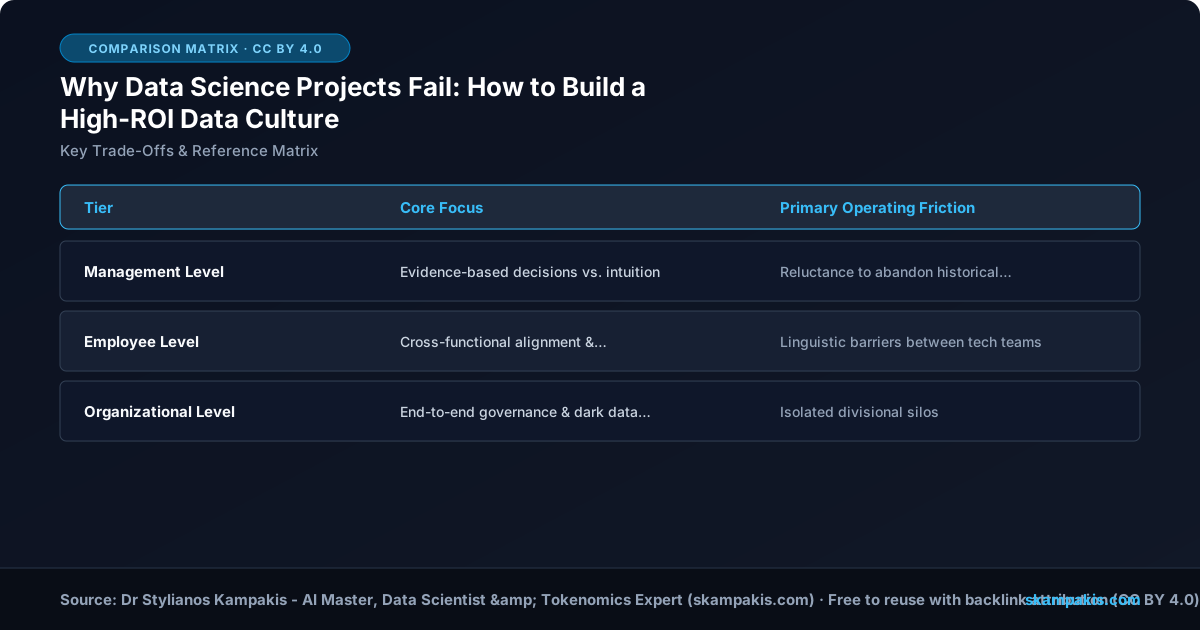
Building resilience requires establishing a comprehensive data culture across three distinct organizational tiers: executive leadership, operational employees, and systemic infrastructure.
| Tier | Core Focus | Primary Operating Friction | Success Metric |
|---|---|---|---|
| Management Level | Evidence-based decisions vs. intuition | Reluctance to abandon historical traditions | Defensible algorithmic adoption |
| Employee Level | Cross-functional alignment & workflow integration | Linguistic barriers between tech teams | High cross-disciplinary velocity |
| Organizational Level | End-to-end governance & dark data activation | Isolated divisional silos | Documented data science ROI |
1. The Management Level: Rationality Over Intuition
At the executive level, culture requires abandoning gut-driven intuition in favor of rational, empirical validation. In the iconic case of Billy Beane and the Oakland Athletics—immortalized in Michael Lewis’s Moneyball—a cash-strapped baseball club outperformed well-funded competitors by embracing sabermetric analysis. Rather than trusting veteran scouts who relied on subjective impressions, Beane prioritized on-base percentage to acquire undervalued talent on a $44 million payroll.
Executive leadership must delineate between being data informed and truly data driven. A data-informed organization references dashboards, monthly KPIs, and tabular spreadsheets to shape conversations. A data-driven organization embeds predictive algorithms into its core operating machinery. When choosing an AI project by defining the decision, evidence, and baseline first, algorithmic outputs actively trigger actions rather than merely populating retrospective slides.
2. The Employee Level: Technical Retention and Data Literacy
Data scientists demand intellectual autonomy, clean pipelines, and the institutional assurance that their research will reach production. Because advanced practitioners frequently lean introspective, forcing them into hostile environments devoid of data literacy sparks rapid attrition.
Surrounding personnel—including front-line software engineers, product managers, and unit directors—must appreciate the nature of statistical modeling. Without basic baseline data literacy, non-technical stakeholders misunderstand model probabilistic tolerances, treating heuristic classifications as deterministic bugs.
3. The Organizational Level: 360-Degree Governance
At the enterprise tier, leadership must maintain complete visibility across data pipelines, regulatory compliance, and cross-functional integration. The systemic implementation of regulatory frameworks like the General Data Protection Regulation (GDPR) demands strict audit trails regarding how consumer information is gathered, sanitized, and fed into algorithmic models.
True organizational alignment breaks down data silos, pairing data scientists directly with engineers and commercial owners to guarantee business relevance from inception to continuous deployment.
Phased Implementation Blueprint: Transitioning from Intuition to High-ROI Science
Transitioning away from the operational traps that cause initiatives to collapse requires a disciplined, step-by-step roadmap designed to maximize institutional value.
Phase 1: Audit Data Infrastructures and Surface Dark Data
Organizations sit on massive quantities of dark data: unstructured, neglected assets including interaction logs, customer support transcripts, server diagnostics, and abandoned telemetry streams. Analysis by IBM Institute for Business Value reveals that an overwhelming portion of enterprise-generated data remains completely dark, never translated into operational intelligence.
- Map ingestion pipelines: Catalog every endpoint capturing customer, machine, or operational telemetry.
- Identify unmined telemetry: Isolate high-frequency logging tables, unstructured feedback notes, and API metadata currently gathering dust.
- Establish data hygiene: Standardize validation schemas and documentation protocols to eliminate data collection problems that ruin machine learning before modeling begins.
Phase 2: Diagnose and Dismantle Resistance to Change
When algorithmic tools threaten established status quos, leadership must identify which form of friction is obstructing progress:
- Cultural resistance: Rooted in long-standing tradition. Common in legacy industries where veteran managers perceive algorithmic diagnostics as existential threats to their hard-earned professional intuition.
- Personal resistance: Grounded in bandwidth strain. Overworked employees push back on data capture protocols because they perceive extra documentation as a burden yielding zero personal reward.
- Intellectual resistance: Driven by anxiety over automated black boxes. Addressed by introducing visible champions who demystify mathematical logic for commercial teams.
Phase 3: Select an Adoption Model (Baby Steps vs. Use-Case Approach)
Companies typically choose between two fundamental strategic deployment vectors:
- The Baby Steps Model: An exploratory, bottom-up path where teams clean historical records, build descriptive dashboards, and gradually cultivate comfort with predictive modeling. While less disruptive, it risks meandering aimlessly without defined commercial deliverables.
- The Use-Case Model: A targeted, top-down strategy centered around solving a high-value operational problem—such as customer churn forecasting or recommendation engines—with specialized modeling. This framework proves quantifiable data science ROI rapidly, building immediate organizational buy-in.
Phase 4: Establish Embedded Product Pods
Isolating technical talent within isolated research labs almost guarantees project failure. Instead, adopt an embedded delivery structure:
- Build cross-functional pods: Colocate data scientists alongside software engineers, UX designers, and commercial product managers.
- Calibrate agile cadences: Shift away from high-pressure daily release requirements to weekly or bi-weekly syncs matching the rhythm of statistical discovery.
- Incorporate specialized translators: Deploy machine learning engineers who bridge the gap between mathematical model code (e.g., Python, R) and enterprise-scale production runtimes (e.g., Java, C++, Go).
Enterprise Case Study: Booking.com’s Embedded Operational Model
A premier example of sustained cultural execution is Booking.com. Processing millions of bookings daily, the travel platform runs an infrastructure driven by over a hundred data scientists directly woven into cross-functional business units.
Rather than confining researchers to academic think-tanks, Booking.com pairs data scientists directly with frontend engineers, product strategists, and commercial leads. Teams leverage the “Booking Agile Essentials Recipe”—integrating targeted retrospectives, clear OKRs, and rapid validation loops that encourage early failure while validating hypotheses through relentless online experimentation. Through workshops and peer-led instructional demos, data scientists continuously upskill while ensuring every model targets concrete business metrics.
Retention, Recognition, and Open-Source Engagement
Top-tier statistical talent is not retained solely through competitive compensation. Data scientists require mental stimulation, high-visibility impact, and intellectual autonomy. When their work remains trapped in internal corporate decks, attrition surges.
Industry frontrunners counteract this dynamic by encouraging public technical contributions. Organizations like Google, Meta, and Netflix maintain public-facing engineering blogs and contribute proprietary tools back to the global developer community. Meta’s open-source release of its Prophet forecasting library showcases internal teams while elevating technical eminence. Allowing teams to publish validated models, author whitepapers, and maintain public code repositories directly drives long-term talent retention.
Closing the Implementation Gap: Securing Sustainable Returns
Ultimately, analyzing why data science projects fail demonstrates that operational breakdowns trace back to strategy and culture rather than technical limitations. Algorithmic investments collapse when teams work in isolation, operate without rigorous statistical foundations, or face legacy leadership wedded to gut instincts.
By championing cross-functional transparency, methodically surfacing dark data, and embedding skilled talent directly inside revenue-generating business units, leadership shifts data operations from a speculative expense into a dependable enterprise engine. When empirical analysis replaces unverified intuition across all organizational layers, data science finally fulfills its commercial promise.
Frequently Asked Questions
What is the primary reason why data science projects fail?
Data science initiatives fail primarily due to organizational barriers rather than algorithmic flaws. Common drivers include isolated silos where data scientists have little contact with commercial operators, deployment of models built without sufficient mathematical rigor, poor communication between data scientists and software engineers, and stubborn executive reliance on intuition over empirical evidence.
How does being data informed differ from being data driven?
Being data informed means using retrospective metrics, dashboards, and reporting KPIs to manually support human discussions and managerial decisions. Being data driven means directly embedding predictive models into production systems, allowing algorithmic outputs to automate actions, improve efficiency, and make mission-critical operational decisions at scale.
What is dark data, and why is it important for enterprise ROI?
Dark data refers to operational information assets that organizations automatically collect, process, and store during regular business activities but fail to use for analytics. Examples include server logs, customer service call audio, and IoT sensor outputs. Mining this unstructured information exposes hidden predictive signals that significantly increase enterprise data science returns.
How can organizations bridge the communication gap between software developers and data scientists?
Bridge this linguistic divide by embedding data scientists directly into product delivery pods with engineers, pairing researchers with software developers, and adjusting delivery expectations to reflect the non-linear rhythm of statistical discovery rather than forcing daily incremental feature releases.
To align your technical talent strategy with high-ROI execution, read our executive guide on hiring data scientists beyond the LeetCode screen.
Enterprise AI Strategy & Implementation Discovery Call
Scope practical AI workflows, human-in-the-loop governance, and measurable delivery milestones with Tesseract Consulting.