
Tidy data architecture is an enterprise operational framework that enforces centralized ingestion, strict tabular standards, and synchronized cross-functional domain rules to guarantee data cleanliness before consumption. By structuring datasets so that each variable forms a column, each observation forms a row, and every transactional entity maps to an unambiguous schema, organizations achieve operational data readiness and eliminate the silent algorithmic failures caused by dirty data silos.
The Silent Failure Crisis: Why Machine Learning Deceives Executives
Dirty data carries severe operational risks that software engineering metrics routinely fail to detect. In standard application development, syntax mistakes, broken dependencies, and invalid pointers immediately throw runtime errors or refuse to compile. In predictive analytics and machine learning, an errant pipeline compiles without friction, ingests corrupted inputs, and generates outputs that look mathematically plausible yet actively mislead the enterprise.
When an organization trains a demand forecasting engine, a dynamic pricing system, or a recommender engine on dirty inputs, the loss of fidelity remains hidden until commercial margins collapse. The system produces operational guidance that diverges from ground truth while stakeholders assume algorithmic precision. As outlined in our strategic guide on Thinking Like a Data Scientist: The Strategic Decision Maker’s Guide, executive leadership must distinguish between surface-level computational execution and underlying statistical validity.
Beyond silent modeling failures, corrupted entries destroy raw analytical volume. An organization may store 5 terabytes of historical logs, yet when deduplication, field validation, and conflict resolution finish, barely 1 terabyte represents usable records. This shrinkage distorts sample distribution, starves deep learning models of representative cases, and costs months of remediation across technical teams.
Case Study: Domain Blindness and the Monday Injury Anomaly
The practical dangers of ungoverned collection appear clearly in athletic performance monitoring within elite European football clubs. In one notable deployment, an analytics team identified what appeared to be an extraordinary physiological pattern: professional athletes returning from the off-season consistently suffered acute training injuries on Mondays after two weeks of pre-season exertion.
The statistical models validated the phenomenon with high confidence. Analysts hypothesized that physical shock—caused by sudden transitions from weekend rest to intense weekday training—induced muscular failure. The club considered overhauling training loads, adjusting rest cycles, and redesigning conditioning programs.
The statistical correlation collapsed upon examining domain collection practices rather than physiological mechanics. The club’s internal operating procedures dictated that if an athlete reported an injury late Thursday or Friday, team protocol required remaining at the club’s medical facility throughout the weekend for supervised rehabilitation. Athletes naturally preferred spending weekend downtime at home or with family.
Consequently, players injured on Friday delayed reporting until Monday morning check-in. The data pipeline lacked an objective clinical diagnostic timestamp, logging injuries purely based on administrative self-reporting dates. The algorithms processed Friday injuries as Monday events, creating a phantom injury wave that consumed months of analytical resources. This breakdown stems directly from three pervasive corporate failure points:
- Fragmented departmental custody: Medical staff, tactical coaches, and physical trainers managed segregated systems without unified schema governance.
- Absent domain documentation: The engineering team modeled timestamps without verifying the human behavior governing data capture.
- Misaligned operational incentives: Medical clinicians prioritized conservative recovery horizons, while coaching staff prioritized rapid return-to-play metrics, skewing field entries.
Foundations of Tidy Data Architecture and Structural Integrity
Preventing structural reporting failures requires shifting from ad-hoc data cleaning to a formalized tidy data architecture. This architectural model draws from foundational principles formalized by Hadley Wickham in the Journal of Statistical Software, where every observation corresponds to a distinct row, each attribute forms a singular column, and each observational unit constitutes an isolated table.
Establishing this standard demands eradicating distributed spreadsheet dependencies. When business units record operational variables in uncontrolled local spreadsheets, free-text inputs multiply instantly. In a sports club, two different physicians routinely document the exact same hamstring strain using conflicting nomenclature, such as “Biceps Femoris Tear Grade 1” versus “Posterior Thigh Pull”. A human specialist might reconcile these values intuitively, but an automated ingestion engine treats them as orthogonal categories, breaking downstream feature engineering pipelines.
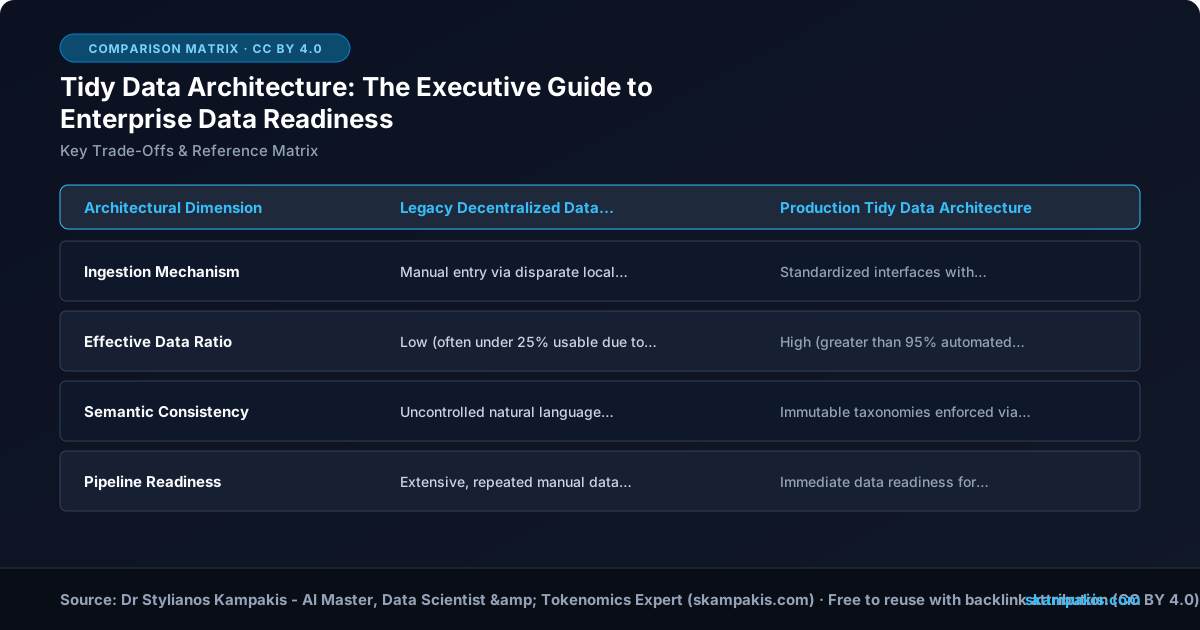
| Architectural Dimension | Legacy Decentralized Data (Spreadsheets) | Production Tidy Data Architecture |
|---|---|---|
| Ingestion Mechanism | Manual entry via disparate local spreadsheets | Standardized interfaces with restricted selection schemas |
| Effective Data Ratio | Low (often under 25% usable due to missing/conflicting records) | High (greater than 95% automated validation rate) |
| Semantic Consistency | Uncontrolled natural language variations and typos | Immutable taxonomies enforced via relational reference tables |
| Pipeline Readiness | Extensive, repeated manual data cleaning before modeling | Immediate data readiness for analytics and machine learning |
| Auditability & Lineage | Opaque versioning across disconnected desktop files | Centralized data lakehouse with versioned metadata tracking |
Implementing Tidy Data Architecture: A Step-by-Step Strategic Playbook
Transitioning enterprise systems away from fragmented storage models requires disciplined structural execution. The following four phases establish a robust pipeline that prepares raw operational exhaust for production analytics.
Phase 1: Centralize Ingestion and Deprecate Manual Spreadsheets
Organizations must first decommission local spreadsheets as storage or entry layers for core operational data. Replace desktop-bound recordkeeping with unified web applications, mobile collection portals, or direct database interfaces. When users input metrics, the front-end interface must strictly restrict input liberty via validated drop-down taxonomies, typed fields, and mandatory constraints.
Phase 2: Enforce Canonical Tabular Data Structures
Raw inputs must land in storage layers configured strictly as a normalized tabular data structure. Ensure your extract, transform, load (ETL) pipelines convert wide tables packed with implicit time series headers into tall, tidy formats where time represents an explicit attribute:
- Atomic rows: Every row must represent a single, indivisible event, transaction, or measurement session.
- Explicit columns: Split overloaded variables into distinct metrics (e.g., separating diagnostic category from diagnostic severity).
- Relational isolation: Store multi-departmental inputs—such as physical training metrics, clinical evaluations, and nutrition records—in isolated entity tables linked exclusively by unique primary keys.
Phase 3: Institute Cross-Functional Synchronization Rituals
Software architecture cannot compensate for operational disconnects between isolated business units. Establish weekly operational data audits where domain experts review edge-case inputs alongside data stewards. If a recovered athlete joins active tactical drills while medical records show active rehabilitation status, cross-functional review reconciles the discrepancy immediately rather than allowing corrupted metrics to drift into enterprise warehouses.
Phase 4: Establish Automated Data Readiness Gates
Before any dataset passes to the analytics or modeling layers, an automated validation suite must verify adherence to pre-defined rules. Employ open data validation frameworks such as Great Expectations to run deterministic assertions on data types, distribution boundaries, null percentages, and primary key uniqueness. Pipeline steps must intentionally fail if datasets violate validation tolerances.
Common Pitfalls and Operational Remediation
Even well-intentioned data engineering projects face recurring institutional barriers during deployment:
- Resistance to input restrictions: Domain specialists often push back against constrained drop-down menus, arguing that rigid interfaces restrict nuanced domain observations. Remediation: Provide structured classification fields alongside an optional, unstructured notes field that is explicitly decoupled from the primary predictive feature store.
- Premature model training: Data scientists frequently rush to tune hyper-parameters before auditing historical data capture workflows. Remediation: Mandate field shadow days where data scientists observe actual operational collection practices in person before generating a single baseline model.
- Neglecting schema evolution: As business needs shift, operational teams introduce new categories that break static schemas. Remediation: Adopt backwards-compatible data serialization standards (such as Apache Avro or Protobuf) with automated alerting for unmapped taxonomy additions.
Executive Verdict: The Long-Term ROI of Architectural Cleanliness
Achieving scalable predictive infrastructure is fundamentally an organizational and architectural challenge rather than an algorithmic one. Clean models emerge entirely from disciplined collection, rigorous tabular standards, and cross-departmental accountability. By shifting enterprise incentives away from localized, ad-hoc spreadsheets toward an integrated tidy data architecture, executives protect their downstream machine learning investments, eliminate costly manual remediation, and establish genuine operational data readiness.
Frequently Asked Questions
What is the core difference between routine data cleaning and a tidy data architecture?
Data cleaning is typically a reactive, manual effort where data scientists scrub missing values, remove duplicates, and reformat conflicting entries after data has already been corrupted. In contrast, tidy data architecture is a proactive design system that enforces relational data models, constrained input interfaces, and automated validation gates at the moment of ingestion, preventing dirty data from entering the storage ecosystem entirely.
How does an untidy tabular data structure impact downstream feature engineering?
When data lacks a standardized tabular structure, automated feature engineering pipelines cannot reliably construct rolling averages, aggregations, or categorical encodings. Non-standardized strings force engineers to write brittle, heuristic-heavy preprocessing scripts that frequently crash or generate high-cardinality noise, masking predictive signals and degrading model generalizability.
Can an organization maintain enterprise data readiness while relying on spreadsheets for operations?
No. Unrestricted spreadsheet environments lack schema validation, programmatic access controls, transaction atomicity, and automated audit trails. As cross-departmental volume expands, distributed spreadsheets inevitably result in conflicting versions, localized nomenclature differences, and corrupted inputs that derail production analytics.
Who within an enterprise should hold ultimate ownership of tidy data architecture?
Tidy data architecture requires shared governance between the Chief Data Officer (or Lead Data Architect) and operational business line leaders. Technical teams define schema structures, validation pipelines, and storage backends, while operational domain leaders ensure capture protocols align with human behaviors, departmental incentives, and operational realities.
Before scaling technical delivery, leaders should align on choosing an AI project by defining the decision, evidence, and success criteria before the model and focus on enterprise AI strategy, governance, and architecture.
In-House Corporate AI Strategy & Governance Clinics
Bespoke executive clinics led by Dr. Stylianos Kampakis for leadership teams, boards, and division directors.