
AI ethics governance is the structured system of organizational policies, algorithmic auditing procedures, and accountability mechanisms designed to ensure artificial intelligence systems operate fairly, transparently, and lawfully. Effective governance transitions organizations from theoretical principles to enforceable operational guardrails, mitigating compliance failures, societal harms, and systemic algorithmic errors across the machine learning lifecycle.
Artificial intelligence has shifted from experimental research into mission-critical infrastructure across finance, healthcare, and human resources. However, without clear oversight, automated decisions can codify discrimination, introduce severe legal liabilities, and erode stakeholder trust. Business leaders must move beyond asking what algorithms can compute to establishing strict organizational limits on what automated systems should be permitted to execute.
Navigating these demands requires business leaders to cultivate analytical instincts. Adopting the mindset detailed in Thinking Like a Data Scientist: The Strategic Decision Maker’s Guide allows executives to evaluate technical systems without relying solely on developer assertions.
The Core Pillars of AI Ethics Governance
Systemic failures in automated systems rarely stem from malicious intent; they result from unmonitored optimization. A robust governance architecture rests upon four foundational dimensions:
- Algorithmic Bias: Prejudices embedded within data or model structures that produce systematically unfair outcomes across distinct demographic groups. Bias stems from historical skews, unrepresentative sample collections, and developer blind spots.
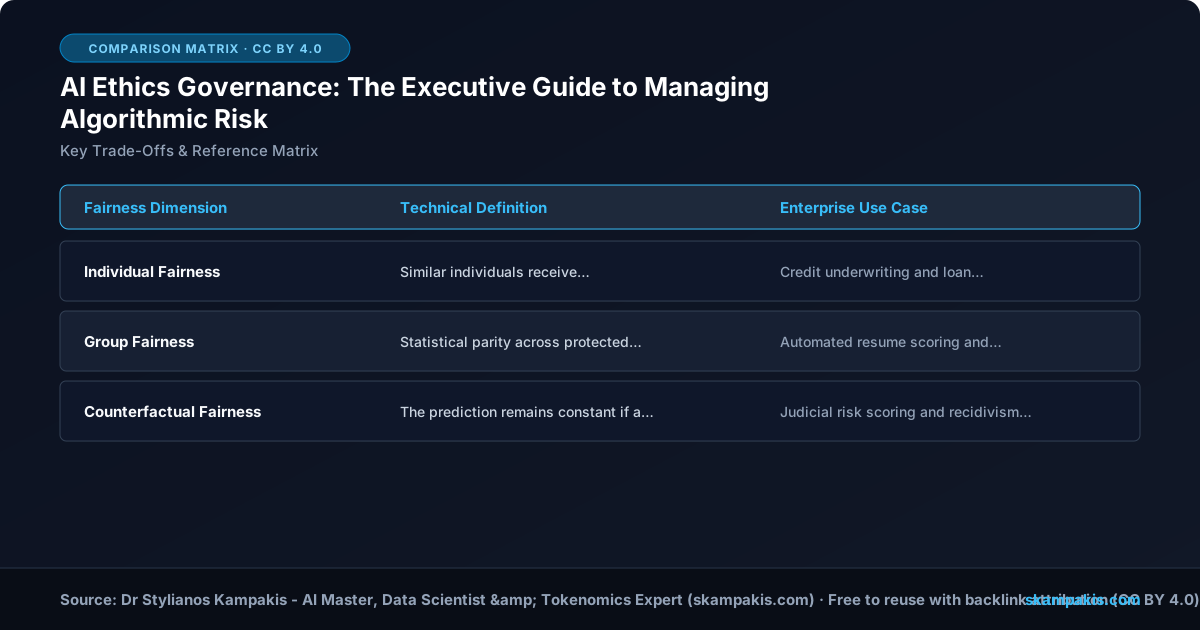
- Fairness in AI: The mathematical and qualitative guarantee of equitable outcomes. This encompasses individual fairness (treating similar candidates similarly), group fairness (parity across demographic segments), and counterfactual fairness (outcomes remaining unchanged had protected characteristics differed).
- System Transparency: The capacity of technical architectures to reveal their internal reasoning. Opacity in deep learning models creates operational risks that can only be resolved through explainable architectures or post-hoc model explanations.
- Accountability: The assignment of human liability for automated decisions. When an autonomous system makes an erroneous or unlawful determination, legal responsibility lies strictly with human leaders and operating entities.
Deconstructing Algorithmic Bias in Enterprise Systems
Algorithmic bias represents the primary hazard in enterprise machine learning pipelines. Left unchecked, models replicate historical prejudices under the guise of mathematical objectivity.
Mechanisms of Bias Generation
Bias enters production workflows through three distinct insertion points:
- Skewed Training Data: Machine learning models generalize patterns from historical data inputs. When historical hiring datasets contain predominantly male candidates, such as the screening engine documented by The Guardian’s investigation into Amazon’s hiring tool, algorithms learn to penalize applications containing the word ‘women’s’.
- Algorithmic and Proxy Prejudice: Removing protected attributes like race or gender does not guarantee neutral decision-making. Proxies such as postal codes, credit utilization velocity, or educational institutions allow algorithms to reconstruct protected classes indirectly.
- Developer Subjectivity: Engineering teams make subjective choices regarding objective functions, loss weights, and feature selection. Homogeneous technical cohorts frequently overlook demographic vulnerabilities until systems fail publicly.
| Fairness Dimension | Technical Definition | Enterprise Use Case | Primary Governance Risk |
|---|---|---|---|
| Individual Fairness | Similar individuals receive identical algorithmic classifications. | Credit underwriting and loan approval pipelines. | Overfitting to edge cases, penalizing unique but qualified candidates. |
| Group Fairness | Statistical parity across protected demographic classes. | Automated resume scoring and recruitment engines. | Risk of reverse discrimination or forced quota distortion. |
| Counterfactual Fairness | The prediction remains constant if a protected attribute is hypothetically flipped. | Judicial risk scoring and recidivism prediction tools. | Complex causal dependencies that are difficult to isolate empirically. |
Transparency: Solving the Black-Box Dilemma
As enterprise architectures integrate advanced neural networks, interpretability frequently degrades. In high-stakes environments—such as clinical triage or criminal justice sentencing—the inability to explain how an algorithm reached a conclusion creates unacceptable organizational exposure.
To eliminate black-box risks, non-technical leaders must establish technical policies that mandate specific interpretability standards before production approval:
1. Inherently Interpretable Architectures
Whenever practical, engineering teams should deploy inherently transparent models such as generalized additive models, constrained decision trees, or linear scoring systems. These mathematical structures clearly demonstrate how input features dictate the final prediction, removing operational guesswork.
2. Post-Hoc Model-Agnostic Explanations
When high-dimensional data demands complex deep neural networks—such as enterprise deployments of why data science projects fail and how to build a high-ROI data culture or sensor processing systems like preventing data collection problems in telemetry pipelines—teams must implement post-hoc attribution methods:
- SHAP (SHapley Additive exPlanations): Grounded in cooperative game theory as established by Lundberg and Lee on unified model interpretability, SHAP calculates the marginal contribution of each variable to explain individual model inferences.
- LIME (Local Interpretable Model-agnostic Explanations): LIME perturbs input data locally around a prediction to train an interpretable surrogate model, illustrating what variables caused that specific decision.
- Counterfactual Generation: Algorithmic tests that determine the minimum input alteration required to flip an adverse decision (e.g., “If income increased by $4,000, the loan would be approved”).
Global AI Regulations: The Shifting Legal Horizon
Regulatory frameworks are evolving rapidly, replacing voluntary self-regulation with strict, punitive enforcement mechanisms across global jurisdictions.
The European Union: Precautionary and Prescriptive
The European Union has codified strict technical rules through the EU AI Act and the General Data Protection Regulation (GDPR). The EU framework establishes a risk-based categorization regime, imposing outright prohibitions on cognitive behavioral manipulation and biometric categorization, while mandating continuous risk assessments, technical documentation, and human-in-the-loop oversight for high-risk applications.
The United States: Decentralized and Sector-Specific
The United States relies primarily on sector-specific enforcement via agencies like the Federal Trade Commission (FTC) alongside voluntary frameworks like the NIST AI Risk Management Framework and the White House Blueprint for an AI Bill of Rights. However, state-level statutes—such as New York City’s Local Law 144 governing automated employment tools—increasingly impose independent annual bias audits on operational software.
China: Algorithmic Registration and Oversight
China enforces direct state oversight over recommendation engines, deep synthesis generation, and generative AI services. Regulations require mandatory security assessments and algorithm registrations with the Cyberspace Administration of China (CAC), focusing heavily on content alignment and national data sovereignty.
Step-by-Step Implementation: Operationalizing AI Ethics Governance
Deploying reliable model governance across an enterprise requires a sequential, structured roadmap to mitigate enterprise AI risk effectively.
Phase 1: Inventory and Classify All Algorithmic Assets
Establish a centralized registry of every machine learning model, rule-based heuristic, and vendor-supplied automated tool operating across your organization. Categorize each system according to downstream impact: Low Risk (marketing segmentation), Medium Risk (inventory routing), or High Risk (credit decisions, candidate screening, healthcare triage).
Phase 2: Establish Cross-Functional Governance Councils
Do not delegate algorithmic oversight exclusively to engineering departments. Form an AI Ethics Board consisting of legal counsel, domain specialists, data scientists, and independent compliance monitors. Authorize this council to veto deployments that fail baseline fairness metrics.
Phase 3: Mandate Pre-Deployment Auditing Protocols
Before any model enters production, evaluate its performance against disparate impact ratios. In employment contexts, verify compliance with the four-fifths rule (ensuring the selection rate for protected groups is at least 80% of the rate for the highest group). Require clear SHAP feature importance profiles to confirm decision factors remain legally defensible.
Phase 4: Implement Continuous Post-Deployment Monitoring
Models degrade over time due to real-world data drift. Implement automated monitoring pipelines to track distribution shifts, concept drift, and performance divergence across demographic segments. Set alerts that trigger automatic human review if disparities cross established safety thresholds.
Common Roadblocks and How to Overcome Them
Enterprise governance programs often falter due to structural misalignments between technical teams and operational leadership:
- The “Fairness-Accuracy Trade-Off” Fallacy: Technical teams often claim that stripping proxy variables reduces model accuracy. Resolution: Reframe performance metrics around long-term enterprise risk. A slight drop in statistical accuracy is vastly preferable to systemic compliance violations or class-action litigation.
- Third-Party Vendor Opacity: SaaS vendors often refuse to disclose algorithmic architectures, claiming intellectual property protections. Resolution: Update procurement guidelines to mandate third-party algorithmic audit reports and contractual indemnification for discriminatory outcomes.
- Ethics Washing: Publishing high-level aspirational principles without enforceable technical thresholds or dedicated remediation budgets. Resolution: Tie governance reviews directly to operational release gates and executive performance reviews.
Building Resilient AI Systems
Establishing effective AI ethics governance is no longer just an academic ideal or public relations exercise; it is an operational imperative. As regulatory scrutiny increases and autonomous decision engines handle critical enterprise functions, organizations that ignore these governance duties face compounding operational vulnerabilities. By institutionalizing proactive bias audits, demanding transparent technical designs, and maintaining decisive human oversight, leaders can harness the power of artificial intelligence safely and equitably.
Frequently Asked Questions
What is the core difference between bias and fairness in AI?
Bias is an empirical property of a dataset, algorithm, or human design process that systematically favors or disadvantages certain outcomes. Fairness is an explicit socio-legal and mathematical framework used to determine whether those distributions are acceptable, equitable, and legally compliant within a specific operational context.
Can an organization eliminate bias simply by removing sensitive data like race or gender?
No. Machine learning models easily reconstruct protected classes through correlated proxy variables, such as zip codes, past employment history, education, or purchasing habits. Truly unbiased outcomes require algorithmic auditing and explicit fairness constraints rather than simple variable suppression.
Who is legally liable when an autonomous AI system makes an unlawful decision?
The operating enterprise and its executive leadership retain full legal responsibility. Algorithms are tools, not legal entities. Under current regulatory frameworks like the EU AI Act and FTC enforcement guidelines, liability for discrimination, fraud, or negligence rests entirely with the human organization that deploys the software.
The Decision Maker's Handbook to Data Science
The definitive guide for non-technical executives and entrepreneurs on navigating AI, machine learning, and big data.