

Enterprise AI in practice represents the systematic operationalization of machine learning, transitioning organizations from task-specific narrow algorithms to generative architectures and autonomous agentic workflows. Successful implementation requires framing clear business questions, matching problems to the correct mathematical archetype, and establishing closed-loop operational workflows that balance algorithmic complexity against tangible economic return.
Deconstructing the Technical Spectrum: From Narrow AI to Generative and Agentic Systems
Modern machine learning did not emerge overnight; it evolved through distinct architectural breakthroughs over decades. Understanding where an enterprise problem sits along this architectural spectrum determines development velocity, infrastructure overhead, and production reliability.
For years, enterprise automation relied exclusively on narrow AI. Convolutional Neural Networks (CNNs) established the benchmark for visual pattern recognition, extracting salient spatial features to automate industrial visual inspection, diagnostic imaging, and content moderation.
Generative modeling expanded this paradigm. Conceived in 2014 by Ian Goodfellow and his colleagues, Generative Adversarial Networks (GANs) paired a generator against a discriminator in a zero-sum game, allowing models to synthesize novel images and media from underlying training distributions.
The paradigm shifted further with latent diffusion models and multimodal transformers. Systems such as Stable Diffusion and DALL-E reverse Gaussian noise processes step-by-step to construct high-fidelity imagery from natural language prompts, while large language models (LLMs) parse unstructured knowledge bases at scale.
Today, enterprises are crossing into agentic systems. Unlike passive prediction models, agentic workflows use foundation models to orchestrate multi-step reasoning, query external databases, invoke software APIs, and execute autonomous decisions with minimal human intervention.
| Dimension | Narrow AI | Generative AI | Agentic Systems |
|---|---|---|---|
| Core Function | Performs single-task classification, regression, or perception | Synthesizes synthetic text, code, audio, and visual assets | Executes dynamic, multi-step goal completion and tool usage |
| Underlying Architectures | CNNs, Random Forests, Gradient Boosted Trees, LSTMs | Transformers, Diffusion Models, GANs, VAEs | LLMs with tool execution, memory buffers, and orchestration loops |
| Primary Enterprise Value | High-throughput triage, risk scoring, predictive maintenance | Rapid prototyping, creative generation, semantic search | Autonomous business process orchestration and workflow automation |
| Dominant Failure Mode | Data distribution shift, concept drift, brittle edge cases | Hallucinations, copyright risk, stochastic unreliability | Cascading errors, runaway API execution, agent loop deadlocks |
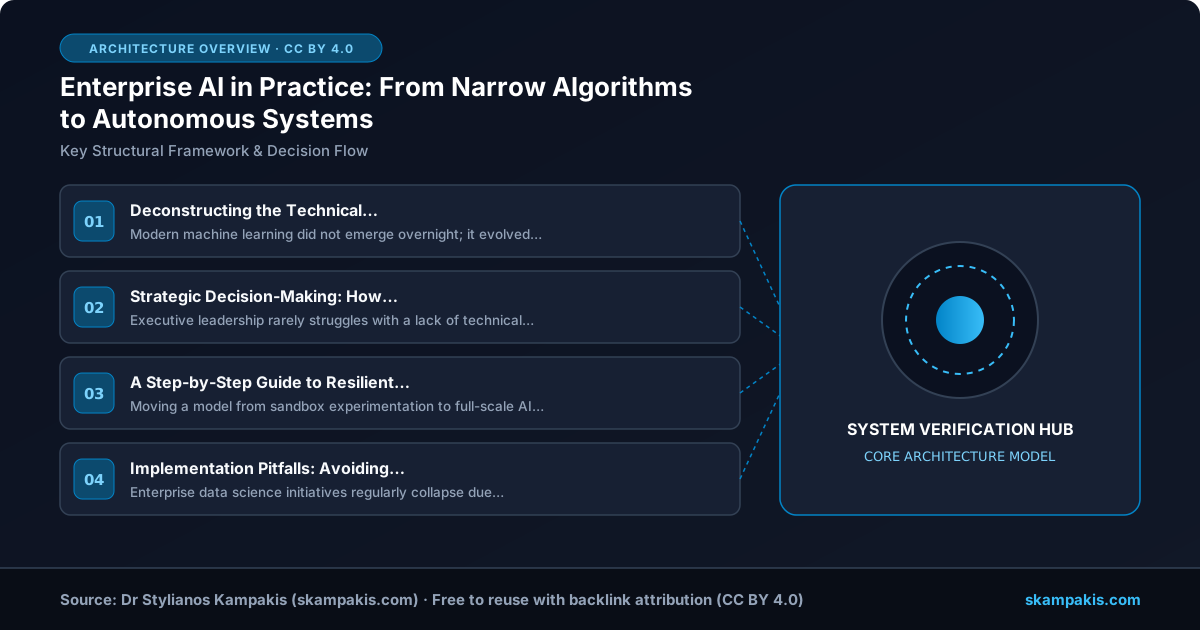
Strategic Decision-Making: How to Frame Enterprise AI in Practice
Executive leadership rarely struggles with a lack of technical enthusiasm; the primary failure point is improper problem formulation. Decision makers must learn how to assess business challenges through an analytical lens rather than treating algorithms as magic bullets.
Business leaders can bridge this gap by thinking like a data scientist when evaluating potential initiatives. Before writing code or buying proprietary tooling, map the business objective to one of four established analytical archetypes:
- Statistical Modeling: Deploy when the business objective demands transparent, explanatory insights into how variable X affects variable Y. If you need to understand whether customer age or macroeconomic rates drive purchase behavior, statistical modeling provides interpretable significance testing.
- Hypothesis Testing: Deploy when comparing distinct operational alternatives or validating interventions. A/B testing digital product variants, pricing changes, or campaign cohorts isolates causal impact and prevents confounding variables from skewing decisions.
- Supervised Learning: Deploy when you have labeled historical data and want to automate an existing human task or forecast quantitative outcomes. Common use cases include credit risk scoring, fraud detection, and demand forecasting.
- Unsupervised Learning: Deploy when uncovering latent structures within unlabeled data. Techniques such as k-means clustering and dimensionality reduction help identify distinct customer segments or detect operational anomalies without predefined rules.
A Step-by-Step Guide to Resilient AI Deployment
Moving a model from sandbox experimentation to full-scale AI deployment requires a disciplined engineering pipeline. The following five-phase framework ensures technical feasibility and operational stability.
Phase 1: Formulate a Falsifiable Business Question
Convert ambiguous corporate goals into tightly scoped, quantifiable problems. Instead of asking to "optimize supply chain operations," ask: "Can we forecast SKU-level regional retail demand 14 days in advance within a 5% mean absolute error?" A precise question determines data requirements and establishes unambiguous criteria for project success.
Phase 2: Audit Data Assets and Governance
Verify whether historical data exists in sufficient volume, quality, and labeling consistency before allocating engineering hours. When planning automated vision workflows, investigate how production systems ingest data, much like how engineering teams why data science projects fail and how to build a high-ROI data culture. Identify missing labels, class imbalances, and compliance boundaries upfront.
Phase 3: Baseline with Minimal Algorithmic Complexity
Always construct a simple baseline model before assembling complex deep learning or generative architectures. A simple logistic regression, linear model, or deterministic heuristic establishes the performance floor. If an advanced neural network cannot decisively outperform a linear baseline on clean validation data, deploying the heavier model introduces unnecessary technical debt.
Phase 4: Operationalize Closed-Loop Automation
Integrate the model into active business workflows with bidirectional data loops. In manufacturing contexts, modern operations demonstrate preventing data collection problems in telemetry pipelines by triggering work orders automatically when anomalous mechanical signals appear. Ensure your deployment includes automated fallbacks to human operators when model confidence scores drop below predefined safety thresholds.
Phase 5: Monitor Drift and Evaluate Economic Return
Algorithmic performance inevitably degrades over time as real-world conditions shift. Implement real-time monitoring for both feature drift (changes in model inputs) and concept drift (changes in statistical relationships). Track model inference costs, latency budgets, and downstream business metrics to confirm that the financial returns generated by the system exceed its infrastructure overhead.
Implementation Pitfalls: Avoiding the "Skynet to Kill a Fly" Fallacy
Enterprise data science initiatives regularly collapse due to two non-technical missteps: overly vague strategic visions and chronic over-engineering. Recognizing these traps early protects corporate capital and engineering velocity.
The Grandiose Vision Trap: Organizations often set unrealistic expectations, planning to build autonomous systems that will predict every enterprise metric years into the future. Grandiose roadmaps obscure immediate deliverables, cause stakeholder fatigue, and routinely fail. Focused, incremental milestones produce reliable ROI far faster than monolithic transformations.
The "Skynet to Kill a Fly" Fallacy: Teams frequently choose the most complex, resource-intensive architecture available to solve problems that simple methods could resolve. Building an unconstrained multimodal LLM agent to handle structured calendar scheduling wastes capital when a deterministic rule engine or simple API integration accomplishes the exact same task reliably.
Underestimating Manual Alternatives: Highly automated data extraction or classification pipelines can be remarkably expensive to develop, test, and host. In early project phases, temporary human-in-the-loop validation or crowdsourced labeling is often dramatically more cost-effective than premature algorithmic engineering.
The Future of Enterprise AI in Practice: Governance and Autonomous Scale
As organizations progress from standalone algorithms to coordinated agentic systems, data governance and system observability become central operational requirements. Autonomy without clear execution guardrails creates substantial corporate liability, ranging from silent data corruption to unmonitored API actions.
Sustainable enterprise automation requires rigorous access boundaries, end-to-end audit logging, and verifiable evaluation pipelines. Treating algorithms as active team members rather than black-box tools demands accountability for every prediction, recommendation, and automated decision.
Ultimately, mastering enterprise AI in practice is not about deploying the latest experimental architecture featured in research papers. It is about systematically applying the right analytical tool to the right operational problem, measuring performance against bottom-line business metrics, and scaling machine intelligence responsibly across the entire organization.
Frequently Asked Questions
What is the main difference between narrow AI and agentic systems?
Narrow AI is designed to perform a single, predefined task—such as image classification, churn prediction, or fraud scoring—based on fixed input-output mappings. Agentic systems, powered by foundation models, operate with autonomy: they interpret broad objectives, plan multi-step workflows, query external databases, use software tools, and self-correct based on operational feedback.
When should an enterprise use statistical modeling instead of machine learning?
Statistical modeling is the preferred choice when interpretability, transparency, and understanding causal relationships between variables are primary requirements. Machine learning excels at maximizing predictive accuracy on complex, high-dimensional datasets, but often acts as a black box that cannot clearly explain which variables drove a specific prediction.
Why do most enterprise AI deployment projects fail?
The majority of projects fail due to poorly scoped problem definitions, misaligned executive expectations, inadequate data hygiene, or choosing overly complex architectures to solve simple operational challenges. Projects succeed when teams baseline against simple models, secure clean domain data, and design narrow, quantifiable business objectives.
How can organizations identify and prevent model drift in production?
Organizations should implement automated observability pipelines that continuously monitor both feature drift (statistical distribution changes in input data) and concept drift (shifts in the underlying relationship between inputs and targets). When drift metrics cross established statistical thresholds, automated alerts should trigger model retraining or route decisions to human reviewers.
The Decision Maker's Handbook to Data Science
The definitive guide for non-technical executives and entrepreneurs on navigating AI, machine learning, and big data.