
Data collection problems are upstream structural, procedural, and technological errors that corrupt, bias, or truncate information prior to model development. Rooted in the fundamental “garbage in, garbage out” principle, these failures—ranging from missing target variables to uncalibrated instrumentation—render predictive algorithms useless before training even commences. Resolving these pitfalls requires rigorous objective alignment, standardized governance, and integrated data pipelines.
Machine learning models do not fail because an algorithm lacks capacity. More often, they fail because the raw inputs feeding their feature space are compromised at inception.
The Real Root of Data Collection Problems in Production
A statistical model has no situational awareness; it solely fits parameters against the distribution provided to it. When teams rush to harvest inputs without establishing a strict protocol, they fall into recurring data collection traps that compromise analytical validity.
- Unsupervised Pipeline Governance: Without an active principal investigator or domain authority validating the ingestion methodology, pipelines silently gather uncalibrated signals and system artifacts.
- Omission of Metadata and Standards: Data dictionaries are often skipped. When variables lack explicit documentation, onboarding contributors make arbitrary assumptions that corrupt feature engineering.
- Fragmented Silos and Device Isolation: Storing vital historical records on local developer drives or dispersed databases risks total data destruction and complicates unified ingestion.
- Regulatory Non-Compliance: Collecting consumer data without adhering to statutory boundaries like the General Data Protection Regulation (GDPR) creates severe downstream liabilities that can force complete database purges.
When organizations treat pipeline construction as an afterthought, engineers waste weeks debugging dirty data rather than refining model architecture. Adopting sound analytical principles, as detailed in Thinking Like a Data Scientist: The Strategic Decision Maker’s Guide, prevents strategic failures before writing a line of modeling code.
Domain Comparative Analysis: Modality Tradeoffs and Failure Points
Data behaves differently depending on the collection channel. Choosing a data acquisition channel requires balancing volume, manual curation cost, and analytical noise.
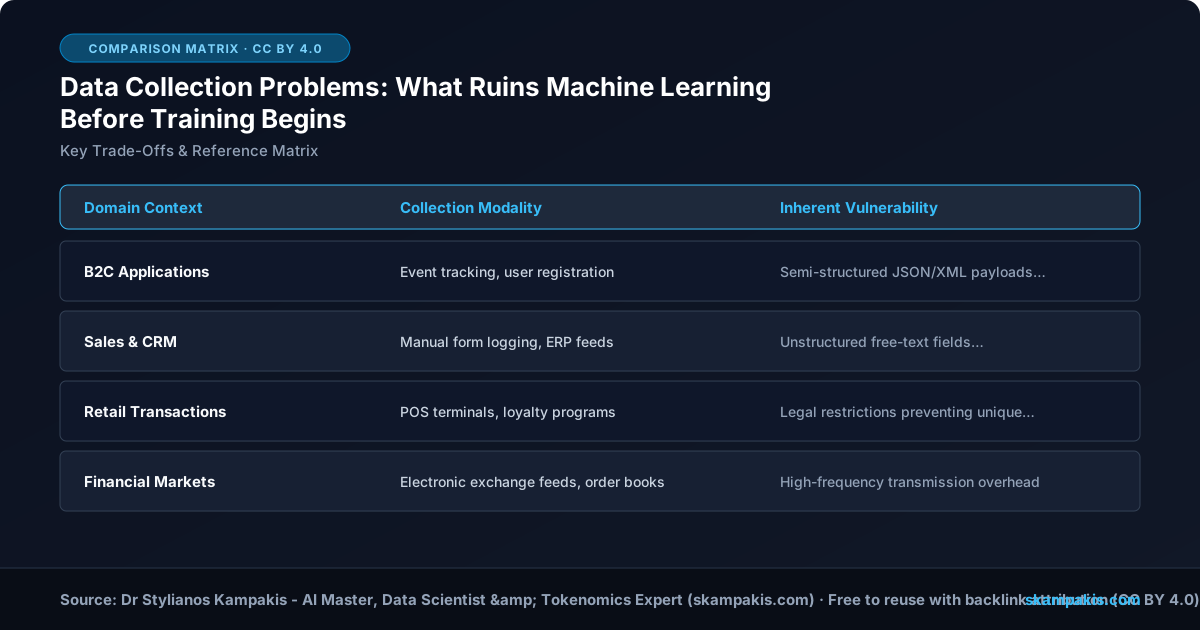
| Domain Context | Collection Modality | Inherent Vulnerability | Preprocessing Latency | Primary Failure Mode |
|---|---|---|---|---|
| B2C Applications | Event tracking, user registration | Semi-structured JSON/XML payloads; intentional user fabrication | High (days to weeks) | Sparse feature tracking; UI schema drift |
| Sales & CRM | Manual form logging, ERP feeds | Unstructured free-text fields; non-standard entry criteria | Moderate | Subjective field definitions across sales reps |
| Retail Transactions | POS terminals, loyalty programs | Legal restrictions preventing unique cross-session identity resolution | Low | Pseudonymization limits individual-level modeling |
| Financial Markets | Electronic exchange feeds, order books | High-frequency transmission overhead | Negligible | Microstructure latency anomalies |
| Sports Analytics | Human observational tracking | Observer fatigue and subjective recording errors | High | Inter-rater unreliability |
| Social Media | Streaming APIs | Noisy, unstructured text with syntax errors and non-standard syntax | Extreme | Out-of-vocabulary artifacts and bot inflation |
While financial tickers stream structured, pre-cleaned data with microsecond precision, consumer apps present high structural ambiguity. Conversely, industrial sensor pipelines require strict baseline calibration, especially when choosing an AI project by defining the decision, evidence, and baseline first under noisy plant conditions.
Case Study: The Variable Imputation Catastrophe
A client contracted a machine learning initiative to evaluate gender-based consumption patterns on an established digital platform. The analytical objective was straightforward: isolate behavioral variance across distinct demographic cohorts using formal hypothesis testing.
During the exploratory phase, the core issue emerged: the product engineering team had never collected or stored user gender in the operational database. The target variable of the entire business objective did not exist.
To salvage the timeline, the team attempted to infer gender algorithmically from first names using international public registries. In an international hub like London, this heuristic collapsed:
- Multicultural Name Distributions: Global population registries failed to reliably match non-Western, compound, or culturally diverse names.
- Unisex Ambiguity: Many recorded names possessed near-equal distributions across sexes, making deterministic assignment impossible without injecting artificial variance.
- Data Attrition: Over 30% of the customer dataset had to be deleted entirely due to zero-confidence matches.
This incident exemplifies common model training pitfalls. What should have taken two days of hypothesis testing turned into a multi-week wrangling failure because the engineering team never planned their data collection around business questions.
Engineering Guide: Establishing an Upstream Data Strategy
To eliminate systemic data collection problems, technical leads must establish formal data capture protocols before building schemas.
Phase 1: Formulate Concrete Business Hypotheses
Never aggregate data under the assumption that it might be valuable later. Formulate precise predictive questions. For example, transition from “Let’s log application interactions” to “Why do 35% of consumers abandon checkout at step three?”
Phase 2: Audit Target Variables and Systemic Bias
Identify every downstream variable necessary to build the intended model. If designing a localized recommendation system, verify that geolocation and explicit user constraints are captured upfront. Unchecked collection architectures often introduce survivorship bias by logging only successful customer transactions while discarding session telemetry from users who encountered UI barriers and churned.
Phase 3: Match Storage Architecture to Query Patterns
Avoid architectural fads. Adopting complex document-oriented NoSQL databases or unindexed data lakes for cleanly tabular entity-relationship problems introduces unnecessary data wrangling debt. Unless the workload demands flexible document formats or dynamic schemas, standard relational engines like PostgreSQL or MySQL provide superior consistency, immediate indexing, and easier extraction.
Phase 4: Synchronize UI Design with Data Pipelines
Data science requirements directly govern user experience engineering. Consider modern dating services: platforms like OkCupid prioritize feature density through exhaustive questionnaires, providing high analytical precision at the cost of onboarding friction. Conversely, platforms like Tinder sacrifice demographic depth for high-velocity swipe interactions. Engineering leaders must balance onboarding friction against feature richness rather than expecting rich features from a minimalist interface.
Avoiding the Shiny Object Trap: Pragmatic Tool Selection
Technological over-engineering is an insidious pipeline vulnerability. When organizations deploy deep neural networks for simple tabular classification, or instantiate distributed NoSQL clusters to manage easily normalized user accounts, operational costs soar while interpretability drops.
Deploying cutting-edge tools to compensate for poor data collection is counterproductive. As computer science research compiled by the Association for Computing Machinery (ACM) regularly demonstrates, model performance is fundamentally bounded by the informational quality and clean labeling of input distributions, not the novelty of the neural network layer.
Invest capital into upfront schema validation, robust data collection contracts, and automated monitoring rather than high-maintenance storage systems. Teams scaling enterprise architectures—and studying why data science projects fail to build a high-ROI data culture—recognize that standardized, deterministic inputs consistently outperform poorly managed, ad-hoc datasets.
Frequently Asked Questions
What is the most common cause of data collection problems in machine learning?
The most common cause is the absence of an operational objective prior to data harvesting. Without specific hypothesis formulation, organizations collect irrelevant telemetry while omitting essential target variables, leading to extensive preprocessing delays and unrecoverable feature gaps.
How does survivorship bias manifest during data collection?
Survivorship bias occurs when a pipeline logs only transactions that cross a completion threshold while discarding the events that dropped out earlier. The resulting training dataset reflects only successful pathways, causing models to fail when predicting failure states or churn risks.
When should an organization choose relational databases over NoSQL for machine learning pipelines?
Relational databases are preferred whenever the underlying domain entities exhibit consistent tabular relationships, such as user profiles, transaction logs, and inventory systems. NoSQL should generally be reserved for irregular hierarchical payloads, dynamic graph structures, or high-throughput unstructured streaming data like social media feeds.
How can teams detect dirty data before model training begins?
Teams should enforce schema validation contracts, run automated distribution profiling to catch null-rate spikes, and verify summary statistics against domain boundaries. Engaging a lead researcher or domain specialist to audit raw samples uncovers systematic logging errors that programmatic unit tests might overlook.
Summary: Planning Resolves Data Collection Problems
No model architecture, hyperparameter sweep, or deep learning algorithm can compensate for fundamental data collection problems. When variable capture is executed haphazardly, downstream predictive failure is inevitable. By formulating clear analytical questions, selecting appropriate storage technologies, and aligning application interfaces with telemetry needs, engineering teams protect their machine learning investments long before training begins.
The Decision Maker's Handbook to Data Science
The definitive guide for non-technical executives and entrepreneurs on navigating AI, machine learning, and big data.