
Successfully hiring data scientists requires evaluating a rare triad of skills: code hacking capabilities, deep mathematical and statistical foundations, and substantive domain curiosity. Traditional algorithmic coding tests fail because data scientists treat code as an investigative vehicle rather than an end product, demanding specialized assessment protocols that test analytical reasoning over rote software syntax.
Deconstructing the Data Science Venn Diagram
To hire effectively, leadership must grasp the classic tripartite profile defining the discipline. A competent practitioner lives at the convergence of three intersecting axes: practical coding skills, statistical depth, and contextual domain expertise.
Isolated proficiencies fail to deliver commercial value. An individual possessing coding skills and deep domain knowledge—but lacking rigorous mathematics—occupies the analytical danger zone. These practitioners confidently execute advanced statistical algorithms, generate visually persuasive artifacts, and reach systematically invalid conclusions due to fundamental misunderstandings of sample variance, multicollinearity, or baseline assumptions.
Conversely, pairing mathematical theory exclusively with business domain expertise yields traditional academic research. These researchers formulate elegant hypotheses but lack the script-level agility required to extract, clean, and vectorize messy corporate data feeds. True value emerges solely at the full intersection of all three capabilities.
The Major and Minor Tribes: Selecting Candidate Archetypes
Data science candidates do not originate from a singular academic pipeline. Instead, they arrive from distinct professional backgrounds, each possessing structural strengths and systemic blind spots when diagnosing data collection problems that ruin machine learning before modeling begins.
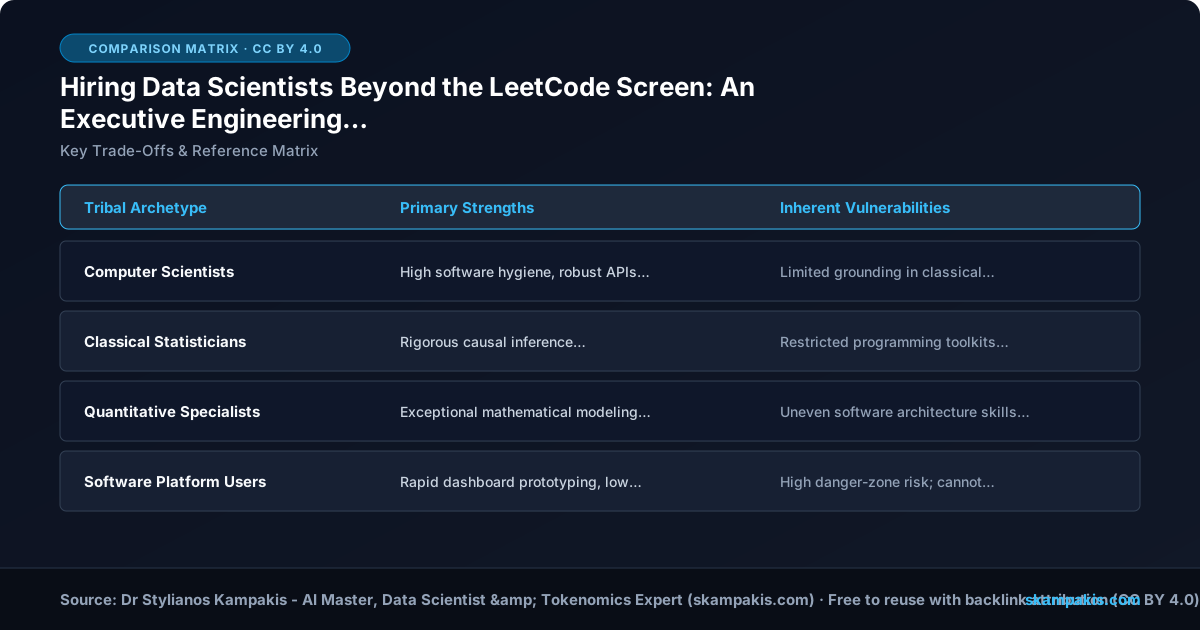
| Tribal Archetype | Primary Strengths | Inherent Vulnerabilities | Ideal Deployment Phase |
|---|---|---|---|
| Computer Scientists | High software hygiene, robust APIs, efficient data pipelines. | Limited grounding in classical inferential statistics and experimental design. | Machine learning engineering, low-latency production pipelines. |
| Classical Statisticians | Rigorous causal inference, experimental design, transparent modeling. | Restricted programming toolkits (often R-only), poor database performance. | Hypothesis testing, causal analysis, regulated risk modeling. |
| Quantitative Specialists | Exceptional mathematical modeling, first-principles problem-solving. | Uneven software architecture skills, self-taught tooling gaps. | Algorithmic research, complex sensor data, unstructured signal analysis. |
| Software Platform Users | Rapid dashboard prototyping, low operational overhead. | High danger-zone risk; cannot diagnose mathematical anomalies. | Basic business intelligence, exploratory internal reporting. |
Among quantitative career changers, physicists consistently show the fastest ramp-up times when transitioning to commercial data initiatives. Their foundational fluency in applied differential equations and vector calculus directly mirrors modern statistical learning architectures, while their laboratory experience requires practical, unpolished programming.
Seniority fundamentally transforms these archetypes through a clear convergence point. After five to eight years and dozens of heterogeneous projects, elite practitioners develop polyglot competencies across Python and R, understand architectural tradeoffs, and intuitively grasp analytical limitations regardless of where they began their technical careers.
Pre-Hire Readiness Audit: When to Freeze Recruitment Drives
Before launching a campaign for hiring data scientists, organizations must audit internal operational maturity. Inserting expensive analytical talent into an immature environment leads to immediate candidate attrition and high resource waste.
- Data Infrastructure Absence: Never hire practitioners before transactional telemetry and extraction pipelines are operational. Paying senior analysts to manually format disorganized files breeds acute career frustration.
- Ambiguous Commercial Objectives: Demanding abstract “business insights” without quantifiable metrics paralyzes analytical execution. Practitioners require concrete problem statements, such as churn mitigation or margin optimization.
- Reporting-Only Traps: Treating a senior modeling specialist as an ad-hoc SQL report generator underutilizes their capabilities, akin to hiring an executive chef to toast sandwich bread.
- Absence of Data Culture: If organizational decisions are driven purely by intuition and executives reject empirical findings that contradict their assumptions, analytical initiatives will fail. For broader strategic alignment, review our breakdown on thinking like a data scientist.
A Blueprint for the Modern Data Science Interview
Eliminate generic dynamic programming algorithms from your technical recruiting pipeline. Instead, evaluate candidate capacity across practical vectorization, exploratory analytical workflows, and statistical defenses.
Stage 1: The Practical Data Wrangling Screen
Provide the candidate with a raw, malformed dataset exhibiting missing indices, mixed type definitions, and subtle string-encoding anomalies. Evaluate algorithmic manipulation using standard libraries like Pandas, Polars, or NumPy.
Verify command-line confidence, awareness of vectorized operations, and script readability. Elite candidates do not write bespoke enterprise software architectures during discovery phases; they construct functional code to isolate underlying data signals quickly.
Stage 2: The Empirical Defense Interview
Present a real-world predictive scenario and prompt the candidate to select, configure, and justify their modeling methodology. Probe their core theoretical knowledge to filter out danger-zone impostors:
- Assumptions and Boundaries: Instruct the candidate to enumerate the underlying distribution assumptions behind their chosen technique and describe how departures from normality alter predictive validity.
- Cross-Validation Rigor: Assess their understanding of temporal data leakage, cross-validation boundaries, and metric selection for imbalanced distributions.
- Interpretability vs. Accuracy: Task the candidate with defending their model architecture to a non-technical stakeholder, evaluating both their communication clarity and visual translation skills.
Managing Data Scientists: Retention, Red Queen Dynamics, and Autonomy
Retaining high-performing technical talent requires intentional management structures. Because elite specialists operate in a seller’s market, retaining a data science team requires alignment across intellectual variety and continuous learning opportunities.
Analytical practitioners are driven by the Red Queen hypothesis: in an accelerating technical landscape, they must continuously expand their toolkits merely to remain viable. Forcing them to maintain legacy architectures or perform manual data entry triggers disengagement and turnover.
- Protect Experimental Autonomy: Give your staff the space to test non-obvious hypotheses. Treat data scientists as internal consultants rather than ticket-executing developers.
- Support Academic Integration: Allocate explicit professional development stipends and paid sabbaticals for prominent research conferences, including the Neural Information Processing Systems (NeurIPS) and the International Conference on Machine Learning (ICML).
- Decouple Domain Dogma: Recognize that statistical methods translate across operational sectors. An engineer with experience analyzing financial time-series can apply the same mathematical structures to industrial equipment, provided leadership avoids the structural traps described in why data science projects fail and how to build a high-ROI data culture.
- Tailor Infrastructure to the Problem: Provide clean analytical tools and modern computational clusters. Restricting machine learning practitioners to basic office software damages morale and project outcomes.
Frequently Asked Questions
Why are LeetCode-style screens ineffective for data scientists?
Algorithmic coding tests prioritize memory efficiency, pointer manipulation, and complex software patterns. Data scientists primarily write code to transform data, run mathematical models, and extract patterns. Testing them on dynamic programming puzzles fails to measure their statistical acumen, data intuition, or ability to solve real business problems.
What is the danger zone in data science hiring?
The danger zone describes candidates who possess strong programming abilities and clear domain knowledge, but lack foundational training in mathematics and statistics. These individuals can build flawed models that appear technically sound, leading organizations to make costly strategic errors based on invalid statistical assumptions.
Should we hire a data scientist or a data engineer first?
Most organizations should hire a data engineer first. Data engineers build the core ingestion infrastructure, clean storage environments, and automated pipelines required for advanced analysis. Bringing in a data scientist before data is accessible forces them to spend their time on basic pipeline plumbing, which often leads to project delays and team turnover.
How much domain experience is truly necessary when evaluating candidates?
Direct domain experience is often secondary to strong methodological foundations. Core statistical modeling and machine learning frameworks apply across a wide range of analytical problems. Exceptional practitioners quickly master the nuances of new domains, provided they have access to business context and clear organizational goals.
Enterprise AI Readiness & Maturity Assessment
Benchmark your organization's data infrastructure, AI governance posture, and high-ROI implementation pathways.