
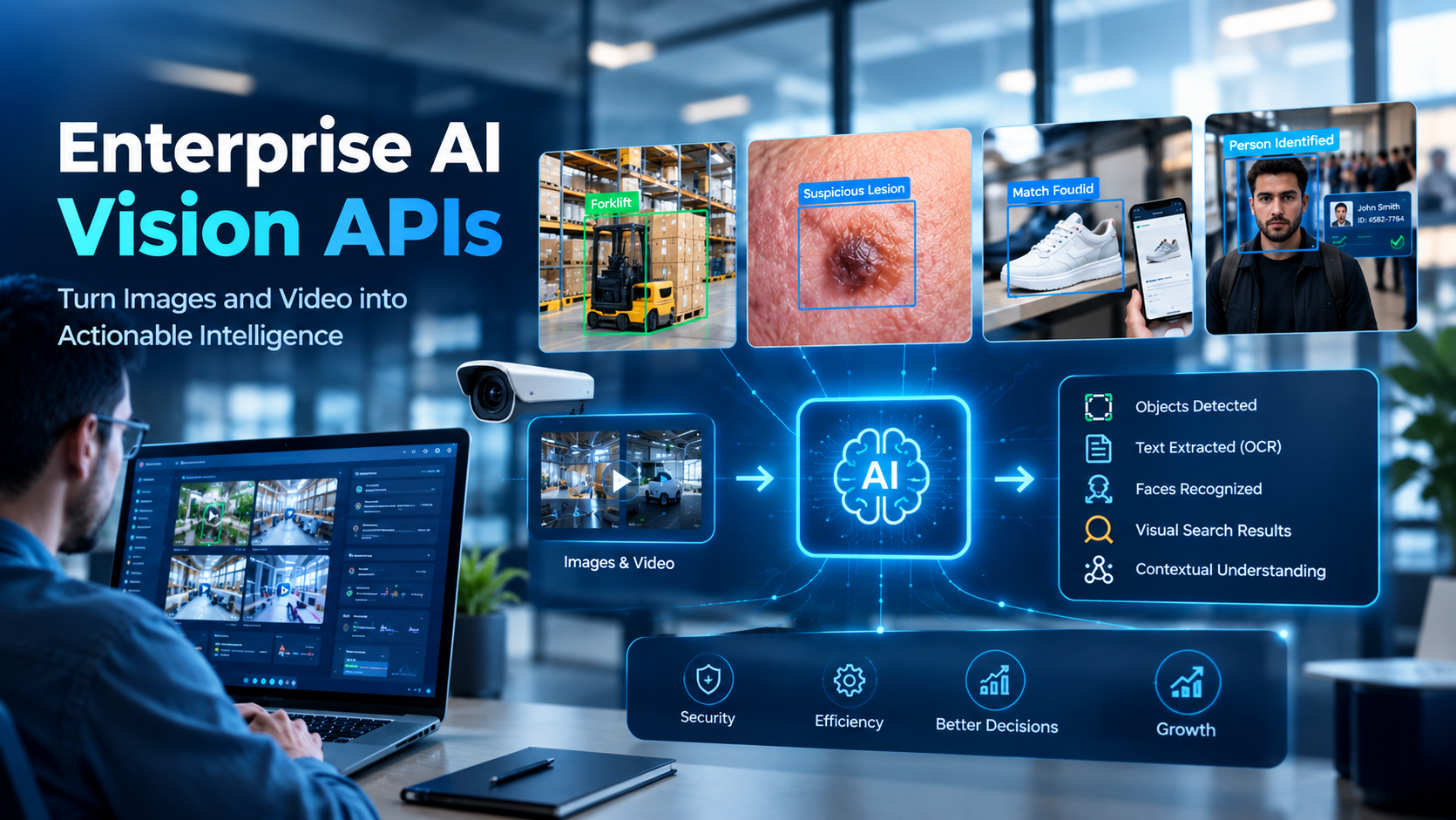
Understanding the distinction between data science vs AI vs machine learning comes down to scope, objective, and execution. Artificial Intelligence (AI) is the overarching engineering goal of emulating cognitive logic and reasoning in machines. Machine Learning (ML) is a computational subfield of AI that uses data to train predictive algorithms without explicit procedural rules. Data Science is the multidisciplinary practice combining statistics, computer science, and domain expertise to extract operational value and actionable decisions from raw information.
Modern organizations routinely conflate these concepts, producing misaligned hiring sprees, flawed procurement choices, and stalled proof-of-concepts. Less than 0.5% of generated business data is systematically transformed into actionable decisions. Clarifying how these disciplines converge and diverge is a baseline requirement for building an effective enterprise technology strategy.
Foundational Taxonomy and AI Definitions
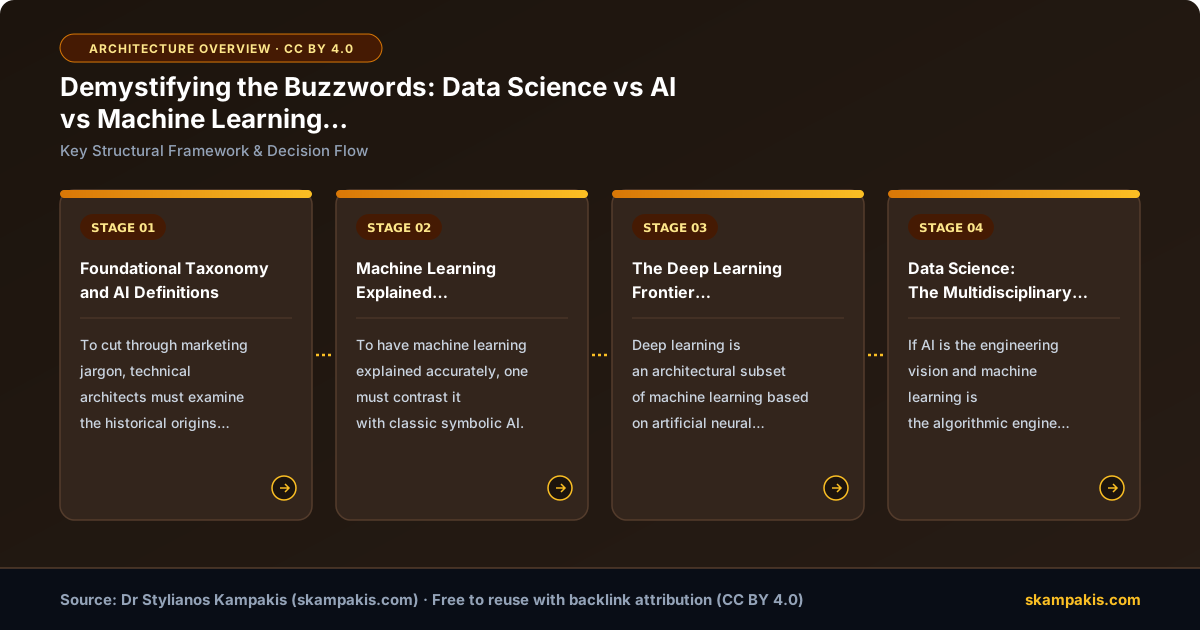
To cut through marketing jargon, technical architects must examine the historical origins and formal AI definitions established over decades of computer science research.
Artificial Intelligence formally crystallized in 1954 at Dartmouth College. Pioneers like Marvin Minsky conceptualized AI as the science of making machines perform tasks that would demand human intelligence. Early efforts leaned heavily on cognitive science and the computational theory of mind, treating cognition as rule-based symbolic manipulation.
Early AI systems used deductive, top-down logic. Human subject matter experts spent months articulating conditional rules in the form of IF (condition) THEN (action). A prominent example was the Stanford-developed MYCIN system in the 1970s. MYCIN contained roughly 600 heuristic rules to identify blood infections and recommend antibiotics, achieving a 69% accuracy rate that rivaled human clinicians. However, because early symbolic AI could not handle statistical variance or self-learn, it collapsed under real-world ambiguity.
When algorithmic over-promising clashed with compute limitations, the field suffered severe “AI Winters”—notably following the UK’s 1973 Lighthill Report and US defense funding reallocations under the Mansfield Amendment. Surviving these downturns required a fundamental paradigm shift away from top-down symbolic rules toward data-driven learning mechanisms.
Machine Learning Explained: The Bottom-Up Paradigm
To have machine learning explained accurately, one must contrast it with classic symbolic AI. Coined by Arthur Samuel at IBM in 1959, machine learning denotes giving computers the operational capability to learn from data without being explicitly programmed.
Classic AI imposed top-down rules constructed by humans. Machine learning operates bottom-up: software consumes historical training inputs, models the underlying statistical distribution, and extracts patterns independently. This shift enables computers to navigate probabilistic ambiguity, which symbolic systems could never resolve.
Three primary paradigms drive machine learning applications:
- Supervised Learning: Algorithms ingest paired features and ground-truth labels (for example, categorizing radiological imagery as benign or malignant). The model maps inputs to discrete targets or continuous values.
- Unsupervised Learning: Systems receive unlabelled datasets to uncover latent clusters, customer segments, or behavioral anomalies without manual categorization.
- Reinforcement Learning: Agents interact within an environment, optimizing decision trajectories through iterative rewards and penalty signals, similar to pathfinding algorithms navigating physical mazes.
Despite its predictive capability, machine learning presents two core architectural challenges. First, standard statistical models identify correlations, not causal mechanics; an algorithm can determine that dropped objects fall with 0.99 probability without grasping Newtonian gravity. Second, high-capacity models operate largely as mathematical “black boxes,” driving the urgent need for interpretable AI techniques in enterprise governance.
The Deep Learning Frontier: Hierarchical Representations
Deep learning is an architectural subset of machine learning based on artificial neural networks that contain multiple hidden layers. Championed by researchers like Geoffrey Hinton, deep architectures bypassed the manual feature engineering that bottlenecked traditional statistical classifiers.
Deep neural networks mimic the hierarchical processing of biological sensory systems. Lower layers isolate low-level spatial primitives (such as edges and contrast gradients), intermediate layers construct geometric shapes, and deep layers resolve holistic semantic entities like faces or objects. This structural hierarchy is why deep learning excels in unstructured domains like computer vision and natural language processing.
Modern breakthroughs rely heavily on transformer networks. Rather than processing text or sequential signals sequentially, transformers process inputs concurrently using self-attention mechanisms. This architecture underpins Large Language Models (LLMs) such as OpenAI’s GPT family, moving enterprise capabilities from static classification to dynamic context generation, code synthesis, and analytical summarization.
However, deep architectures are not universal remedies. Deploying deep neural networks on tabular datasets with limited rows introduces severe risks of overfitting—where an over-parameterized model memorizes training noise and fails catastrophically on production inputs. For narrow, structured problems, classical regression or tree-based ensembles regularly outperform deep networks while using a fraction of the compute budget.
Data Science: The Multidisciplinary Operational Unifier
If AI is the engineering vision and machine learning is the algorithmic engine, data science is the cross-disciplinary framework that converts data assets into empirical business value. As defined by statistician Chikio Hayashi, data science unifies statistics, data analysis, and machine learning methods to analyze actual phenomena.
In practice, data science is about using data to do useful work. In clinical healthcare, misdiagnoses affect 5% of outpatients annually. Applying predictive data science platforms to correlate patient histories with subtle physiological signals allows hospital networks to catch life-threatening cardiac conditions that individual clinicians might easily mistake for minor gastrointestinal complaints.
Data science blends three foundational domains:
- Mathematical Statistics: Ensuring experimental rigor, hypothesis testing, sampling validity, and model interpretability.
- Software Engineering & Computing: Building scalable pipelines, executing data wrangling, and deploying models into real-time environments.
- Domain Acumen & Narrative Translation: Formulating valid business hypotheses and communicating technical metrics clearly to executive stakeholders.
Evaluating Data Science vs AI vs Machine Learning in Practice
Enterprise decisions stall when technical leaders select tools based on vendor hype rather than system requirements. The table below delineates the functional differences between these disciplines to guide architectural investments.
| Dimension | Data Science | Artificial Intelligence | Machine Learning |
|---|---|---|---|
| Primary Objective | Extract operational insights and inform decisions from enterprise data | Replicate human cognitive functions and autonomous decision-making | Optimize task-specific performance through statistical pattern recognition |
| Core Methodology | Hypothesis testing, exploratory data analysis, descriptive/predictive modeling | Symbolic reasoning, automated planning, expert logic, neural representations | Supervised, unsupervised, semi-supervised, and reinforcement learning |
| Primary Data Type | Structured enterprise databases, logs, metrics, survey data, mixed inputs | Multimodal sensory inputs, high-dimensional text, real-time environments | Labeled datasets, vectorized feature spaces, historical observation logs |
| Critical Failure Mode | Misaligned commercial assumptions, unvalidated sampling bias | Unintended autonomous drift, hallucination, reasoning brittleness | Statistical overfitting, concept drift, lack of model interpretability |
| Primary Enterprise Output | Executive dashboards, pricing algorithms, churn interventions, strategic roadmaps | Autonomous support bots, real-time routing engines, robotic automation | Risk scoring models, fraud detection classifiers, recommendation engines |
Step-by-Step Implementation Guide for Enterprise Teams
Navigating these technologies requires an orderly, sequential engineering workflow. Organizations that purchase tools before defining their data pipelines consistently fail to capture value.
Phase 1: Conduct a Comprehensive Data Inventory
Catalog all enterprise data assets, distinguishing between passive observational data (such as web server logs, transactional records, and support tickets) and active experimental data (such as A/B testing logs). Verify ingest integrity and assess historical depth before evaluating modeling techniques.
Phase 2: Classify the Problem and Select the Technical Paradigm
Match the business problem to the simplest suitable algorithmic family. If the workflow requires explainable inferences for compliance audits, use traditional statistical regression. If it requires continuous predictive automation on multi-feature transactions, implement supervised machine learning. Reserve complex deep networks and LLMs for unstructured computer vision, audio, or natural language workflows.
Phase 3: Assemble Specialized Technical Roles
Avoid hiring for a generic “data unicorn.” Allocate tasks across specialized job profiles:
- Data Engineers: Construct and maintain distributed pipelines, database architectures, and data warehouses.
- Data Scientists: Run statistical experiments, test feature relationships, and map modeling outcomes to core business metrics.
- Machine Learning Engineers / MLOps Specialists: Containerize predictive models using Docker and Kubernetes, automate CI/CD training loops, and monitor production latency.
Phase 4: Implement Operational Governance
Establish strict testing protocols prior to enterprise rollout. Monitor for data drift (changes in real-world distribution relative to baseline training data) and concept drift (decay in real-world predictive validity over time). Enforce rigorous interpretability checks to ensure systems remain auditable and legally defensible.
Troubleshooting Common Enterprise Roadblocks
Even well-funded initiatives stumble over familiar operational pitfalls. Use this reference to diagnose common project breakdowns:
- The “Black Box” Compliance Barrier: When a deep neural network cannot explain credit rejections or clinical diagnoses to regulators, retrain the baseline using glass-box models (such as Generalized Additive Models) or deploy post-hoc explainers like SHAP (Shapley Additive exPlanations) to trace feature weights.
- Overfitting on Sparse Data: When an algorithm shows 99% accuracy in training but fails in production, reduce model complexity. Drop excessive neural layers, use regularized regression (L1/L2), and enforce strict k-fold cross-validation.
- Model Drift and Silent Degradation: Automated systems degrade as customer behavior shifts. Set up automated alerts via MLOps pipelines to trigger model retraining whenever feature drift exceeds predefined statistical boundaries.
Verification and Readiness Checklist
Before moving an analytics, ML, or AI initiative into production, ensure the project passes every operational gate:
- Baseline Metric Defined: Is the model’s accuracy, precision, or recall benchmarked against a simple heuristic or naive baseline?
- Pipeline Reproducibility: Are raw data transforms, feature extractions, and model weights version-controlled end-to-end?
- Infrastructure Separation: Is the operational training environment isolated from downstream operational scoring services to prevent resource contention?
- Governance & Privacy Compliance: Has data lineage been audited to guarantee no personally identifiable information (PII) or unvetted intellectual property is exposed to third-party model APIs?
Mastering the boundaries between data science vs AI vs machine learning allows enterprise executives to stop chasing tech industry buzzwords and start building resilient, measurable capabilities. By pairing sound statistical hygiene with focused machine learning pipelines and realistic AI targets, technical leaders can build automated, reliable decision engines that deliver sustained enterprise value.
Frequently Asked Questions
Can you have data science without machine learning?
Yes. Data science incorporates classical statistics, exploratory data analysis, data warehousing, and business intelligence. Many high-value data science projects generate vital operational decisions using descriptive statistics, experimental A/B testing, and hypothesis testing without ever deploying an automated machine learning algorithm.
Is deep learning always better than traditional machine learning?
No. Deep learning models require vast quantities of training data and substantial compute resources, making them prone to overfitting on small or structured tabular datasets. Traditional techniques like gradient-boosted decision trees (such as XGBoost) or regularized linear models routinely outperform deep networks on structured business data while remaining faster to train and far easier to interpret.
What is the difference between Narrow AI and General AI?
Narrow AI (Weak AI) designs software to handle specific, bounded tasks—such as facial recognition, automated translation, or fraud monitoring. These systems cannot operate outside their explicit programming. General AI (AGI) refers to theoretical systems that possess adaptable human-grade reasoning across all cognitive disciplines, capable of learning, problem-solving, and abstract thought without task-specific constraints.
Why do so many enterprise AI projects fail in production?
Most enterprise initiatives falter due to poor data engineering, fragmented data governance, and an absence of MLOps pipelines. Organizations frequently prototype models in isolated environments without planning for real-world data pipelines, changing data distributions, operational monitoring, or cross-functional change management.
Read our guide on Data Collection Problems: What Ruins Machine Learning Before Modeling Begins.
Learn more about Why Data Science Projects Fail.
In-House Corporate AI Strategy & Governance Clinics
Bespoke executive clinics led by Dr. Stylianos Kampakis for leadership teams, boards, and division directors.