

Data science pitfalls are systematic organizational, methodological, and architectural errors—ranging from conflating correlation with causation to mismanaging elite technical talent—that derail analytical initiatives and destroy capital. Avoiding these high-stakes failures requires rigorous causal validation, balanced technical staffing, and disciplined alignment between mathematical models and real-world commercial outcomes.
Organizations routinely burn millions of dollars on data initiatives that deliver zero operational return. Executive leaders often assume the culprit is inadequate computational power or insufficient data volume.
In practice, enterprise failure stems from fundamental structural oversights. Understanding how to navigate these challenges demands an approach rooted in disciplined methodology rather than unchecked hype, an ethos explored in Thinking Like a Data Scientist: The Strategic Decision Maker’s Guide.
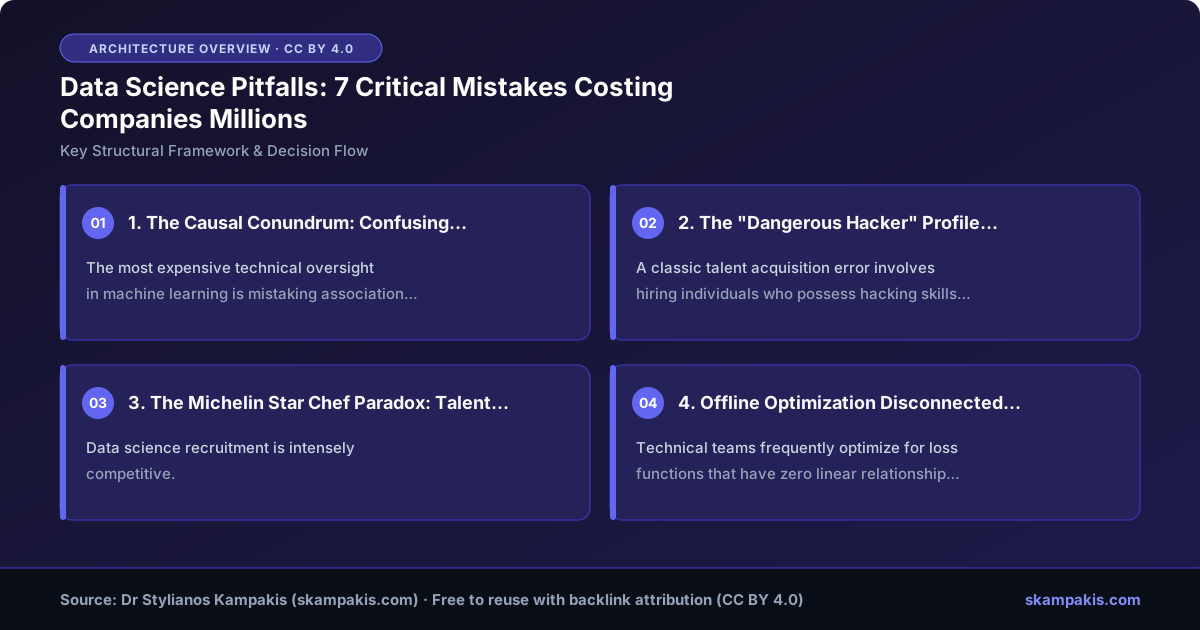
1. The Causal Conundrum: Confusing Association with Intervention
The most expensive technical oversight in machine learning is mistaking association for causation. When enterprise teams deploy standard supervised learning algorithms, they train systems optimized solely for curve fitting.
As computer scientist and Turing Award laureate Judea Pearl demonstrates in his foundational work, human reasoning relies on the Ladder of Causation, a three-tiered hierarchy of cognitive analysis described extensively in Judea Pearl’s research on causal inference:
- Rung 1: Association (Observational): Asking “What does symptom X tell us about condition Y?” This is the exclusive domain of traditional regression and deep learning.
- Rung 2: Intervention (Actionable): Asking “If we take action X, will it cause outcome Y?” This requires active experimentation or causal identification techniques.
- Rung 3: Counterfactuals (Retrospective): Asking “What would have happened had we acted differently?” This represents true analytical intelligence and scenario modeling.
When organizations deploy Rung 1 models to make operational interventions, systems collapse. For instance, an algorithm might observe that customers who contact technical support renew subscriptions at higher rates, falsely concluding that creating customer friction drives retention.
Without causal graph formalization—using modern frameworks such as Microsoft’s DoWhy library—enterprises fall into systemic analytics failure modes that lead to devastating policy decisions.
2. The “Dangerous Hacker” Profile: Structural Skill Imbalances
A classic talent acquisition error involves hiring individuals who possess hacking skills and domain knowledge, but lack deep mathematical and statistical foundations. This profile creates an acute organizational liability.
Drew Conway’s canonical Venn diagram establishes that legitimate data science requires the complete synthesis of code hacking, mathematics/statistics, and substantive domain expertise:
| Archetype Profile | Skill Configuration | Operational Risk Profile |
|---|---|---|
| Traditional Researcher | Math/Stats + Domain Expertise (Lacks Hacking) | High theoretical rigor, but incapable of processing large-scale data or building production pipelines. |
| Machine Learning Specialist | Math/Stats + Code Hacking (Lacks Domain) | Builds mathematically sophisticated models that solve irrelevant or misframed commercial problems. |
| The Dangerous Operator | Code Hacking + Domain Expertise (Lacks Math/Stats) | Generates legitimate-looking analytical artifacts based on violated statistical assumptions and false confidence. |
| Full-Spectrum Data Scientist | Code Hacking + Math/Stats + Domain Expertise | Formulates sound hypotheses, writes functional exploration code, and interprets structural results accurately. |
The dangerous profile writes clean scripts and speaks the commercial language fluently. However, because they lack foundational statistical mechanics, they routinely run tests with violated distributional assumptions, miss severe multicollinearity, and misinterpret p-values.
Leadership takes their charts at face value, funding multi-million-dollar strategies founded on mathematical mirages.
3. The Michelin Star Chef Paradox: Talent Misallocation
Data science recruitment is intensely competitive. Top practitioners in tech hubs routinely receive dozens of cold recruiter solicitations each month, granting them enormous market leverage.
Companies invest heavily to secure these specialists, only to commit a catastrophic managerial mistake: reducing elite analytical minds to mundane data janitors.
Employing a senior data scientist to spend 80% of their operational week manually formatting CSV files and patching dirty data is the financial equivalent of hiring molecular gastronomy pioneer Heston Blumenthal to flip plain grilled cheese sandwiches. It creates two immediate enterprise failures:
- Severe Talent Churn: High-performing data scientists operate under the evolutionary dynamic of the Red Queen’s Hypothesis—they must continually learn and refine skills simply to remain competitive. Repetitive data cleaning causes rapid demoralization and turnover.
- Destructive Over-Engineering: Bored, highly capable specialists invariably overcomplicate simple requirements. Tasked with standard analytical queries, they construct fragile, multi-layered deep learning frameworks simply to stay mentally engaged.
Enterprise teams achieve superior outcomes by building dedicated data engineering pipelines upstream, freeing analytical talent to tackle high-leverage business problems.
4. Offline Optimization Disconnected from Online Realities
Technical teams frequently optimize for loss functions that have zero linear relationship with enterprise balance sheets. A model that increases an offline metric like Area Under the ROC Curve (AUC) from 0.84 to 0.89 can still bankrupt a process if false positives carry disproportionate operational expenses.
This dynamic often triggers expensive ROI traps in mission-critical applications. In physical asset environments, such as those evaluated in preventing data collection problems in telemetry pipelines, a statistical model that minimizes root-mean-square error might fail to catch catastrophic component anomalies that shut down an entire manufacturing facility.
Data teams must design utility-based loss functions that directly reflect economic costs, operational downtime, and customer friction before writing their first line of model training code.
5. Upstream Data Wrangles: The Missing Software Engineering Bridge
Data scientists utilize code as an exploratory chisel, not an end product. Expecting them to build highly maintainable, resilient enterprise systems without specialized engineering partnerships is a recipe for system collapse.
When developers build transactional applications without coordinating schema requirements with the data team, analytical pipelines fracture. Data scientists end up spending immense energy untangling inconsistent schemas, undocumented null values, and asynchronous log events.
Organizations must establish clear functional boundaries: software and data engineers build and maintain hardened data pipelines; data scientists interrogate that data to design models; and machine learning engineers deploy those models into stable production workflows.
6. Production Blindness: Ignoring Covariate Shift and Concept Drift
A static model deployed into a dynamic world degrades from its first millisecond of runtime. Assuming that an analytical asset retains its validation-set performance indefinitely is one of the most persistent AI implementation mistakes seen in modern enterprises.
Environmental shifts fall into two distinct mechanical failures:
- Covariate Shift (P(X) changes): The distribution of input features transforms over time due to external real-world shifts, even if the underlying relationship to the target remains constant.
- Concept Drift (P(Y|X) changes): The fundamental statistical relationship between input features and target variables changes, rendering past training data obsolete.
Deploying automated monitoring frameworks that continuously assess model outputs, feature distributions, and baseline calibration is vital. Without real-world feedback loops, algorithmic decay will quietly erode gross margins across entire commercial portfolios.
7. The Black-Box Scale Illusion: Premature Architectural Complexity
Corporate decision-makers routinely assume that deploying state-of-the-art architectures, like massive transformer networks or deep ensemble models, constitutes commercial progress. However, excessive complexity introduces brittle dependencies, massive inference latencies, and extreme debugging overhead.
Many enterprise problems are solved far more effectively by simpler, transparent statistical methods—or well-architected API integrations. Organizations scaling cognitive services, as demonstrated in why data science projects fail and how to build a high-ROI data culture, often discover that managed, specialized interfaces vastly outperform bloated internal models.
Starting with simple, interpretable baselines is essential. Move to higher architectural complexity only when data scale, business impact, and verifiable causal gains justify the added maintenance overhead.
A Systematic Framework to Eliminate Data Science Pitfalls
De-risking data operations requires operational discipline across organizational design, analytical modeling, and system architecture. The following implementation checklist helps maintain alignment throughout the project lifecycle:
- Phase 1: Pre-Commitment Hypothesis Architecture: Prior to any data ingestion, mandate that stakeholders write out their foundational causal assumptions. Explicitly declare whether the goal is pure observational prediction (Rung 1) or strategic intervention (Rung 2).
- Phase 2: Talent Matrix Balancing: Screen technical candidates specifically for foundational statistical intuition rather than basic syntax memorization. Ensure data engineering and business translation roles exist alongside core model builders.
- Phase 3: Economic Loss Mapping: Translate mathematical optimization parameters directly into monetary values. Establish explicit performance boundaries where an analytical failure triggers automated human overrides.
- Phase 4: Causal & Robustness Auditing: Run counterfactual challenge datasets through systems before staging production releases. Use causal validation frameworks to verify that features reflect actual business mechanisms, not transient correlations.
By implementing proactive structural boundaries, organizations can sidestep devastating data science pitfalls, transforming their analytical teams from speculative cost centers into reliable, value-generating assets.
Frequently Asked Questions
What is the single most costly data science pitfall in enterprise operations?
The single most destructive pitfall is confusing correlation with causation. When businesses base operational interventions on standard observational machine learning models (Pearl’s Rung 1 of Causation), they frequently act on spurious correlations, driving strategies that actively degrade profitability.
Why do skilled programmers without statistical backgrounds pose a major risk?
Programmers lacking deep statistical foundations can easily run algorithms and output polished analytical visualizations without understanding their mathematical limits. This creates a false sense of security, encouraging leadership to make high-stakes operational bets on mathematically invalid conclusions.
How can business leaders prevent data scientist disengagement and turnover?
Leaders can prevent attrition by providing specialized data engineering support upstream to eliminate continuous data cleaning, clearly communicating business context, and assigning data scientists complex problems that demand rigorous modeling and strategic experimentation.
What is the primary difference between machine learning and true causal inference?
Traditional machine learning focuses entirely on pattern recognition and curve fitting within historical data distributions (Association). In contrast, causal inference models the underlying data-generating mechanisms, allowing teams to accurately simulate interventions and evaluate counterfactual questions.
AI and Data Science for Decision Makers
Equip leadership and operations teams to evaluate, scope, and govern production AI initiatives.