

Data science pitfalls are systemic technical, methodological, and managerial errors—such as conflating correlation with causation, underestimating data wrangling debt, or deploying under-skilled multidisciplinary teams—that derail analytics initiatives and destroy business value. Organizations evade these costly AI implementation mistakes by enforcing rigorous causal inference standards, aligning technical talent with real business domains, and building robust experimentation protocols prior to production deployment.
Enterprises invest millions of dollars building advanced predictive capabilities, only to see high-profile models fail silently in deployment. When data science initiatives collapse, leadership frequently blames algorithmic accuracy or computational limitations.
In reality, enterprise failures stem from deep-seated conceptual oversights, organizational mismatch, and poor causal governance. Moving from experimental proofs-of-concept to durable production requires diagnosing these analytics failure modes before they compromise executive decision-making.
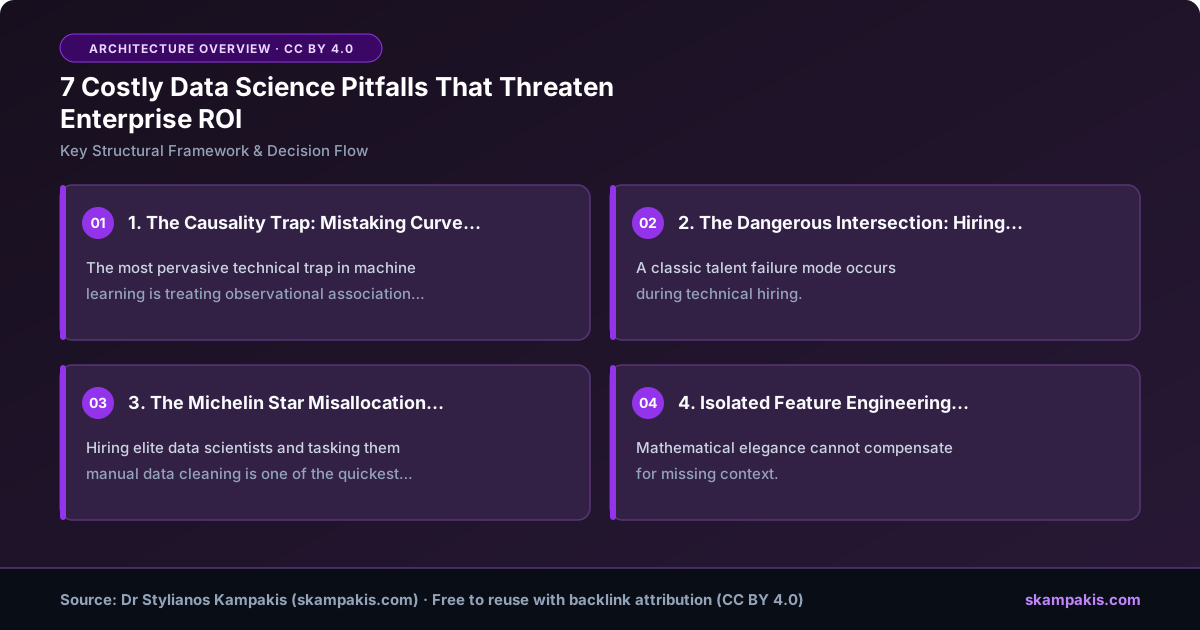
1. The Causality Trap: Mistaking Curve Fitting for Business Truth
The most pervasive technical trap in machine learning is treating observational association as an operational lever. Traditional supervised machine learning architectures excel at identifying statistical patterns across large feature sets, but observational correlation does not govern real-world interventions.
Turing Award winner Judea Pearl articulated this structural limit through his Ladder of Causation. Most enterprise deep learning sits squarely on the first rung: Association. This rung answers passive observational queries (“If I observe a customer buying product X, how does my belief about their churn risk change?”).
Business operations, by contrast, function on the second and third rungs:
- Intervention (Rung 2): What happens to customer retention if we actively discount their subscription fee?
- Counterfactuals (Rung 3): Would this specific churned client have renewed if our customer support team had intervened 48 hours earlier?
When organizations deploy associative models to determine policy interventions, they encounter severe ROI traps. A machine learning system might discover that users who frequently configure account settings have a higher lifetime value. If product managers blindly force users through mandatory account setup wizards to artificially drive retention, churn often increases because the configuration behavior was a downstream indicator of engaged power users, not the causal engine of satisfaction.
To avoid this failure mode, engineering teams must incorporate modern causal frameworks such as open-source causal inference engines (e.g., Microsoft’s DoWhy library) to validate assumptions and isolate true treatment effects prior to policy rollout.
2. The Dangerous Intersection: Hiring Without Foundational Theory
A classic talent failure mode occurs during technical hiring. A functional data science team requires a delicate balance across three core pillars: code hacking skills, mathematical and statistical knowledge, and substantive domain expertise.
When leadership hires talent possessing only a subset of these three disciplines, project integrity degrades rapidly:
| Talent Archetype | Skill Combination | Primary Organizational Risk Profile |
|---|---|---|
| Machine Learning Specialist | Hacking Skills + Math/Stats | Builds mathematically sound, highly optimized models that solve the wrong operational problem due to zero domain integration. |
| Traditional Academic Researcher | Domain Expertise + Math/Stats | Designs rigorous observational studies but cannot engineer scalable, algorithmic data pipelines or vectorized code. |
| The “Dangerous Hacker” | Hacking Skills + Domain Expertise | Executes fast scripts and packages that look convincing, but applies erroneous statistical assumptions, producing misleading insights. |
| Complete Data Scientist | Hacking + Math/Stats + Domain | Formulates valid statistical hypotheses, automates clean data pipelines, and maps technical discoveries to real commercial outcomes. |
The most acute operational hazard is the combination of code hacking and domain knowledge without theoretical statistical training. These professionals know just enough programming to pull an off-the-shelf model from an open-source repository and apply it to internal business metrics.
Because they lack grounding in variance estimation, bias-variance trade-offs, and multi-collinearity, they report results with misplaced statistical confidence. Executive teams make multi-million-dollar capital investments based on dashboards generated by non-statisticians who conflated statistical noise with structural trends.
3. The Michelin Star Misallocation: Starving Senior Talent with Wrangling
Hiring elite data scientists and tasking them with manual data cleaning is one of the quickest ways to drain department budgets. It mirrors hiring a Michelin-star chef known for molecular gastronomy, like Heston Blumenthal, and forcing them to cook standard grilled cheese sandwiches in an under-equipped diner kitchen.
Two distinct organizational failures emerge here:
- Talent Disengagement: Elite practitioners thrive on cognitive stimulation, challenging statistical architectures, and driving strategic impact. Forcing them to spend 80% of their billable hours correcting malformed string encodings or manual spreadsheet migrations sparks swift disengagement.
- Over-Engineering Out of Boredom: When experienced practitioners are assigned trivial tasks, they often deconstruct and over-engineer the solution simply to stay intellectually engaged. Instead of delivering a straightforward SQL aggregation, they might construct a distributed, deep-learning pipeline to justify their technical baseline, increasing production latency and infrastructure costs.
Organizations must establish foundational data engineering pipelines and database integration protocols before deploying senior data science personnel. This operational separation is explored further in our guide on thinking like a data scientist for strategic decision-makers.
4. Isolated Feature Engineering: Neglecting Physical and Domain Context
Mathematical elegance cannot compensate for missing context. Many organizations isolate technical personnel from operations teams, assuming that pure deep learning models will independently uncover all relevant latent variables.
In practice, pure pattern-recognition engines fail when edge cases occur outside their training distribution. Machine learning systems must be grounded in physical or commercial domain realities:
- Industrial Implementations: An anomaly detection model that analyzes physical degradation must account for operational physics, ambient factory temperatures, and equipment maintenance intervals. We see this firsthand in industrial deployments of preventing data collection problems in telemetry pipelines, where raw frequency spectrums yield meaningless correlations without mechanical context.
- Visual and Perceptual Workflows: Enterprise teams scaling computer vision with advanced APIs must account for real-world optical distortions, catalog shift, and downstream logistics, detailed in our analysis of why data science projects fail and how to build a high-ROI data culture.
Without ongoing domain feedback, models routinely pick up on spurious background features instead of core operational dynamics.
5. The Red Queen’s Race: Technical Stagnation and Retention Loss
The field of modern applied artificial intelligence evolves under the biological pressure of the “Red Queen’s Race”—an evolutionary dynamic where an organism must constantly run, adapt, and evolve simply to maintain parity with its environment.
Data science teams that do not dedicate continuous research-and-development hours to modern methodologies inevitably fall behind on model performance. When enterprises freeze their analytical stacks into rigid legacy frameworks, they fail in two distinct ways:
- Model Drift and Inefficiency: Competitors transition to lighter transformers, modern causal inference frameworks, and Bayesian optimization layers that generate better inference with lower computational overhead.
- Talent Attrition in Seller’s Markets: Accomplished data scientists receive inbound recruiter approaches every week. If your enterprise limits their growth by locking them into outdated technologies, top performers will transition to forward-looking companies.
High-performing organizations address this risk by establishing internal research days, encouraging academic paper publications, and incentivizing testing of modern algorithmic primitives on sandboxed data assets.
6. Misaligned Hypothesis Testing and Experimentation Hurdles
Many multi-million-dollar AI implementation mistakes stem from a basic operational flaw: deploying a complex algorithmic system before defining the counterfactual hypothesis test. Business units frequently generate an analytical dashboard, discover an apparent historical shift, and immediately roll out sweeping operational policies without structured A/B validation.
To avoid this analytics failure mode, implement a strict three-phase experimentation framework prior to writing production code:
- Phase 1: Pre-Commitment of Hypotheses: Document the primary metric, acceptable p-value thresholds, minimum detectable effect sizes, and operational guardrail metrics before data ingestion.
- Phase 2: Power and Sample Size Analysis: Calculate the minimum statistical sample size required to validate the expected business uplift, ensuring that seasonal variability does not corrupt statistical confidence.
- Phase 3: Controlled Rollout Architecture: Deploy model recommendations to a randomly assigned operational cohort while holding back an identical control cohort under legacy business logic.
If an enterprise cannot structure a clean randomized controlled trial due to logistical or ethical constraints, teams must rely on synthetic controls, difference-in-differences, or instrumental variable methods rather than naive before-and-after historical snapshots.
7. The Production Gap: Treating Code Hacking as Software Engineering
A fundamental distinction exists between “code hacking” and “software engineering.” Data scientists utilize code hacking as an exploratory vehicle: executing linear scripts, mutating dynamic tables in memory, and running ad-hoc notebooks to extract analytical signal from chaos.
Hacking code is entirely appropriate for preliminary hypothesis exploration. The critical pitfall occurs when enterprise product teams export these exploratory notebook scripts directly into mission-critical backend environments without architectural refactoring.
Production environments require resilient software engineering standards: strict type annotations, unified microservice architectures, input data validation, deterministic version control, and continuous integration/continuous deployment (CI/CD) pipelines. When organizations bypass this refactoring layer, analytical pipelines quickly collapse under live schema migrations, silent null injections, and runaway API latency.
Frequently Asked Questions
What are the most common data science pitfalls in enterprise deployments?
The most common data science pitfalls are treating observational correlation as causal truth, hiring technical talent without verified mathematical and statistical foundations, forcing skilled data scientists to spend their time on basic manual data munging, and deploying raw exploratory notebook code into production without proper software engineering rigor.
How does Judea Pearl’s Ladder of Causation apply to AI mistakes?
Judea Pearl’s Ladder of Causation establishes that classical machine learning systems reside on the first rung (Association/Observation), whereas strategic business decisions require the second rung (Intervention) and third rung (Counterfactuals). Mistaking first-rung predictive associations for actionable business interventions causes expensive strategic failures because standard machine learning cannot predict how a system will react when you change its underlying rules.
How can enterprises prevent AI implementation mistakes early?
Enterprises prevent AI implementation mistakes by establishing cross-functional teams that combine mathematical statistical knowledge, code hacking ability, and deep operational domain expertise. Teams must build unified data engineering infrastructure prior to hiring modeling talent, enforce rigorous pre-registered hypothesis testing protocols, and validate causal interventions using dedicated causal inference frameworks before production deployment.
AI and Data Science for Decision Makers
Equip leadership and operations teams to evaluate, scope, and govern production AI initiatives.