

Understanding machine learning requires looking beyond high-level buzzwords to inspect how algorithms extract utility from input spaces. In this guide to machine learning types explained, machine learning is broken down into three operational modalities: supervised learning maps known inputs to labeled ground truths, unsupervised learning discovers latent data distributions without target labels, and reinforcement learning optimizes sequential policies via environmental rewards.
Modern algorithmic engineering treats mathematical models not as magic wands, but as modular components designed to achieve business utility. Choosing the wrong learning paradigm creates compounding architectural friction, bloated infrastructure costs, and flawed deployment pipelines. Engineering teams must understand how these paradigms function mechanically to build reliable data pipelines.
Supervised Learning: Classification Versus Regression Paradigms
Supervised learning models inductive mappings between feature vectors and known target variables. By ingesting training pairs consisting of input attributes and annotated labels, the model adjusts internal weights to minimize empirical loss. Within supervised paradigms, two primary problem architectures dominate practical applications: classification and regression.
Classification architectures partition feature space into discrete categorical buckets. When predicting multi-party national elections, an algorithm cannot output a single scalar value. Instead, it must assign class membership probabilities across four or five distinct political party classes, utilizing techniques like softmax cross-entropy to handle mutually exclusive outcomes.
Regression architectures approximate continuous real-valued functions. Rather than predicting whether a stock ticker will rise or fall, regression models compute the exact anticipated asset price in two weeks. Similarly, instead of predicting whether an ad impressions will generate an interaction, a regression pipeline predicts aggregate click counts across millions of impressions.
Technical leadership must assess problem formulations methodically:
- Target Cardinality: Binary indicators (buy/sell) simplify modeling but truncate the nuance required for high-yield spread betting, whereas continuous scalars (exact price points) unlock complex strategies at the cost of higher sample complexity.
- Performance Ceilings: Different formulations of the same core business problem possess fundamentally different theoretical upper bounds on achievable performance metrics.
- Decomposable Sub-Problems: Production problems operate like modular LEGO assemblies; an enterprise predictive system is rarely a single model, but rather a compound structure of interconnected sub-problems evaluated sequentially.
Strategic practitioners frequently discover that reframing a business objective from directional classification into numerical regression yields higher commercial returns, despite requiring more sophisticated loss functions and cleaner telemetry.
Unsupervised Learning: Clustering, Anomaly Detection, and Dimensionality Reduction
Unsupervised learning models ingest unlabeled datasets to uncover structural topologies, joint distributions, or geometric manifolds. Because unsupervised tasks lack definitive ground-truth targets, models optimize heuristic objective functions such as variance explained or geometric distance metrics.
Clustering and the Problem of Subjective Topology
Clustering algorithms group unannotated data points into coherent partitions. A retail organization can process raw behavioral records to automatically segment active customer cohorts without manual tagging.
However, clustering is inherently ill-defined because multiple mathematically valid patterns co-exist within the same feature space. Consider grouping an arbitrary set of multi-colored fruits and vegetables: an algorithm might cluster objects strictly by spectral reflectance (color), geometric dimensions (shape), or biological taxonomies (produce family). None of these segmentations is mathematically incorrect; usefulness depends entirely on downstream business constraints.
Time-Series Anomaly Detection
Anomaly detection identifies data points or trajectories that deviate from established distributional baselines. In server infrastructure, where 99% of network requests exhibit standard load signatures, isolation forests or density estimators isolate the remaining 1% of abnormal ingress traffic to intercept malicious intrusions.
Similarly, temporal query analysis frequently uncovers cyclical demand anomalies. Search volumes for specific consumer keywords, such as queries for puppies, demonstrate reliable seasonal spikes every January, allowing retail systems and shelters to adjust inventory, supply chains, and staffing ahead of predictable volume shifts.
Dimensionality Reduction and Manifold Compression
Dimensionality reduction projects high-dimensional matrices onto lower-dimensional subspaces while preserving dominant variance or semantic neighborhoods. In empirical psychology, factor analysis distilled hundreds of questionnaire variables down to the foundational Big Five personality traits: Extraversion, Agreeableness, Conscientiousness, Neuroticism, and Openness to Experience.
This compression mechanism solves dense industrial data bottlenecks. For instance, high-frequency GPS telemetry collected during professional athletic training sessions captures over 100 physiological and spatial variables per athlete. Applying supervised principal component analysis compresses those redundant metrics into five actionable latent factors that isolate injury risk, drastically improving interpretability for performance analysts.
| Learning Paradigm | Primary Target Objective | Core Mathematical Mechanics | Primary Enterprise Failure Modes |
|---|---|---|---|
| Supervised Learning | Discrete labels (Classification) or real numbers (Regression) | Empirical risk minimization, cross-entropy loss, mean squared error | Label noise, covariate shift, data leakage across train-test splits |
| Unsupervised Learning | Cluster assignments, latent factors, anomaly scores | Centroid distance optimization, spectral clustering, eigenvector decomposition | Heuristic misalignment, degenerate cluster collapse, uninterpretable factors |
| Reinforcement Learning | Cumulative discounted future reward policy | Bellman state-value updates, Markov Decision Processes, policy gradients | Exploration traps, sparse reward plateaus, simulation-to-reality divergence |
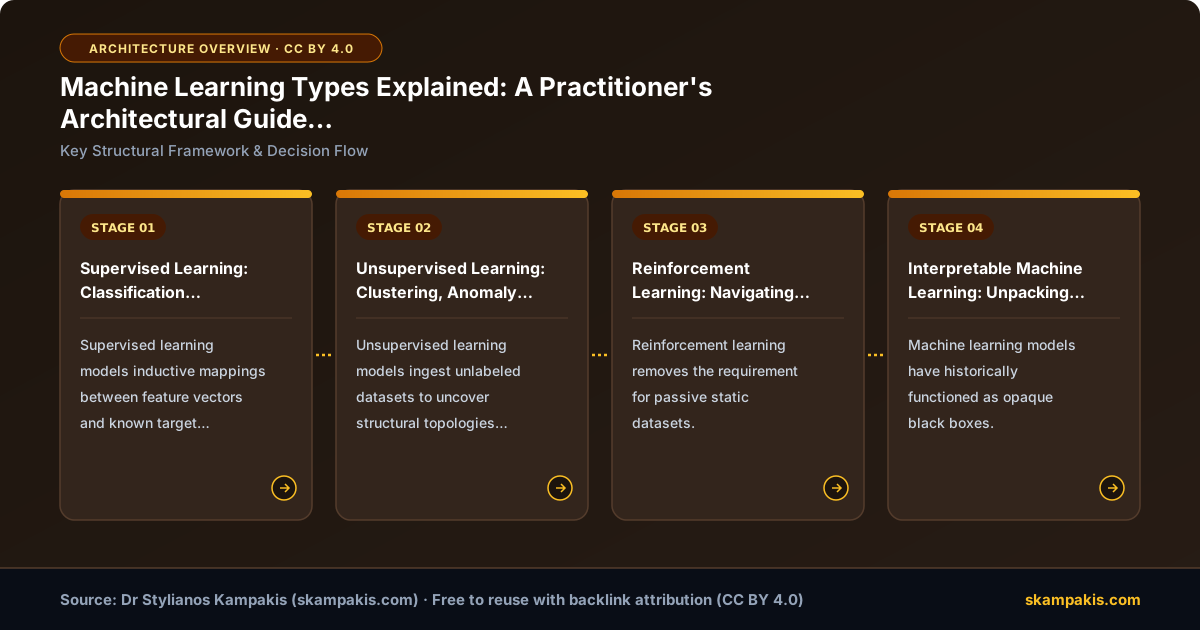
Reinforcement Learning: Navigating Markov Decision Processes
Reinforcement learning removes the requirement for passive static datasets. Instead, an autonomous agent interacts directly with an environment structured as a Markov Decision Process (MDP). At each discrete time step, the agent observes the current environmental state, executes an action selected from an action space, receives a scalar feedback reward, and transitions to a subsequent state.
Unlike supervised pipelines that penalize momentary prediction deviations, reinforcement models optimize cumulative long-term returns. This paradigm underpins dynamic systems like automated trade routing, robotic manipulation, and closed-loop process automation where immediate decisions alter future operational states. For teams exploring sequential telemetry applications, reviewing preventing data collection problems in telemetry pipelines illustrates how time-series data streams integrate with autonomous industrial monitoring.
Interpretable Machine Learning: Unpacking the Black Box
Machine learning models have historically functioned as opaque black boxes. Architectures configured strictly for high predictive capacity, such as deep neural networks or gradient-boosted ensembles, naturally obscure the internal logic driving specific inferences. High-stakes enterprise deployments require transparency to satisfy governance and risk standards.
Modern interpretability relies on three primary frameworks:
- Surrogate Decision Models: Training an intrinsically interpretable shallow decision tree directly on the predictive outputs of an uninterpretable deep neural network. The resulting tree mirrors the complex model’s global boundaries, allowing non-specialists to inspect critical feature thresholds.
- Local Interpretable Model-Agnostic Explanations (LIME): Perturbing individual input vectors locally to construct an interpretable linear boundary around a single inference. In text classification tasks separating discussions on atheism from Christianity, LIME identifies the exact keywords that sway categorical assignment.
- Game-Theoretic Shapley Values (SHAP): Calculating marginal feature contributions across all potential feature permutations based on cooperative game theory, as formalized by foundational research published via the ACM Digital Library on Unified Approaches to Interpreting Model Predictions. SHAP provides globally consistent attributions that measure exactly how each metric alters model outputs.
Developing structural model transparency prevents catastrophic edge-case failures. Leaders mapping out complex technical initiatives should review thinking like a data scientist to balance interpretability constraints against raw accuracy targets.
Architectural Execution Roadmap: How to Select and Deploy the Optimal Model Type
Translating theoretical paradigms into production requires a methodical selection workflow. Teams should follow this structured implementation sequence to mitigate technical debt:
- Audit Data Provenance and Target Signal Quality: Catalog available data assets. If clean, verified ground-truth labels exist, prioritize supervised architectures. If labels are absent, costly, or unreliable, construct unsupervised clustering baselines or deploy self-supervised feature extractors.
- Establish Problem Granularity: Determine if business objectives require continuous numerical estimations or discrete directional markers. When dealing with unstructured visual inputs, review choosing an AI project by defining the decision, evidence, and baseline first to verify whether existing foundational models supersede custom pipelines.
- Construct Simple Parametric Benchmarks: Build a straightforward linear regression or shallow decision tree before training dense networks. Baseline models establish the performance floor and highlight initial data sanitation issues.
- Evaluate Interpretability and Governance Overhead: Determine regulatory auditability requirements. If the deployment falls within healthcare diagnostics, credit scoring, or physical infrastructure monitoring, integrate SHAP or surrogate modeling from day one.
- Deploy Shadow Pipelines: Run candidate models alongside legacy systems in production without routing automated actions to their outputs. Compare runtime latency, inference drift, and distribution stability against historical data streams.
Strategic Summary: Machine Learning Types Explained for Engineering Leaders
Navigating the operational realities of machine learning demands precise taxonomy. Supervised models excel at bounded inductive inference when annotated training data is abundant. Unsupervised architectures compress complex distributions and expose structural anomalies across high-dimensional spaces. Reinforcement learning provides the theoretical blueprint for autonomous sequential agents handling fluid environments.
Having the core machine learning types explained enables engineering teams to treat algorithmic components like interchangeable building blocks. By diagnosing enterprise challenges accurately, measuring performance ceilings, and implementing transparent interpretation layers, technical organizations build machine learning systems that deliver consistent, scalable value.
Frequently Asked Questions
What is the fundamental difference between supervised and unsupervised learning?
Supervised learning models train on input features paired with verified target labels, optimizing internal weights to predict continuous values or categorical classes. Unsupervised learning ingests unlabeled datasets to identify latent groupings, dimensional factors, or topological densities without target guidance.
When should a team use classification instead of regression?
Classification should be used when output spaces consist of discrete, qualitative categories—such as routing support tickets, detecting spam, or determining multi-candidate election outcomes. Regression is required when the business objective demands calculating continuous quantities, such as asset pricing, customer lifetime value, or arrival times.
How does LIME explain complex black-box models?
LIME (Local Interpretable Model-Agnostic Explanations) perturbs input features around a single prediction point and observes the resulting shifts in model outputs. It then trains a simple, interpretable linear model locally around that specific instance, isolating which features drove that individual decision.
Why is clustering considered an ill-defined machine learning problem?
Clustering lacks objective ground truth, meaning multiple mathematically valid groupings can co-exist within the same dataset. An algorithm can partition objects equally well by color, geometric shape, or underlying metadata; the validity of the selected cluster distribution depends entirely on downstream business requirements rather than pure mathematical optimization.
To identify early warning signals before algorithmic deployments fail in production, review our analysis on Why Data Science Projects Fail.
For foundational overviews of algorithms and statistical classifications, refer to the Wikipedia Machine Learning taxonomy.
Building Autonomous AI & Data Agents with Python
Hands-on engineering course with ReAct agents, MCP tool integrations, and LangChain/CrewAI production patterns.