

An enterprise data management guide provides business leaders and technical stakeholders with a structured framework to acquire, govern, store, and utilize data assets efficiently across an organization. It bridges commercial objectives and technical infrastructure, ensuring that high-integrity data flows into machine learning algorithms, reporting engines, and operational workflows without regulatory infractions or spiraling infrastructure costs.
Data drives contemporary business value, but deploying algorithmic systems without rigorous data acquisition protocols guarantees operational failure. The foundational axiom of machine learning—garbage in, garbage out—dictates that no mathematical model, regardless of sophistication, can salvage unvetted or misaligned input data. Developing robust enterprise data assets requires treating acquisition not as an ad-hoc ingestion task, but as a core architectural discipline governed by strict commercial and technical parameters.
The Four Pillars of Data Acquisition
Acquiring organizational data requires evaluating trade-offs across four interdependent dimensions before committing capital or engineering resources:
- Appropriateness of the Data: Alignment between variables and business objectives. If a retailer seeks to calculate average transaction sizes for a specific regional outlet, feeding aggregate national figures or customer survey ratings renders the model useless. Missing the correct variables represents the most common reason enterprise analytics initiatives stall.
- Nature of the Data: Inherent noise, bias, and fidelity. Consumer sentiment surveys and polling data invariably introduce respondent and questionnaire design bias. Physical deployments—such as telemetry analyzed when preventing data collection problems in telemetry pipelines—exhibit mechanical sensor drift and physical noise that require algorithmic correction.
- Time Requirement: The latency between real-world events and pipeline ingestion. Data collection velocity determines viability; if market intelligence takes weeks to assemble, market conditions shift before models generate predictions, eliminating operational utility.
- Cost of Acquisition: Total cost of ownership for data access. Ingestion cost scales exponentially with collection speed. Purchasing ultra-low-latency, real-time data feeds routinely costs five times more than post-event datasets while delivering higher error rates due to truncated verification windows.
| Pillar | Strategic Focus | Key Operational Risk | Mitigation Strategy |
|---|---|---|---|
| Appropriateness | Variable relevance to business question | Deploying algorithms against proxy metrics that fail to reflect actual causal factors | Strict schema pre-validation aligned with commercial targets |
| Nature | Noise profile, sampling bias, fidelity | Uncalibrated models outputting distorted predictions based on biased distributions | Algorithmic de-biasing, calibration benchmarks, and sensor cleaning |
| Time | Pipeline latency from capture to compute | Decisions rendered on stale metrics that lag changing market conditions | Decouple real-time actions from batch analytics based on true utility |
| Cost | Financial procurement and ingestion expense | Unsustainable infrastructure overhead exceeding project ROI | Selective latency investments; leverage verified historical batches |
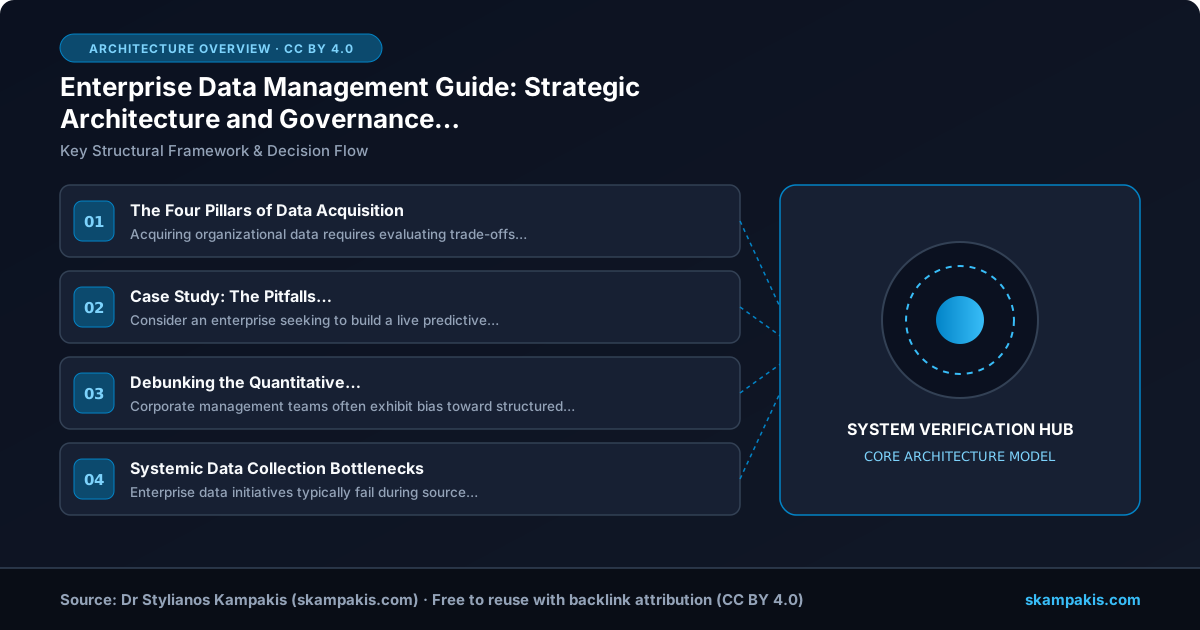
Case Study: The Pitfalls of Real-Time Acquisition
Consider an enterprise seeking to build a live predictive engine for in-play sports wagering. The concept requires real-time automated predictions on in-game events—such as corner kicks or second-half possession—to secure betting margins. While commercially appealing, examining the acquisition parameters reveals immediate structural barriers:
First, the appropriateness of off-the-shelf vendor feeds must provide granular event-level tracking rather than top-line commentary. Second, the nature of sports telemetry entails frequent live human operator errors that skew algorithmic forecasting. Third, the time requirement reveals that standard supplier feeds impose a 5-to-10-minute reporting lag; predictions generated after game states shift provide zero utility. Finally, obtaining genuine millisecond latency inflates the cost of acquisition dramatically, compounding financial burn alongside elevated input error rates.
Conducting this assessment before writing production code demonstrates that post-match batch analytics—though crowded by competitors—is computationally stable and financially sound, whereas real-time execution threatens model viability. Strategic planning requires thinking like a data scientist to validate economic assumptions before building technical pipelines.
Debunking the Quantitative vs. Qualitative Myth
Corporate management teams often exhibit bias toward structured quantitative research, viewing numerical datasets as objectively superior, broader in sample size, and less biased than qualitative artifacts. That belief is fundamentally flawed.
Quantitative questionnaires frequently introduce profound bias through leading inquiries, rigid Likert scales, or deliberate respondent fabrication. Measuring inaccurate variables at scale merely produces high-volume distortion. Conversely, qualitative research uncovers causal motives, customer dissatisfaction points, and contextual drivers that structured surveys miss.
Recent advances in Natural Language Processing (NLP) and computer vision have eliminated historical scalability constraints for unstructured data. When teams deploy why data science projects fail and how to build a high-ROI data culture, deep neural networks programmatically evaluate visual assets, while topic modeling algorithms parse thousands of unstructured customer interactions. Qualitative data is no longer subjective or unscalable; modern compute converts language and imagery into structured, machine-actionable intelligence.
Systemic Data Collection Bottlenecks
Enterprise data initiatives typically fail during source collection rather than model training. Organizations consistently encounter six architectural and administrative failures:
- Unstandardized Data Capture: Manual entry errors or uncalibrated IoT sensors corrupt input streams at the ingestion point, triggering systemic failures under garbage-in, garbage-out conditions.
- Lack of Domain Supervision: Data collection conducted without direct oversight from the project’s Principal Investigator leads to irrelevant metric collection and misaligned analytical schemas.
- Absence of Data Dictionaries: Field definitions left undocumented create architectural blind spots when personnel transition, leading to false assumptions about variable meanings.
- Regulatory Non-Compliance: Storing user identifiers without adherence to frameworks like the General Data Protection Regulation (GDPR) creates severe financial and legal liabilities.
- Siloed Local Storage: Assets sequestered on endpoint machines expose enterprises to catastrophic data loss from hardware theft, failure, or access revocation.
- Unconsolidated Storage Fragmentation: Housing disparate operational tables across isolated platforms prevents automated data pipelines from producing consolidated analytics.
Evaluating Enterprise Data Collection Domains
Enterprise data origins determine schema complexity, interpretability, and regulatory governance requirements across three primary operational domains:
1. Consumer Mobile and Web Applications (B2C Apps): Tracking consumer interactions removes human entry error and provides high-volume behavioural telemetry. However, self-reported registration profiles frequently contain falsified user entries. Furthermore, this interaction data generates semi-structured JSON and XML trees rather than structured relational tables, requiring significant downstream pipeline wrangling before analytical use.
2. Sales Infrastructure (CRM Platforms): Commercial tools and company registers—such as the UK Companies House registry—offer structured operational metrics, including call volume, transaction frequency, and contract value. However, freeform qualitative notes logged by sales representatives are notoriously inconsistent, demanding advanced parsing pipelines to unlock predictive value.
3. Retail Point of Sale (POS) Records: Transaction logs track inventory throughput, margin figures, and unit velocity with absolute interpretability. The primary friction stems from compliance hurdles: identifying consumer habits across physical outlets requires strict pseudonymisation to maintain compliance with consumer privacy regulations.
Implementation Roadmap: From Pipeline to Lakehouse
Translating raw operational data into high-value enterprise assets requires an intentional engineering lifecycle that balances storage cost against computational performance.
- Audit and Identify Canonical Sources: Catalog physical endpoints, relational schemas, and third-party APIs. Eliminate redundant feeds and establish clear operational owners for every data stream.
- Establish Centralized Ingestion Pipelines: Build automated data pipelines that extract semi-structured inputs into raw landing zones, applying automated sanitization before models access the records.
- Converge Storage Architecture: Move beyond fragmented legacy infrastructure. Evaluate unified storage designs where data warehousing analytics and flexible data lakehouse architectures run over a cohesive layer to lower storage costs while preserving query efficiency.
- Deploy a Unified Modern Data Stack: Integrate modern orchestration, distributed storage, and continuous testing frameworks across your modern data stack to surface lineage breakdowns before they impact executive dashboards.
- Enforce Governance and Metadata Catalogs: Institute automated schema validation, centralized data dictionaries, and cryptographic access tiers to protect institutional knowledge from regulatory non-compliance.
Following this enterprise data management guide ensures that capital deployments produce verifiable analytical utility. By addressing data appropriateness, noise profiles, latency, and true ingestion costs upfront, business leaders build durable analytical assets that deliver consistent enterprise ROI.
Frequently Asked Questions
Why do predictive enterprise analytics projects fail most frequently?
Most projects fail because of misaligned data acquisition rather than algorithmic defects. When enterprises ingest unverified, noisy, or lagging inputs, models fall victim to the garbage-in, garbage-out principle, producing distorted business forecasts.
Can modern qualitative data match the analytical rigor of quantitative data?
Yes. Deep learning, topic modeling, and natural language processing allow companies to convert semi-structured text, audio, and visual inputs into structured analytical features. Qualitative data provides causal context that numerical data collections frequently fail to capture.
What is the operational distinction between a data warehouse and a data lakehouse?
A data warehouse stores structured, cleaned data optimized for fast SQL queries and business intelligence. A data lakehouse unifies that analytical performance with the cheap, scalable object storage of a data lake, enabling teams to query both structured tables and semi-structured assets like JSON or imagery within a single platform.
In-House Corporate AI Strategy & Governance Clinics
Bespoke executive clinics led by Dr. Stylianos Kampakis for leadership teams, boards, and division directors.