
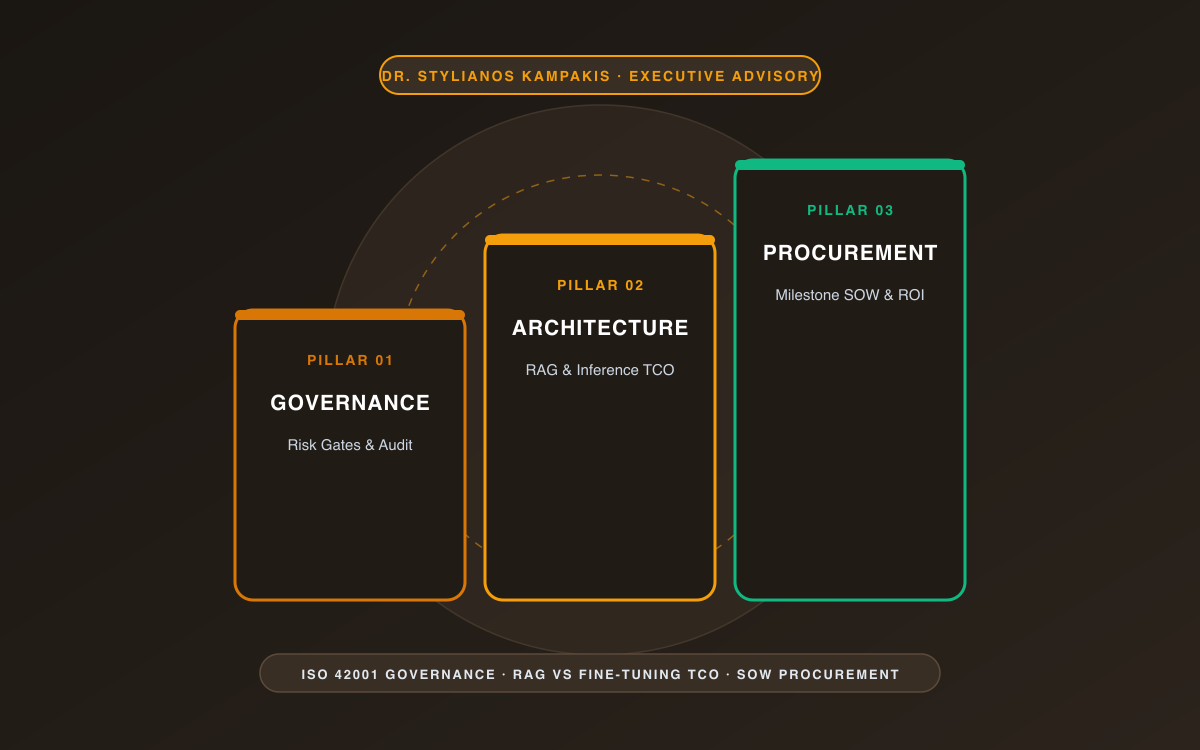
What an AI Strategy Consultant Does
An artificial intelligence (AI) strategy consultant is an advisor who helps organizational leaders assess, plan, and deploy machine learning and automated systems to solve business challenges. Unlike purely technical engineers focused strictly on code execution, an AI strategy consultant links organizational objectives with technological viability, risk management, and regulatory compliance. The consultant translates broad technology goals into actionable roadmaps, ensuring that investments in predictive analytics, natural language systems, or generative AI align with institutional strategy and operational constraints.
Day-to-day advisory tasks draw directly on standard management consulting practices. According to the UK National Careers Service, consultants engage directly with staff, leadership, and operational users to define underlying problems, collect and evaluate operational data, build analytical models to test options, present evidence-backed recommendations, and support organizational transitions during deployment. In the context of AI, this includes choosing an AI project by defining the decision, evidence, and success criteria before the model is built, evaluating whether machine learning is even necessary, identifying technical dependencies, and setting governance structures before procurement or software development begins.
Core Elements of an Enterprise AI Strategy
A resilient AI strategy must be built on established standards rather than experimental vendor demonstrations. According to the UK Government AI Playbook published by the Department for Science, Innovation and Technology (DSIT), effective AI adoption is guided by ten foundational principles. Central among these is verifying that decision-makers know what AI is and what its limitations are, ensuring systems are applied lawfully, ethically, and securely, maintaining meaningful human control at appropriate stages, and applying the right tool for the specific job rather than defaulting to complex models.
Furthermore, guidance from the UK Guidelines for AI Procurement mandates that any technology deployment must sit within a broader corporate strategy. Prior to purchasing or developing technology, organisations must execute thorough data readiness assessments. Addressing data collection problems that ruin machine learning before training begins is critical, because machine learning relies on statistical pattern recognition across large datasets; a lack of accessible, representative, and governed data prevents viable system deployment. An AI strategy consultant establishes data governance mechanisms, manages commercial procurement alignment early, and creates multidisciplinary delivery units encompassing domain expertise, model engineering, commercial operations, and data ethics.
Governance and Risk Management Frameworks
Enterprise AI governance cannot operate as an informal set of aspirations; it requires verifiable controls. The NIST Artificial Intelligence Risk Management Framework (AI RMF 1.0) provides systematic guidance to manage risks and improve the trustworthiness of AI systems across their lifecycle. Structured governance prevents failures associated with bias, output drift, opacity, and security vulnerabilities.
To establish auditable operational compliance, organizations increasingly turn to international management standards. Published in December 2023, ISO/IEC 42001:2023 serves as the first dedicated international standard for an Artificial Intelligence Management System (AIMS). Built on ISO’s standard Harmonized Structure (Clauses 4 through 10), ISO 42001 specifies requirements for leadership accountability, planning, lifecycle management, performance monitoring, and continual improvement. It features Annex A, which contains 38 control objectives spanning nine operational domains, including AI policy, resource allocation, data governance, and third-party supplier management.
A critical requirement of ISO 42001 is the mandatory AI system impact assessment (Clause 6.1.4 and Clause 8.4), requiring organizations to systematically analyze and document potential impacts on individuals, user groups, and society. Major technology vendors—including AWS, Microsoft, and Anthropic—have achieved accredited ISO/IEC 42001 certification. An AI strategy consultant prepares enterprise infrastructure and policies to meet these auditable standards, ensuring alignment with emerging legal frameworks such as the European Union AI Act.
Architectural Trade-offs: Build, Buy, or Partner
A central deliverable of an AI strategy consultant is determining the delivery route for AI capabilities. Organizations face three primary strategic pathways: building custom proprietary models internally, procuring commercial off-the-shelf (COTS) software, or partnering with specialized external systems integrators. Each choice introduces distinct commercial, operational, and data governance tradeoffs.
| Strategic Path | Primary Architectural Profile | Key Governance & Risk Factors | Resource Requirements |
|---|---|---|---|
| Build (In-House Development) | Custom model development and local training infrastructure tailored to proprietary processes. | Full control over intellectual property and data lineage; complete internal accountability for model drift, testing, and ISO 42001 lifecycle controls. | High demand for specialized data science, systems engineering, continuous testing, and computational infrastructure. |
| Buy (COTS & Embedded SaaS) | Subscription to pre-trained commercial models, managed APIs, or enterprise software with embedded AI. | Data leakage concerns, third-party supplier lock-in, reliance on external vendor updates, and limited model explainability. | Lower initial implementation burden; requires commercial management, procurement oversight, and supplier contract evaluation. |
| Partner (Systems Integration) | Co-developed solutions delivered alongside specialized AI consultancies or technology partners. | Complex intellectual property attribution; requires rigorous contractual definitions of responsibility across the supply chain. | Balanced operational split; internal multidisciplinary teams work alongside external domain specialists. |
Procuring AI Expertise: Strategic Checklist
Engaging advisory firms or purchasing specialized AI tools requires structured due diligence. Grounded in the UK Government’s procurement guidance and the ISO 42001 Annex A.10 supplier controls, organizations should use the following checklist when evaluating external AI consulting and engineering partners:
- Data Governance and Readiness Validation: Has the consultant verified data availability, quality, legal access rights, and bias risks prior to proposing technical implementations?
- Multidisciplinary Skill Composition: Does the engagement team include verified domain specialists, data engineers, commercial procurement advisors, and compliance experts?
- Framework Grounding: Are the proposed advisory methodologies aligned with auditable risk frameworks, such as NIST AI RMF 1.0 and ISO/IEC 42001?
- Transparent Accountability and Lifecycle Planning: Does the roadmap account for total lifecycle maintenance—including testing, ongoing monitoring, human oversight controls, and retirement plans?
- Commercial Alignment: Are intellectual property ownership, data sharing limits, and vendor dependency explicitly defined in accordance with standard technology procurement rules?
Routes and Skills Required to Become an AI Consultant
Becoming an AI strategy consultant requires blending core management consulting proficiencies with rigorous analytical knowledge. According to the UK National Careers Service, traditional entry into consultancy happens through undergraduate or postgraduate degrees in business studies, finance, mathematics, science, or management. Advanced qualifications such as a Master’s in Business Administration (MBA) or specialized analytical postgraduate degrees provide foundational knowledge.
Alternative pathways include Higher Apprenticeships (Level 4 Junior Management Consultant) or Degree Apprenticeships (Level 6 Chartered Manager), which combine operational industry placement with academic study over two to four years. Professionals also transition directly into advisory roles after accumulating technical experience in IT delivery, project management, or systems architecture.
The core competencies for advisory success include analytical thinking, computer literacy, structured communication, and the capacity to guide strategic decisions. Practitioners often pursue formal recognition through bodies such as the Institute of Consulting or the Chartered Management Institute to validate their professional consulting expertise across client engagements.
Frequently Asked Questions
What is the difference between an AI strategy consultant and a data scientist?
A data scientist focuses primarily on mathematical modeling, statistical coding, data preparation, and algorithmic system construction. In contrast, an AI strategy consultant operates at an organizational level, evaluating commercial viability, determining build-or-buy choices, setting up governance under frameworks such as ISO 42001, and ensuring that technological solutions directly resolve strategic enterprise problems.
What role does generative AI play in strategic consulting?
Generative AI consulting focuses on deploying large-scale language and foundation models to enhance organizational productivity and operational workflows. As emphasized in official public sector guidance such as the UK Government AI Playbook, applying generative systems requires strict assessment of accuracy limitations, emerging cybersecurity risks, human oversight mechanisms, and rigorous data protection controls to prevent proprietary data leakage.
How long does an ISO/IEC 42001 implementation take?
Implementing an auditable Artificial Intelligence Management System under ISO/IEC 42001 generally requires between four and nine months, depending on organizational maturity and existing alignment with standards such as ISO 27001. Certification is conducted via a two-stage audit by an accredited external body and remains valid for three years, subject to regular annual surveillance audits.
References
- Guidelines for AI procurement – GOV.UK
- Management consultant | Explore careers | Get careers information and advice
- Artificial Intelligence Playbook for the UK Government (HTML) – GOV.UK
- Artificial Intelligence Risk Management Framework (AI RMF 1.0) | NIST
Enterprise AI Readiness & Maturity Assessment
Benchmark your organization's data infrastructure, AI governance posture, and high-ROI implementation pathways.