
Why Enterprise Learning Is Moving Toward Grounded, Interactive and Governed AI Infrastructure
Generative AI has revolutionized the way that digital learning is financed.
What was once a long process of many hours or even days of instructional writing, design, and assessment design can now be completed in a matter of minutes. One prompt can create an entire lesson, write a summary of a document, design test questions or turn the idea of a prompt into a well-structured instructional module.
The change is important. It also creates an entirely new issue.
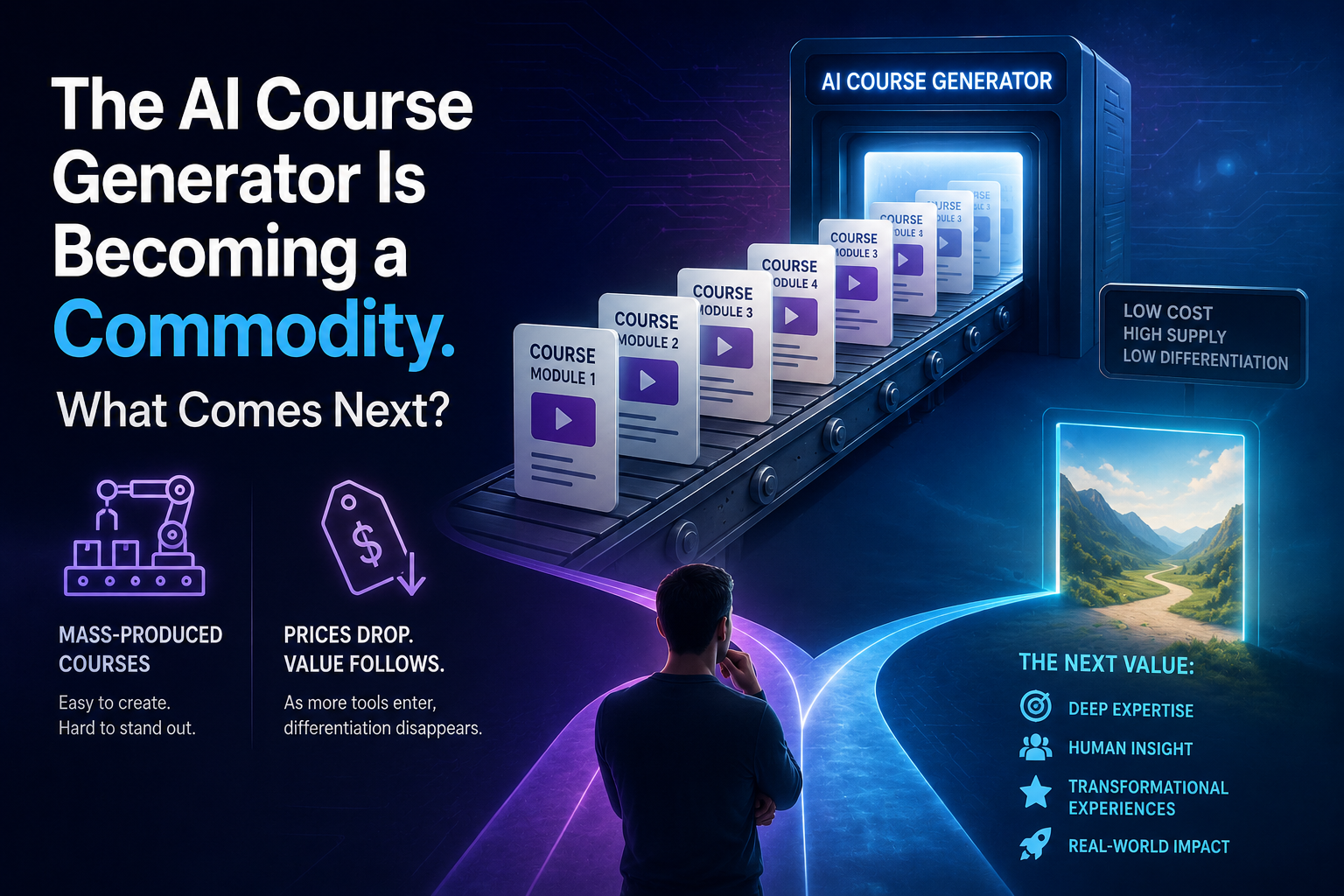
As AI-powered course creation is made available to an ever-growing variety of authoring and learning platforms, the capability to produce content in a hurry is diminishing as an advantage.
The challenge for enterprise learning teams isn’t just:
“How quickly can AI create a course?”
It’s:
“Can we trust what AI creates, control how it is created, turn it into meaningful practice, and manage the entire learning lifecycle at scale?”
It is a transition from AI authoring to AI-native infrastructure.
1. AI Course Generation Is Becoming a Commodity
The fundamental workflow for creating AI-assisted courses is becoming increasingly simple:
Prompt – Generate – Publish
To test prototypes, or drafting a draft, this workflow could be extremely efficient.
A L&D professional can explain the subject and provide an outline. An expert in the subject can create a document and transform into the content of a class. Trainers can make assessments without writing each question.
However, enterprise learning is not always over with the next generation.
Training can be built on internal policies or operational procedures, product documentation and compliance requirements, or even exclusive information. It might need for review from multiple parties before being distributed to employees. It could also have to be reviewed when the data that underlies it changes.
The more the content AI produces, the more crucial these processes are.
Generation is an ability that many platforms are able to provide.
Generation control is now the key factor.
2. Why Generation Speed Is No Longer Enough
A course created by a programmer can look refined, yet be ineffective for business use.
Think about a learning module that is constructed from an old internal document. The AI could produce grammatically correct explanations, beautiful designs and convincing questions for assessment. However, the information it is based on may be inaccurate.
This is why enterprise learning creates challenges that a content generator is unable to handle by itself.
Companies must know:
- Quelles were utilized to produce the material?
- Are those sources affixed?
- Are they still in style?
- Can content generated be edited and reviewed?
- Who was the one who approved that finalization?
- Which version was given to the learners?
- Then what happens when base knowledge shifts?
- How are sensitive corporate information secured?
- Can various AI models be governed in a uniform way?
- Does the learning experience be integrated into current LMS infrastructure?
- What can learner behavior and learning outcomes be quantified?
These aren’t just authoring questions.
They are questions of infrastructure.
The challenge for the enterprise is to move from creating content, to managing the system that surrounds the content.
3. The Enterprise Problem: Trust, Governance and Scale
The more deep AI is integrated into enterprises, the more the need for management.
A company could possess thousands of documents with details that pertain to training. Some of them are up-to-date. Some are not. Some of them are approved corporate policies. Other documents could be drafts and working papers.
In the event that an AI system is able to treat all information available equally The quality of the training it generates becomes difficult to monitor.
This is why the idea of the source in Truth is becoming more and more significant.
Instead of relying on AI to create content from an unrestricted knowledge source Organizations can base their production by establishing controlled information sources.
The aim isn’t to eliminate AI’s creativity. It’s about giving these capabilities a solid base.
A well-managed workflow could be more similar to:
Approved Sources – AI Generation – Human Review – Versioning – Deployment – Measurement
It is quite different from simply entering an instruction into the course generator.
It provides a traceable learning workflow that helps organizations keep a greater degree of control over the results that AI creates and the reasons behind.
Mexty for instance, utilizes an approach known as a Source of Truth approach to embed AI-generated learning content into organization-specific knowledge and minimize the possibility of hallucination. The platform integrates the manual editing process with AI-assisted authoring to keep humans in charge of the learning experience.
4. From Content Generation to Interactive Practice
Another important shift is happening.
AI is not just about making it easier to make content.
It is easier to develop the practice.
The traditional digital learning model is usually based on the same format:
Content – Slides – Quiz
The learner absorbs information, and then responds to questions to show recall.
But many of the workplace skills cannot be effectively learned through the passive consumption of information alone.
Employees could be required to make decisions, deal with difficult conversations, interact with customers, adhere to procedures and identify risk areas or apply their knowledge in difficult situations.
This creates a chance for an entirely different model of learning:
Scenario – Decision – Feedback – Retry – Performance
AI can drastically reduce the amount of effort needed to create these experiences.
A team of trainers can design branches of scenarios where various decisions have different outcomes. Participants can engage in simulations, play with conversations, complete assessments, and receive feedback. They are able to commit mistakes within a secure environment and retry.
Interactivity is as crucial as speed of generation.
The competitive advantage is not just about producing more training.
This is creating more opportunities for employees to get involved from what they’ve learned.
Modern AI-based platforms for learning have a tendency to expand beyond slide and text into branches, simulations adaptive learning routes, assessments, and other formats that are interactive.
5. AI-Native Learning Requires Human Control
It is tempting explain AI as a substitute for instructional designers.
This is a missed chance.
The benefit for AI for enterprise-level learning isn’t necessarily to eliminate human beings from this process. It’s to eliminate the repetitive work of production so that the professionals who are learning can spend more time on strategy for learning and performance, quality, and efficiency.
Human review is particularly important when it comes to safety, compliance, or specific procedures for a company.
A large-scale AI learning system thus requires methods for users to get involved.
The content generated should be easily editable.
Learning teams must be able to read material prior to publication.
Changes must be identifiable.
Different versions must be able to be managed.
Organizations should be able to discern what information was provided to students.
This results in a human-in the-loop model:
AI enhances the creation process. Humans maintain control.
This distinction will become more crucial as AI-generated learning is pushed from the lab to production.
6. Security and Compliance Become Part of the Learning Architecture
Enterprise learning could contain greater levels of information that a standard training program might suggest.
Take a look at the material you will use for:
- employee at the time of boarding
- internal processes
- Procedures for compliance
- intellectual property
- Knowledge of the product
- customer information
- security measures
- sales enablement
- Documentation for operations
Incorporating this data in an AI workflow raises questions about data security privacy, access, access and governance.
Security, therefore, cannot be viewed as a last-minute thought.
The learning infrastructure itself requires proper controls on access to data users, permissions, and AI use.
Mexty declares its platform to be GDPR-compliant as well as EU AI Act ready, with European hosting options as well as controls focused on privacy and responsibly AI use. Mexty states that it doesn’t use the customer’s requests or created content to develop its AI models.
The ISO 27001 and SOC 2 certifications are currently in progress instead of being completed.
For companies, this trend is crucial because compliance is becoming an integral part of AI adoption, rather than the checklist that must be completed following the implementation.
7. Mexty as an Example of Governed AI-Native Learning Infrastructure
Mexty is an example of how this type of category is developing.
Instead of positioning AI solely as a speedier method of creating course content, Mexty combines AI-assisted authoring with interactive learning, LMS capabilities, assessment as well as analytics and governance.
Its methodology brings all the components of the learning cycle in one environment that is connected:
- Sources of Truth to ground AI-generated content
- Interactive authoring with AI
- Simulations and scenarios for branching
- Assessments and learning pathways
- Human review and manual editing
- Versioning and traceability
- LMS has capabilities
- Compatibility with SCORM
- Analytics for the learner
- AI agents
- Multi-model AI support
The importance is not in the amount of features, but rather.
It’s the link between them.
A course may be created by utilizing trusted knowledge, then transformed into an interactive experience assessed by a human and then delivered to students, monitored and evaluated in the same process.
Mexty’s platform can also support SCORM export, allowing companies to distribute learning experiences that they have created via existing LMS environments, rather than having to ask each organization to upgrade its existing infrastructure.
This is a reflection of a larger change in the way enterprise learning technology is developed.
Instead of focusing on the process of authoring, delivery, and analytics as distinct stages that are connected with multiple tools, an AI-based platform can integrate these into a single workflow.
8. What Comes Next for Enterprise Learning?
The next stage of AI in learning may not be based on the person who can create an instruction from an input the fastest.
The capability is quickly becoming commonplace.
The most difficult task is constructing an efficient system based on AI.
Teams of enterprise learning will more often require a system that can address questions regarding:
The foundation: Where did the knowledge originate from?
Governance:
Who is in charge of what AIs can create and use?
Human supervision:
Who is responsible for reviewing and approving the work?
Traceability:
Can the business understand what was produced, altered and the results
Interactivity:
Employees can be trained rather than just consume information?
Security:
What are the ways to ensure that enterprise knowledge and learner’s data secured?
Interoperability:
Does learning work with the the existing LMS infrastructure?
Measurement:
Are organizations able to determine if training has actually changed behavior or increased performance?
These requirements suggest the creation of a new definition for the term “AI learning platform.” AI Learning Platform.
It’s not just an instrument to create courses.
It’s a network that connects the human mind, knowledge, generation, supervision and training experiences and deployment, and evaluation.
Mexty’s AI learning workspace shows this wider direction by bringing AI’s native learning capabilities to a connected learning environment.
The Future Is Not More Content. It Is More Capability.
AI has created content plentiful.
The future competitive advantage will be derived from the entire ecosystem around that generation that is interactivity, grounding, security management, traceability and control by humans.
This doesn’t mean that AI course generation insignificant.
It’s just the beginning.
Future of Enterprise Learning won’t be determined by who creates more courses.
It will be determined by the person who can transform AI-generated content into a trusted capability for the workforce.
This requires something more than a course generator.
It needs a learning infrastructure to accommodate an AI-based future.
Atlas Paragon Small Business Operations & Security Guides
Independent, evidence-backed checklists for small-business software selection, accounting workflows, and security.