

Corporate conferences, executive retreats, and industry summits face intense demand for authoritative commentary on artificial intelligence. However, event planners frequently encounter a crowded marketplace filled with futurists, technology vendors, and theorists whose claims collapse under operational scrutiny. Selecting the right AI keynote speaker requires a disciplined vetting process that balances stagecraft, domain rigor, and strategic relevance.
An impactful keynote presentation moves beyond surface demonstrations to give executive audiences actionable perspectives on capability, enterprise risk, and organizational governance. By examining formal speaking credentials, technical literacy, and empirical grounding, event planners can ensure their selected presenter delivers genuine substance rather than ephemeral buzzwords. Planners can review the AI strategy consultant enterprise governance guide to better align stage briefings with long-term organizational mandates.
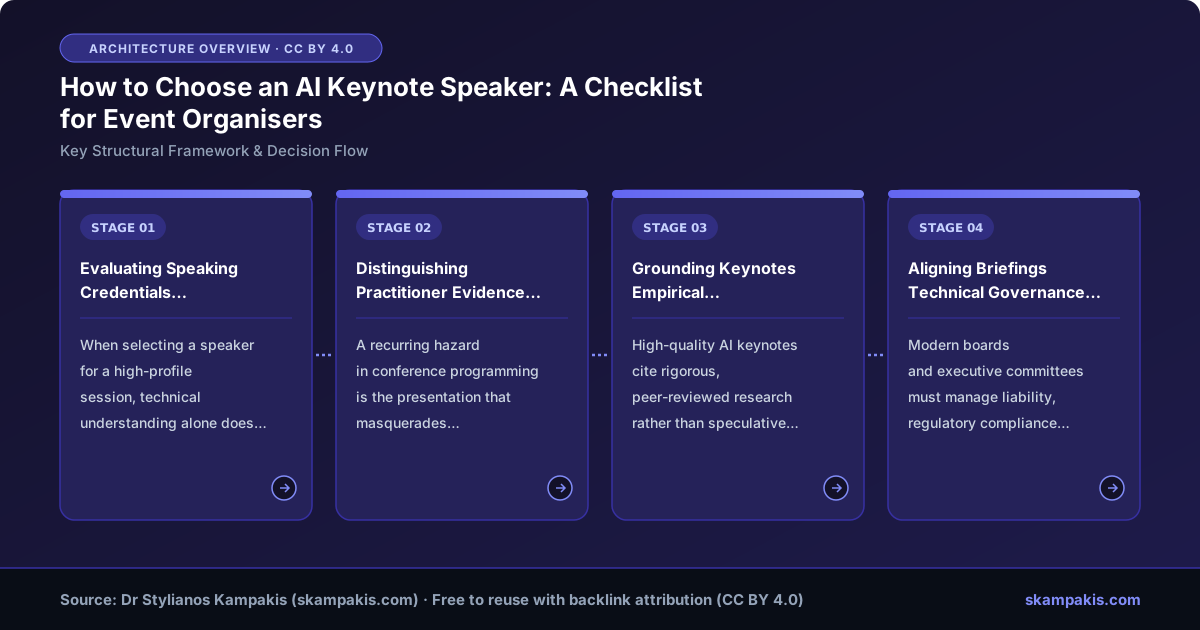
Evaluating Speaking Credentials and Professional Designations
When selecting a speaker for a high-profile session, technical understanding alone does not guarantee a successful presentation. A speaker must also possess the platform mechanics necessary to engage diverse executive audiences. One objective benchmark for stage competence is the Certified Speaking Professional (CSP) designation administered by the National Speakers Association (NSA). According to the National Speakers Association, fewer than 700 speakers worldwide hold the CSP credential, which requires documented proof of professional fee-paid presentations over a five-year period, verified client evaluations, and formal coursework before undergoing rigorous committee review.
Professional designations like the CSP indicate that a presenter understands audience management, pacing, narrative structure, and stage mechanics. Meeting planners often rely on these credentials to confirm a baseline of reliability and audience engagement. However, in technical disciplines like artificial intelligence, speaking credentials must be paired with proven technical domain expertise to avoid polished presentations that lack operational depth.
Distinguishing Practitioner Evidence from Vendor Hype
A recurring hazard in conference programming is the presentation that masquerades as an objective keynote while functioning as a vendor sales pitch. Technology vendors, platform advocates, and sponsored consultants often frame artificial intelligence entirely around proprietary tools, unverified performance statistics, and polished marketing demonstrations. These presentations routinely gloss over integration challenges, ongoing operating costs, and failure modes.
In contrast, practical AI practitioners ground their presentations in verifiable operational constraints. When reviewing prospective keynote speakers, event planners should audit past presentation recordings and writing samples for objective evaluations of both capabilities and limitations. A qualified speaker openly discusses where models degrade, how systems fail in production, and what architectural overhead is required to maintain reliability. Decision-makers can explore the decision-maker guide to thinking like a data scientist to understand how empirical methodologies contrast with commercial sales presentations.
Grounding Keynotes in Empirical Productivity Research
High-quality AI keynotes cite rigorous, peer-reviewed research rather than speculative forecasts. For instance, an evidence-based presenter addressing workplace transformation might cite the field experiment conducted by Fabrizio Dell’Acqua, Edward McFowland, Ethan Mollick, Hila Lifshitz, Katherine C. Kellogg, Saran Rajendran, Lisa Krayer, François Candelon, and Karim R. Lakhani, published in Organization Science in 2026. Studying 758 consultants in collaboration with Boston Consulting Group, the authors examined how knowledge workers interact with large language models.
The study demonstrated the concept of a “jagged technological frontier,” where generative AI capabilities are uneven across tasks of similar perceived complexity. For 18 tasks within the frontier, consultants with AI access completed 12.2% more tasks, finished them 25.1% faster, and produced significantly higher quality output. Yet for tasks deliberately selected outside that frontier, workers utilizing AI were 19% less likely to produce correct solutions. An AI keynote speaker who integrates empirical findings of this caliber provides corporate leadership with an honest, nuanced assessment of workforce productivity dynamics.
Aligning Briefings with Technical Governance Frameworks
Modern boards and executive committees must manage liability, regulatory compliance, and operational vulnerability across their AI portfolios. Keynote speakers must speak with precision about recognized governance architectures rather than offering generic ethical platitudes. Credible speakers are well-versed in established standards bodies and national guidelines.
Key standards that demonstrate a speaker’s regulatory and operational literacy include:
- NIST AI Risk Management Framework (AI RMF 1.0): Published by the National Institute of Standards and Technology as NIST.AI.100-1 in January 2023, this technology-agnostic guidance establishes four core lifecycle functions: Govern, Map, Measure, and Manage. It formalizes seven trustworthiness characteristics, including validity, reliability, safety, security, transparency, explainability, and privacy.
- NIST Generative AI Profile (NIST AI 600-1): Published in July 2024 as a specialized companion profile, this document identifies twelve specific risks exacerbated by generative models, such as confabulation (hallucination), data privacy leaks, harmful bias, intellectual property exposure, and supply-chain vulnerabilities.
- ISO/IEC 42001:2023: The international standard for Artificial Intelligence Management Systems (AIMS), which specifies certifiable governance controls, AI impact assessments, continuous monitoring, and accountability structures across enterprise deployments.
Structuring Actionable AI Briefings for Executive Audiences
Corporate audiences rarely benefit from purely academic recitations of neural network architecture or speculative musings about artificial general intelligence. Executive leaders require strategic clarity: capital allocation priorities, organizational risk management, and workforce development. Event organisers should require prospective speakers to submit detailed session outlines structured around concrete organizational outcomes.
A well-structured AI briefing balances technical fundamentals with commercial execution. It explains the mechanics of model limits without excessive jargon, analyzes regulatory exposure across relevant jurisdictions, and provides frameworks for evaluating vendor claims. Event planners can consult the framework on choosing an AI project by defining decisions and success criteria to see how strategic evaluation precedes technical tooling.
The Event Organiser’s Speaker Evaluation Matrix
To objectively compare prospective speakers across multiple criteria, conference committees can apply a standardized evaluation matrix. The following framework contrasts attributes of high-impact practitioners against common warning signs seen in superficial presentations.
| Evaluation Dimension | High-Impact Practitioner Standard | Superficial / Vendor-Led Indicator |
|---|---|---|
| Empirical Grounding | Cites peer-reviewed studies (e.g., Dell’Acqua et al. on the jagged frontier) and documented failure rates. | Relies on marketing slides, viral social media demonstrations, or unsubstantiated productivity claims. |
| Governance Competence | Frames risks around recognized frameworks (NIST AI RMF 1.0, NIST AI 600-1, ISO/IEC 42001). | Treats risk as an abstract philosophical debate or ignores compliance and audit requirements entirely. |
| Stage Mechanics | Holds proven delivery credentials such as CSP designation or verifiable client reference audits. | Lacks professional delivery discipline, reads text-heavy slides, or overruns stage timing. |
| Commercial Objectivity | Evaluates architecture trade-offs neutrally across open-source, proprietary, and internal tooling. | Frames solutions exclusively around single proprietary software suites or sponsor ecosystems. |
The Complete Selection Checklist
Event organisers can execute this step-by-step checklist during their speaker procurement lifecycle to protect conference quality and maximize audience value:
- Define Audience Maturity: Determine whether the executive cohort requires introductory literacy on technical foundations, regulatory compliance briefings, or deep-dive operational implementation playbooks.
- Audit Unedited Presentation Footage: Request full-length, unedited video recordings of recent stage presentations rather than promotional highlight reels. Assess stage presence, pacing, and responses to unscripted audience questions.
- Verify Technical and Platform Credentials: Check whether the candidate holds recognized speaking credentials such as the CSP alongside verifiable engineering, statistical, or data science backgrounds.
- Review Empirical Citations in Slide Materials: Ask to review draft decks or recent presentation materials. Confirm that claims regarding productivity, model capabilities, and cost efficiency link back to published academic studies or verified enterprise implementations.
- Cross-Examine for Commercial Neutrality: Conduct a discovery call to verify that the presenter does not receive undisclosed sponsorship kickbacks or steer recommendations toward proprietary vendors.
- Mandate Specific Governance Coverage: Ensure the briefing touches upon formal risk structures, explicitly covering confabulation, data privacy, and compliance frameworks such as NIST AI RMF or ISO/IEC 42001.
Frequently Asked Questions
What is the difference between a Certified Speaking Professional (CSP) and an AI subject matter expert?
A Certified Speaking Professional (CSP) is a credential awarded by the National Speakers Association recognizing professional platform performance, documented fee-paid presentation volume, and verified client satisfaction. A technical subject matter expert possesses deep operational and theoretical knowledge in data science and machine learning. The most effective AI keynote speakers combine verifiable domain competence with professional platform craft.
Why is vendor independence critical when selecting an AI keynote presenter?
Speakers employed by or affiliated with specific technology platforms face inherent conflicts of interest. They are often incentivized to promote their company’s proprietary services, downplay architectural weaknesses, and overlook vendor lock-in risks. An independent advisor or researcher provides unbiased evaluations of tooling, architecture, and deployment overhead.
How should an event organiser assess whether a speaker’s presentation will be too technical for executives?
Organisers should evaluate the prospective speaker’s ability to translate complex statistical and architectural concepts into executive-level risk, capital, and organizational frameworks. Reviewing past recordings of presentations delivered to corporate boards or non-technical business leaders reveals whether the speaker can articulate complex technical tradeoffs without descending into impenetrable academic jargon.
Enterprise AI Strategy & Implementation Discovery Call
Scope practical AI workflows, human-in-the-loop governance, and measurable delivery milestones with Tesseract Consulting.