
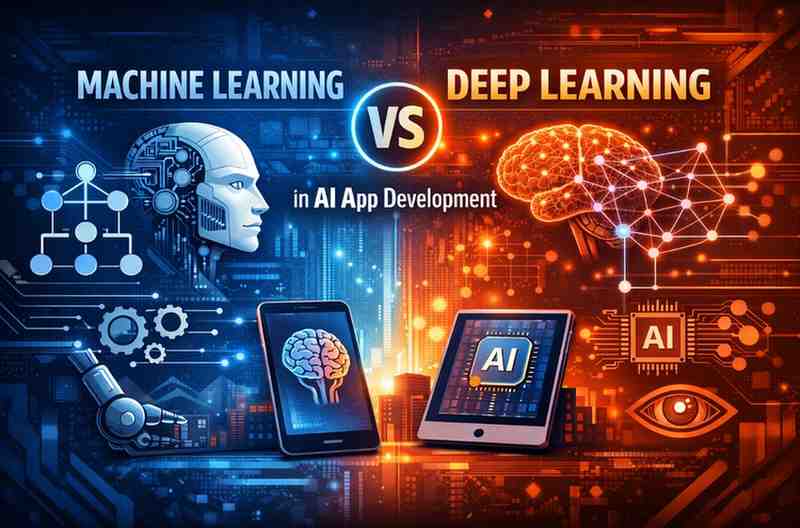
From being a dream-like thought, the Artificial Intelligence technology has transformed into a productive business resource whose systems enable recommendation engines and smart chat programs. And when businesses start investing more and more into intelligent digital products, they come across two terms very often in strategic meetings: Machine Learning and Deep Learning. They are analogous but not identical. Knowing their differences is crucial as organizations get ready to construct intelligent, scalable applications.
If you are an organization seeking to work with an AI app development company (or similar), these technologies deserve proper attention as they help you to make smarter investment decisions. Whether it is Generative AI, Natural Language Processing (NLP), or advanced AI Agent Development systems, it all begins with the decision of selecting between machine learning and deep learning.
In this article, we will delve into their differences and practical applications, as well as development implications, along with guidance on how businesses can ascertain which approach works best for their AI app development strategy.
How Machine Learning is Understood in AI App Development
It is a sub-class of artificial intelligence that allows computer systems to learn from input data and adapt to changes in real time without the need for explicit programming for every case. Rather than writing hard-and-fast rules, developers train models on historical data so the model can recognize patterns and make predictions.
Machine learning is commonly applied in areas such as fraud detection, recommendation systems, predictive analytics, and customer behavior modeling in the development of AI apps. This can be seen in the case of an e-commerce development that uses past purchases and browsing history to suggest products for specific users.
This is usually a structured data and features engineering in machine learning modeling. Feature engineering means picking and transforming the relevant data points that allow for a more effective model learning. It requires careful analysis and often domain expertise. Though it requires a significant investment of time and knowledge, it gives you robust control over how your model parses the input.
Machine learning is generally the first thing that comes to mind for businesses looking to build intelligent systems based on measurable patterns and robust statistical modeling, especially since machine learning algorithms are produced when working with an AI app development company.
Deep Learning: The Concept Explained using AI App Development
Deep Learning, a subfield of machine learning, involves the use of deep neural networks (DNNs) to model complexities in data. These neural networks have many layers and are designed to mimic how the human brain processes information.
Deep learning models automatically recognize patterns from raw data, in contrast to regular machine learning models, which rely on engineered features. That makes them especially strong for images, speech, and other forms of unstructured text.
Deep learning is the building block of many recent AI advancements, such as generative AI content creation models, advanced natural language processing systems that understand human-like text, and intelligent assistants capable of live decision-making.
Deep learning comes into play in AI application development when the applications must understand voice commands, recognize faces, produce text, or process big volumes of intricate data. It makes for high-performance at those tasks, but it also requires greater computational capacity and more extensive data.
An AI software development company that knows what they’re doing first determines if the problem is complex enough to warrant using deep learning, and whether or not you could get results faster and more efficiently with machine learning-based solutions.
Differences between Machine Learning and Deep Learning.
While deep learning is a branch of machine learning, it differs in terms of data requirements, complexity, scalability, and use cases.
Machine learning models are typically well-suited for structured inputs and small datasets. These are often machine-based, using algorithms like decision trees, support vector machines, and linear regression. These models are also easier to interpret, involve less time for training, and require less computational power.
Deep learning is most beneficial for applications that require large datasets and unstructured inputs, such as in audio, image, or text formats. They employ deep learning, using artificial neural networks with many hidden layers that make them more powerful but also more demanding in terms of resources.
Development is much faster in the early stages of a machine learning project (especially, when well defined business problems exist; from that perspective). Deep learning projects tend to take longer due to data processing, infrastructure configurations, or performance optimizations.
For business use cases around AI Agent Development or deploying Generative AI solutions, deep learning is typically a cornerstone, because these systems will need to comprehend context, generate content, and make autonomous decisions.
Hands-on AI App Development With Machine Learning
Machine learning is behind a lot of business use cases today. In fintech apps, it helps recognize unusual transactions by studying spending behaviors. In healthcare platforms, it anticipates patient risks using prior data. In marketing platforms, it segments audiences and predicts campaign performance.
One of the initial steps we follow once companies reach out to Mehula ADMediaTek for AI app development is firmly identifying The Business objective. When the solved problem is related to classification, forecasting, or pattern detection in structured datasets, machine learning can be the most effective solution.
And machine learning models tend to be more transparent. Businesses are able to trace why the decision was made in a formal way, which is critical in industries with regulatory compliance. Such transparency can also render machine learning a safer and more effective option in certain fields.
Another advantage is cost efficiency. While deep learning algorithms tend to need more compute resources, leading machine learning models often will require less processing power, making their deployment and maintenance lower cost, particularly for start-ups and mid-sized companies.
Deep Learning for Modern Applications of AI
Deep learning has revolutionized what is possible within AI systems. It drives voice assistants, image recognition software, automated translation engines, and content generation services. By processing raw data without the need for a manual feature extraction, it has the potential to identify patterns that might be missed by traditional machine learning.
Generative AI is among the most prominent examples of deep learning in action. Text, image, music, or code-generation applications depend heavily on neural network architectures like transformers and generative adversarial networks.
Deep learning has also transformed Natural Language Processing systems. Recent advancements in NLP models allow understanding of context, sentiment,t and intention in human communication, which helps AI-powered chatbots and virtual agents to communicate more naturally with humans.
Many AI Agent Development approaches use deep learning models that integrate perception, reasoning, and action. These intelligent agents can help by interpreting user input, making contextual decisions, and autonomously performing tasks.
But deep learning is a data-hungry and compute-intensive endeavor. It can be computationally expensive and time-consuming to train sophisticated neural networks. This means that one must have a well-thought-out plan before delving into deep learning projects.
Data Requirements and Infrastructure Considerations
Machine Learning vs Deep Learning: Key Differences. One of the key differences between machine learning & deep learning is the data and infrastructure requirements.
With decent amounts of structured data, machine learning models can work very well. They excel when the datasets of history are orderly and characterized. By choosing the right features, development teams can boost performance.
Deep learning only gets better with more data, but that is not always easy to obtain. They flourish on high-volume datasets and typically require GPUs or cloud-based processing environments for model creation and deployment.
For businesses collaborating with an AI software development company, discussion points revolve around planning the infrastructure. Cloud computing platforms, scalable data pipelines, and systems for model monitoring have to be incorporated into the architecture from the earliest stage.
Predominantly, organizations with an approach that overlooks these requirements risk incurring performance bottlenecks or cost overruns at the time of deployment.
Get the Best AI Approach for Your App
Trend should never be the cause to choose machine learning over deep learning, or vice versa. It has to match the business problem, available data, and budget, time,e and resources.
When used with this goal in mind, machine learning will often be faster and cheaper if we are after predictive analytics over structured data. Deep learning is required, for example, if the goal involves image recognition, deep language understanding, or generative content.
A seasoned AI application development firm not only assesses technical viability but also long-term scalability. In other cases, hybrid solutions employ both hands like machine learning for structured scenarios and Deep learning for text/image/sound classification.
The approach usually starts with a detailed analysis of business goals and technical limitations at Mehula ADMediaTek. This ensures that whatever approach has been taken results in proven impact rather than extra complexity.
Generative AI in Modern Development: A Practical Guide
Generative AI has transformed the experiences users have with digital applications. From automated content generation to smart code pen down, its impact is ever-increasing in various industries.
These generative systems are powered by deep learning architectures, most notably transformer models. These AIs leverage these profuse datasets and output what closely resembles human-style creativity and reasoning.
For example, in mobile app development powered by AI, integrating generative AI can enable a higher level of personalization, automated customer support functions, and accelerate product innovation in an organization. But it has also raised concerns about data privacy, content accuracy and computational costs.
They should collaborate very closely with their development partners to instill ethics and responsible AI design and use into the model.
Dealing with Natural Language – Processing and Intelligent Applications
It is imperative for building conversational interfaces and text-based analytics systems. Traditional machine learning and rules were the foundation of early NLP systems, whereas deep learning has taken a central role in modern NLP.
Today’s smart chatbots, voice assistants, and sentiment analysis tools employ neural networks that grasp context and nuance. This has tremendously increased the amount of user interaction and quality.
The second category consists of businesses building AI applications, and this is the one where implementing advanced NLP functionality can improve customer experience. From automated ticket resolution to intelligent search functionality, NLP increases efficiency and personalization.
AI Agent Development and Autonomous Systems
AI Agent Development is the next step in intelligent systems. These agents are more than predictive: they are interactive. They analyze inputs, make decisions, and take actions in real time.
Creating such agents often involves combining deep learning models with reinforcement learning methods. The architecture of these systems always needs to be designed meticulous and constant monitoring is required.
Scalability, security, and real-time processing needs are key requirements for organizations deploying AI agents. A well-defined development roadmap makes sure agents can reliably act in changing worlds.
Emerging Trends In AI App Development
We can expect to see deeper Machine Learning/Deep learning integration in the future of AI app development. Statistics-based systems will be combined with neural networks and other powerful algorithms, which are currently domain-specific.
Edge computing is also on the rise, which allows AI models to process data locally and not on a centralized server. This minimizes latency and improves privacy.
Upon the evolution of regulations towards AI transparency, explainable AI will gain even more momentum. Businesses will require systems not only to execute accurately but also to explain their decisions.
As innovation becomes a growing trend, picking the right development partner is essential. AI app development companies that take the time to understand both what is possible now and how tech trends will impact various industries invest in ensuring that applications remain relevant over the years.
Conclusion
While Machine Learning and Deep Learning are both powerful juggernauts, they serve two distinct purposes within AI app development. Machine Learning is king in structured data land, where you want predictive modeling and interpretability. Deep learning is particularly effective at solving complex, unstructured problems like image recognition or natural language processing and generative systems.
The appropriate option varies by business objectives, data available, infrastructure capacity, and long-term goals. By considering these factors carefully, organizations can develop intelligent applications that provide a tangible impact.
As Generative AI, Natural Language Processing, and AI Agent Development gain traction, the need for expertise in AI software development is on the rise. By working with seasoned partners like Mehula ADMediaTek, businesses can make these technology decisions confidently and create scalable AI solutions that are ready for the future.
Author Bio:-

| Kalpesh Raval is Founder & CEO of Mehula ADMediaTek. I am full of passion for technology and entrepreneurship; I help the company to provide innovation in web solutions, mobile app development, SEO, and digital solutions to clients worldwide. Leading Mehula ADMediaTek, my sight and leadership have made it earn trust in delivering quality execution, breakthrough technologies, and commitment towards client satisfaction, along with building a sense of innovation, collaboration, and sustainability. |
Atlas Paragon Small Business Operations & Security Guides
Independent, evidence-backed checklists for small-business software selection, accounting workflows, and security.