
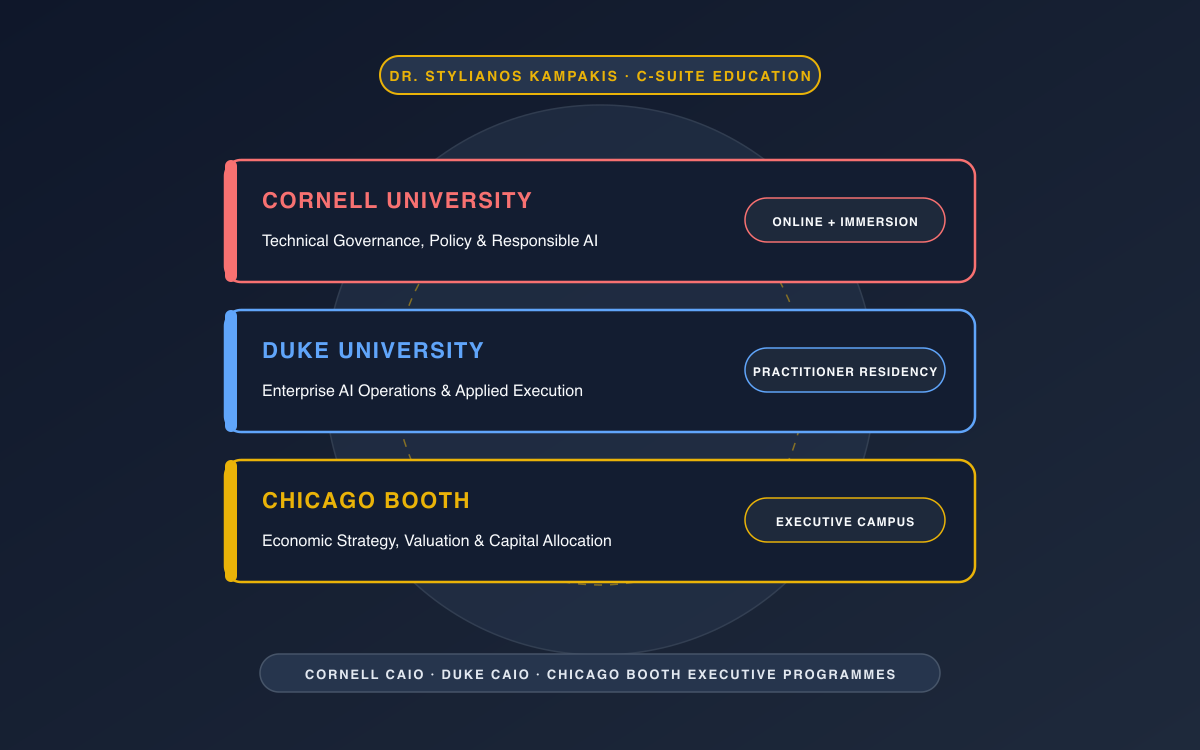
Enterprise adoption of artificial intelligence has shifted from exploratory generative pilots to formal organizational governance, requiring dedicated C-suite leadership. The Chief AI Officer (CAIO) role bridges business strategy, technological infrastructure, and regulatory compliance. To equip senior executives for these responsibilities, premier business and engineering schools have launched specialized executive development tracks. Comparing leading offerings from Chicago Booth, Duke University, and Cornell University reveals distinct variations in curriculum architecture, delivery format, time investment, and financial commitment.
The CAIO Mandate: Governance, Architecture, and Enterprise Alignment
The contemporary Chief AI Officer does not function merely as an advanced engineering lead or a data science director. Instead, the CAIO occupies a strategic nexus responsible for aligning artificial intelligence investments with corporate objectives, establishing enterprise risk frameworks, and driving organizational transformation. Core duties include auditing legacy technical debt, architecting modern data pipelines, prioritizing high-yield use cases, and maintaining cross-functional governance alongside legal, compliance, and cybersecurity stakeholders.
Organizations evaluating whether to appoint a full-time executive or engage external guidance must weigh operational scale against internal maturity. A fundamental responsibility is establishing rigorous qualification protocols when choosing an AI project so that decision criteria and ROI metrics are established before technical investment begins. While large enterprises with complex regulatory requirements benefit from a permanent CAIO reporting directly to the CEO or governance board, smaller organizations often rely on fractional guidance to establish their initial use-case inventories and oversight protocols before committing capital to a dedicated C-suite office.
Chicago Booth Chief AI Officer Program
The University of Chicago Booth School of Business offers its Chief AI Officer Program in partnership with Global Alumni. Designed for senior leaders with at least ten years of managerial experience, this comprehensive program spans ten months and requires an investment of $28,000 USD. Booth delivers the course via a hybrid structure, combining bi-weekly live online sessions held on Tuesday and Thursday mornings with a three-day in-person residency on the Chicago Booth campus.
The curriculum encompasses seven distinct modules led by academic faculty—including Christian B. Hansen, Wallace W. Booth Professor of Econometrics and Statistics, and Roger Moore of the MS in Applied Data Science program—alongside active industry practitioners. The coursework progresses through foundational technical concepts, strategic alignment, and modern data architecture before tackling deployment frameworks (AIOps, xOps, and build-versus-buy trade-offs). Crucially, the governance module equips leaders to operationalize National Institute of Standards and Technology (NIST) and OWASP frameworks, culminating in an applied capstone project that develops an enterprise-grade AI deployment plan.
Duke University Chief Artificial Intelligence Officer Program
Duke University addresses executive AI readiness through a joint initiative between Duke Executive Education, The Fuqua School of Business, and the Pratt School of Engineering, delivered in collaboration with Great Learning. Priced at $25,000 USD, this seven-month program is structured specifically for C-suite and upper-tier executives tasked with navigating capital allocation, board engagement, and workforce change management under competitive pressure.
Duke balances live online delivery with two intensive five-day on-campus immersions in Durham, North Carolina. The learning journey is divided across four macro-modules focusing on strategy, enterprise value creation, and perpetual transformation. A central pillar of the curriculum is the Applied Capstone Project, conducted across six structured sprints ranging from opportunity qualification and failure-mode exposure to final implementation delivery. Duke also integrates dynamic team-building methodologies through its Duke Basketball Signature Experience and subjects participants to multi-round transformation simulations that replicate high-stakes board scrutiny.
Cornell University Chief AI Officer Program
Cornell University provides a focused executive credential in collaboration with XED Institute. With a tuition of $5,400 USD and a duration of six months, Cornell’s program offers an accessible alternative for leaders seeking strategic clarity without extensive multi-week residential requirements. The program centers on sixteen live interactive sessions complemented by small-group working labs.
Led by prominent faculty including Karan Girotra, David Rand, and legal scholar Frank Pasquale, the Cornell curriculum is organized into three core pillars: AI and Underlying Technologies, the AI Opportunity Stack, and AI Transformation and Leadership. Instruction covers foundational machine learning and reasoning models, business model reconfiguration, and organizational defensibility against ecosystem disruption. Participants translate these theoretical insights into a practical deliverable termed the enterprise AI strategy and governance Blueprint, receiving direct faculty feedback on their phased experimentation models and resource architectures.
Comparative Assessment: Curriculum, Modality, and Investment
Choosing an executive program requires matching institutional pedagogical styles with organizational operational realities. While Chicago Booth emphasizes deep technological infrastructure and enterprise compliance, Duke focuses on high-stakes simulations and extended residential immersion, and Cornell delivers concentrated strategic blueprinting.
| Feature | Chicago Booth | Duke University | Cornell University |
|---|---|---|---|
| Academic Units | Chicago Booth Executive Education | Fuqua School of Business & Pratt School of Engineering | Cornell University |
| Delivery Partner | Global Alumni | Great Learning | XED Institute |
| Duration | 10 Months | 7 Months | 6 Months |
| Tuition Fee | $28,000 USD | $25,000 USD | $5,400 USD |
| Format & Residency | Live online + 3-day on-campus immersion (Chicago) | Live online + two 5-day on-campus residencies (Durham, NC) | 16 live interactive sessions + 3 small-group working labs |
| Core Deliverable | Applied Capstone & Board-Level Governance Framework | 6-Sprint Applied Capstone & Strategy Simulation | Comprehensive AI Strategy Blueprint |
| Primary Governance Focus | NIST and OWASP risk frameworks; cross-functional CXO alignment | Pre-deployment risk assessment; board advocacy & capital allocation | Ethical, legal, and regulatory considerations; workflow rewiring |
Hypothetical Worked Example: Executive Track Selection
Consider a hypothetical mid-market logistics enterprise with $400 million in annual revenue seeking to establish an internal AI leadership structure. The company operates distributed freight hubs, maintains legacy operational databases, and faces mounting customer pressure to integrate predictive supply chain algorithms. The leadership team evaluates two internal profiles and their corresponding educational trajectories:
The first candidate, a Senior Director of IT Infrastructure, possesses fifteen years of technical execution experience but lacks formal boardroom exposure and enterprise-level risk credentials. For this profile, the Chicago Booth CAIO Program provides the optimal alignment: its curriculum covers MLOps pipelines and cloud-edge optimization while systematically training the candidate in NIST governance and cross-functional C-suite collaboration over a ten-month runway.
The second candidate, an Executive Vice President of Operations, already leads broad organizational units and interfaces with the board, but requires strategic clarity to evaluate why data science projects fail and where to preserve human judgment across core workflows. Duke’s intensive, on-campus residency model and six-sprint capstone provide this candidate with immediate, pressurized simulations to stress-test capital allocation decisions. Alternatively, if the enterprise opts for a conservative budget, enrolling the operations executive in Cornell’s six-month blueprinting track delivers an actionable implementation roadmap at a fraction of the capital expenditure.
Checklist: Evaluating Enterprise CAIO Readiness
A structured evaluation ensures organizational investments in executive upskilling align with technical infrastructure realities. Before committing capital to an executive CAIO track or formalizing the C-suite office, executive committees should evaluate the following structural prerequisites:
- Governance Board Formulation: Establish an oversight committee incorporating legal, compliance, cybersecurity, and operational leads to define AI decision rights.
- Use-Case Portfolio Inventory: Document and rank existing and proposed AI initiatives using structured scoring models based on return on investment, technical complexity, and regulatory exposure.
- Data Infrastructure Audit: Verify the maturity of enterprise data pipelines, ensuring accessibility, cleanliness, and security protocols satisfy model training and inference requirements.
- Build-vs-Buy Economic Modeling: Formulate clear procurement thresholds that determine when to license commercial models versus engineering proprietary edge or fine-tuned internal solutions.
- Resource Model Scoping: Assess whether internal operational scale justifies a permanent full-time CAIO or if initial strategic needs are better served through fractional leadership paired with structured upskilling.
Frequently Asked Questions
What are the primary admission prerequisites for university CAIO programs?
Programs such as Chicago Booth mandate a minimum of ten years of managerial experience, typically vetting applicants through competitive application processes. Duke and Cornell similarly target seasoned corporate officers, functional vice presidents, and senior technical directors who hold direct operational or strategic responsibility within their firms.
How do capstone projects differ across these institutions?
Chicago Booth centers its capstone on translating technical data infrastructure into an enterprise-ready transformation and governance thesis. Duke utilizes a six-sprint agile structure targeting an operational challenge within the student’s company, complemented by live transformation simulations. Cornell requires participants to construct an actionable AI Strategy Blueprint detailing short-, medium-, and long-term experimentation milestones.
Can fractional leadership substitute for a permanent CAIO?
For mid-market firms navigating early-stage maturity, engaging fractional AI executives allows the organization to establish data governance frameworks, conduct build-versus-buy audits, and prioritize use cases without absorbing recurring C-suite payroll costs. This transitional approach enables executive committees to validate initial project ROI before committing capital to a dedicated, full-time appointment.
References
The comparative assessments in this guide draw directly on official curriculum and program specifications published by the respective academic institutions:
- Chicago Booth Executive Education: Chief AI Officer (CAIO) Program
- Duke University Executive Education: Duke Chief Artificial Intelligence (AI) Officer Program
Enterprise AI Readiness & Maturity Assessment
Benchmark your organization's data infrastructure, AI governance posture, and high-ROI implementation pathways.