

Emerging AI startup companies face an operating environment defined by rapid architectural evolution and mounting enterprise scrutiny. While early cohorts of software providers built thin interfaces around foundation model APIs, modern ventures must navigate multi-step agent orchestration, persistent system integration, and rigorous procurement requirements. For founders, technical leaders, and enterprise buyers evaluating these vendors, viability is no longer measured solely by model capability; it depends on an organization’s ability to demonstrate verifiable system governance, manage autonomous runtime behavior, and establish operational resilience.
As organizations transition artificial intelligence deployments from conversational prototypes to autonomous systems, commercial buyers increasingly mandate compliance with internationally recognized management standards and risk frameworks. To understand the trajectory of modern AI startups, decision-makers must evaluate how these businesses structure their technology stacks, how they align with standards such as the National Institute of Standards and Technology (NIST) AI Risk Management Framework and ISO/IEC 42001, and how they handle the emerging operational liabilities introduced by agentic tools.
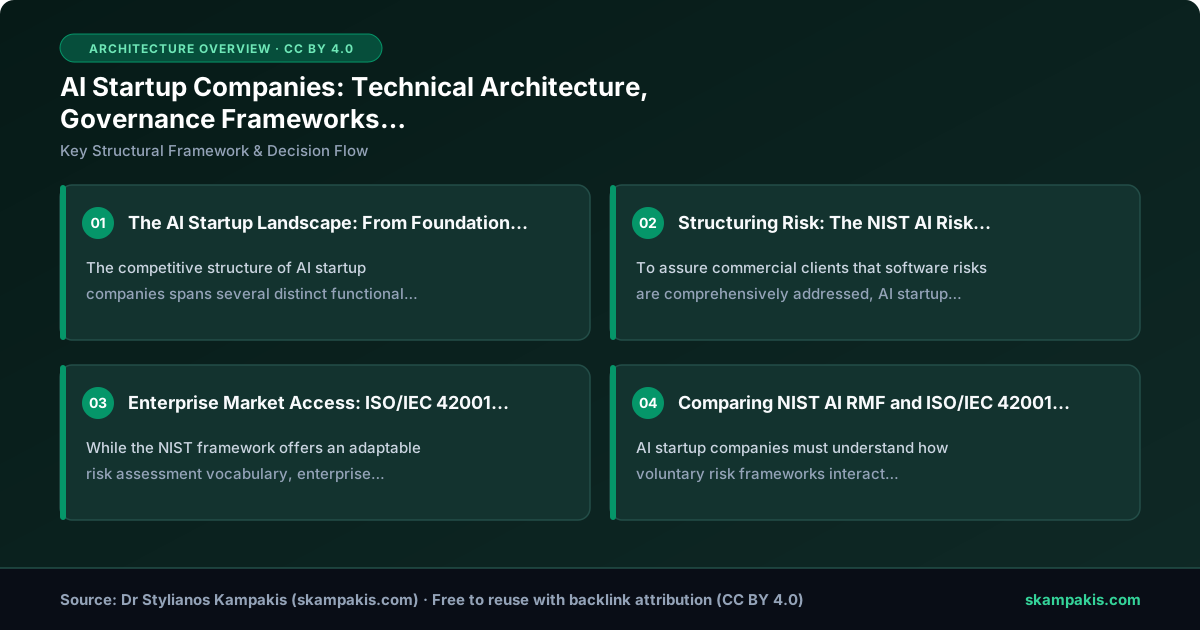
The AI Startup Landscape: From Foundation Layers to Multi-Agent Orchestration
The competitive structure of AI startup companies spans several distinct functional tiers. At the foundation layer, frontier labs and research organizations develop base models that supply core reasoning capabilities. Frontier developers such as Anthropic and OpenAI build foundational model architectures, while major cloud providers including Amazon Web Services (AWS) and Microsoft provide the hyperscale infrastructure and enterprise distribution channels required to serve these models at production scale.
Above the raw model layer, application-focused AI startups build specialized tooling to connect models with proprietary enterprise data and external execution environments. In late 2024, Anthropic introduced the Model Context Protocol (MCP), establishing an open standard interface designed to standardize how AI systems communicate with external tools, databases, and enterprise systems. Within months of its introduction, hundreds of enterprise integrations adopted the protocol to enable structured data interchange between models and operational software.
Simultaneously, multi-agent orchestration frameworks such as LangGraph, AutoGen, and CrewAI have enabled startup teams to move beyond single-turn conversational prompts. By coordinating multiple autonomous agents that divide complex objectives into discrete tasks, delegate subroutines, and execute sequential workflows, startups can automate complex workflows across software engineering, cloud infrastructure maintenance, security operations, and financial transactions. However, this architectural autonomy introduces operational dependencies and failure modes that traditional enterprise software testing was never designed to address.
Structuring Risk: The NIST AI Risk Management Framework (AI RMF 1.0)
To assure commercial clients that software risks are comprehensively addressed, AI startup companies increasingly align their development lifecycles with the NIST Artificial Intelligence Risk Management Framework (AI RMF 1.0). Published on January 26, 2023, by the National Institute of Standards and Technology as NIST AI 100-1, the framework provides voluntary, non-prescriptive, sector-neutral guidance intended to help organizations incorporate trustworthiness considerations into the design, development, deployment, and evaluation of AI systems.
The operational core of NIST AI RMF 1.0 is organized into four interconnected functions that span 19 categories and 72 subcategories:
- GOVERN: Cultivates an organizational culture of risk management, formalizes internal accountability structures, and mandates oversight for third-party AI supply chains and software components.
- MAP: Contextualizes operational risks by defining the AI system’s intended purpose, categorization, organizational constraints, and societal impacts on individuals and groups.
- MEASURE: Deploys rigorous quantitative and qualitative methods, tracking metrics through continuous testing, evaluation, verification, and validation (TEVV) workflows.
- MANAGE: Prioritizes verified risks, plans and implements systematic risk treatment options (mitigating, avoiding, transferring, or accepting), and sustains post-deployment monitoring.
Under the NIST framework, trustworthy AI systems must balance seven interdependent characteristics: validity and reliability, safety, security and resilience, accountability and transparency, explainability and interpretability, privacy enhancement, and fair management of harmful bias. Startups must explicitly navigate trade-offs among these characteristics; optimizing an architecture strictly for explanatory transparency, for example, can occasionally involve trade-offs with predictive accuracy or operational latency.
Enterprise Market Access: ISO/IEC 42001 AI Management Systems
While the NIST framework offers an adaptable risk assessment vocabulary, enterprise procurement teams often demand independently auditable compliance. This need is addressed by ISO/IEC 42001:2023, the first international standard specifically dedicated to establishing, implementing, maintaining, and continually improving an Artificial Intelligence Management System (AIMS).
Published in December 2023 by the International Organization for Standardization (ISO) and the International Electrotechnical Commission (IEC), ISO/IEC 42001 uses the Harmonized Structure common to other management system standards like ISO 27001. Its certifiable requirements reside across Clauses 4 through 10, supplemented by Annex A, which establishes 38 specific controls organized across nine objective areas:
- A.2 (Policies related to AI): Establishing lifecycle-specific organizational policies aligned with broader governance.
- A.3 (Internal organization): Formalizing AI roles, responsibilities, and dedicated channels for reporting AI concerns.
- A.4 (Resources for AI systems): Documenting and inventorying tooling, data assets, compute infrastructure, and human expertise.
- A.5 (Assessing impacts of AI systems): Running structured impact assessments examining consequences on individuals, groups, and society.
- A.6 (AI system life cycle): Governing responsible design, development, verification, and system deployment.
- A.7 (Data for AI systems): Enforcing data quality, provenance, acquisition standards, and lifecycle preparation.
- A.8 (Information for interested parties): Ensuring user transparency, external reporting, and timely communication of incidents.
- A.9 (Use of AI systems): Defining acceptable operational parameters and continuous in-use monitoring.
- A.10 (Third-party and customer relationships): Managing cross-vendor supply chain dependencies and supplier liabilities.
Accredited certification under ISO/IEC 42001 is issued for three-year cycles subject to annual surveillance audits. Large enterprise operators and pioneer AI organizations have moved swiftly to complete certification; AWS achieved accredited ISO 42001 certification in November 2024, Anthropic certified in January 2025, and Microsoft certified enterprise offerings such as GitHub Copilot and Microsoft 365 Copilot. For an emerging startup, formalizing an AIMS provides a recognized, repeatable mechanism to pass enterprise vendor security reviews without negotiating custom security questionnaires for every deal. Technical leaders can further evaluate these deployment dynamics through this detailed guide to enterprise AI governance and procurement.
Comparing NIST AI RMF and ISO/IEC 42001 for AI Startups
AI startup companies must understand how voluntary risk frameworks interact with auditable management standards. Rather than competing against one another, NIST AI RMF and ISO/IEC 42001 serve complementary functions across an enterprise software lifecycle.
| Attribute | NIST AI RMF 1.0 (NIST AI 100-1) | ISO/IEC 42001:2023 |
|---|---|---|
| Publishing Authority | National Institute of Standards and Technology (U.S. Dept. of Commerce) | ISO and IEC (International Standards Organizations) |
| Publication Date | January 2023 | December 2023 |
| Primary Nature | Voluntary guidance and risk management methodology | Certifiable management system standard (AIMS) |
| Structural Architecture | 4 core functions (GOVERN, MAP, MEASURE, MANAGE), 19 categories, 72 subcategories | Harmonized Structure (Clauses 4–10) with 38 Annex A reference controls across 9 domains |
| Audit & Certification | No formal third-party accredited certification mechanism | Third-party certification audits (Stage 1 and Stage 2) valid for 3 years |
| Regulatory Interaction | Referenced in state frameworks (e.g., Texas H.B. 149 defense safe harbor citing the Generative AI Profile) | Directly operationalizes corporate governance requirements resembling EU AI Act expectations |
| Startup Implementation Focus | Establishing internal risk taxonomy, TEVV benchmarking, and operational tracking | Demonstrating documented institutional accountability, supplier controls, and procurement readiness |
NIST maintains crosswalk documents that map AI RMF subcategories directly to ISO/IEC 42001 clauses. Startups that deploy NIST AI RMF as their daily engineering risk assessment process can utilize that documentation to populate the Statement of Applicability (SoA) required during an ISO/IEC 42001 certification audit.
Managing Operational Edge Cases: The Agentic Fitness Gap
As AI startup companies pivot from static classifiers to autonomous agents that invoke tools and execute runtime decisions, they encounter governance challenges that standard baseline frameworks did not fully anticipate. As documented in analysis from the Cloud Security Alliance, original governance models were conceived primarily around conversational assistants or discriminative classifiers, where errors were discrete, contained within a single interface, and visible immediately to a human user.
Autonomous agents introduce a distinct risk profile. When systems possess tool-use capabilities, access external APIs, and execute actions asynchronously, failures can propagate across cascading delegation chains before human operators detect anomalous behavior. Organizations governing agentic systems face three primary structural gaps:
- Lack of Formal Autonomy Tiers: Standard frameworks treat an AI application generating text recommendations identically to an autonomous deployment authorized to execute financial transactions or modify cloud infrastructure. Startups require defined autonomy tiers that govern when autonomous actions are permitted versus when human approval is mandatory.
- Tool-Use Risk Propagation: In an agentic architecture, risks do not stem solely from base model outputs; they emerge from the interaction between model reasoning and external environment tooling. Risks include prompt injection via tool responses, unauthorized privilege escalation, and tool-chain poisoning.
- Runtime Behavioral Drift: Chained agent interactions can accumulate minor reasoning deviations over multi-hour execution windows. Without runtime monitoring across sub-agents, system performance can degrade silently while technically fulfilling downstream API calls.
Addressing these gaps requires startups to implement clear deactivation policies, continuous logging, and automated execution guardrails as core components of their product architecture.
Actionable Governance Checklist for AI Startup Companies
Founders and engineering leaders seeking enterprise adoption must translate governance concepts into daily operational controls. The following checklist synthesizes core controls from NIST AI RMF MANAGE subcategories and ISO/IEC 42001 Annex A requirements:
- Inventory All Tool and Model Assets: Maintain a living registry of proprietary models, third-party foundation APIs, fine-tuning datasets, compute dependencies, and external tool endpoints (aligning with ISO/IEC 42001 Control A.4 and NIST MANAGE 3.2).
- Define Risk Response Protocols: Document clear criteria for mitigating, transferring, avoiding, or accepting identified model risks, explicitly recording residual risks passed downstream to software users (NIST MANAGE 1.3, MANAGE 1.4).
- Establish Kill Switches and Disengagement Triggers: Implement robust mechanisms and assign operational responsibilities to override, disengage, or deactivate AI systems when runtime telemetry reveals behavior inconsistent with intended use (NIST MANAGE 2.4).
- Execute Impact Assessments: Conduct formal system impact assessments documenting potential negative consequences on affected individuals, data privacy, and societal dynamics before pushing features to production (ISO/IEC 42001 Clause 6.1.4 and Control A.5).
- Implement Independent Incident Reporting: Establish dedicated channels for users, employees, and third parties to report safety, privacy, or reliability incidents, backed by formal incident escalation procedures (ISO/IEC 42001 Controls A.3.3 and A.8.3, NIST MANAGE 4.3).
For organizations establishing institutional governance programs, tailoring internal processes to specific business objectives is critical. Founders and enterprise leaders can learn more about Dr Stylianos Kampakis’s advisory background or review AI strategy and data consulting frameworks.
Frequently Asked Questions
Is compliance with NIST AI RMF mandatory for AI startup companies?
NIST AI RMF 1.0 (NIST AI 100-1) is voluntary guidance, not a regulatory statute. However, its adoption is widely treated as a baseline expectation by enterprise technology buyers. Furthermore, certain state legislation—such as the Texas Responsible Artificial Intelligence Governance Act (Texas H.B. 149)—provides legal defenses against civil penalty actions for organizations that discover violations through internal reviews while substantially complying with recognized standards such as the NIST AI 600-1 Generative AI Profile.
How does ISO/IEC 42001 differ from ISO 27001?
While both standards share the Harmonized Structure and follow a Plan-Do-Check-Act cycle, ISO 27001 focuses on information security management systems. ISO/IEC 42001 evaluates the specific risks of artificial intelligence, including model opacity, societal and individual impacts, fairness, bias mitigation, and the management of AI data pipelines throughout the product lifecycle.
What are the primary operational functions in NIST AI RMF?
The NIST framework divides AI risk management into four core functions: GOVERN, MAP, MEASURE, and MANAGE. GOVERN establishes organizational culture and accountability policies; MAP contextually identifies use-case risks; MEASURE applies quantitative and qualitative testing (TEVV); and MANAGE applies risk treatments, continuous post-deployment monitoring, and recovery procedures.
References
Enterprise AI Readiness & Maturity Assessment
Benchmark your organization's data infrastructure, AI governance posture, and high-ROI implementation pathways.