
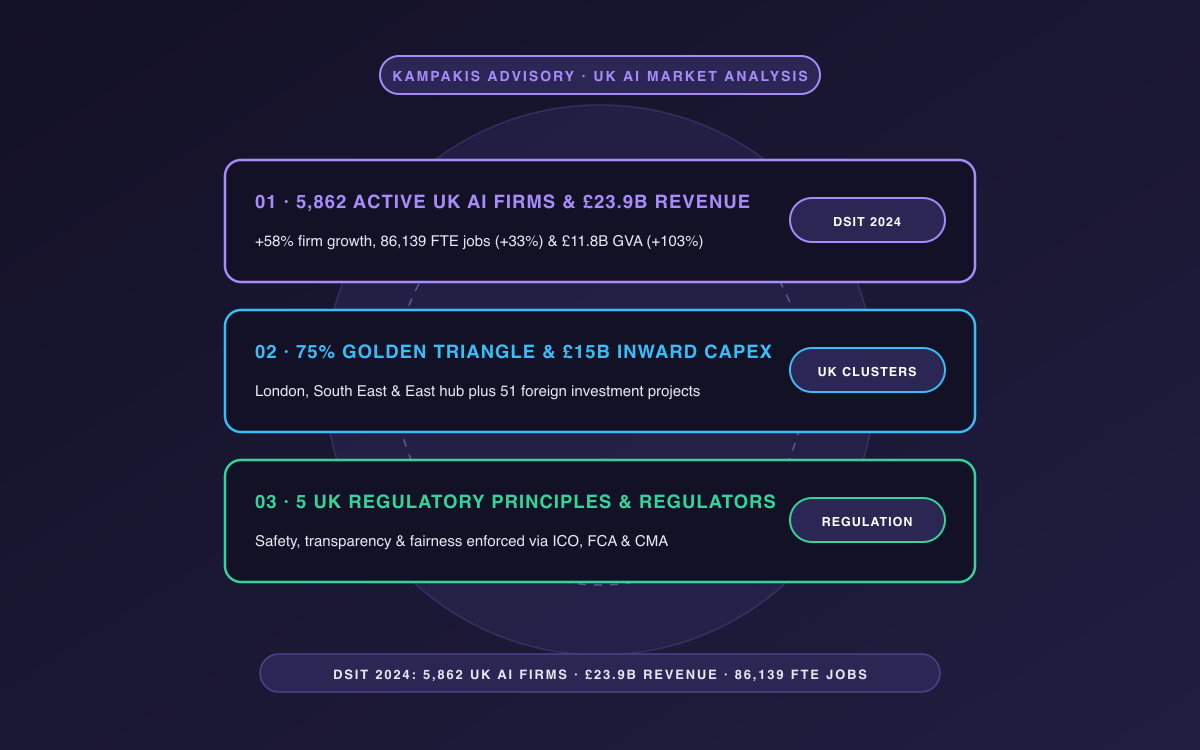
The United Kingdom’s enterprise artificial intelligence ecosystem has transitioned from experimental piloting to structural economic integration. Official research from the Department for Science, Innovation and Technology (DSIT) reveals that the UK AI sector expanded to 5,862 active companies by 2024, generating £23.9 billion in total revenue and contributing £11.8 billion in Gross Value Added (GVA) [1]. For executive boards, enterprise architects, and technology leaders, engaging with artificial intelligence companies across the UK and London requires evaluating market concentration, dependency risks, and a decentralized regulatory environment across financial and professional services.
Macroeconomic Trajectory of Artificial Intelligence Companies in the UK
The scale of artificial intelligence companies in the UK reflects rapid acceleration between 2022 and 2024. According to DSIT’s 2024 AI Sector Study, sector employment increased by 33% year-on-year to 86,139 full-time equivalents in 2024, while total estimated revenue grew by 68% from £14.2 billion in 2023 to £23.9 billion [1]. Dedicated AI firms accounted for £4.9 billion of this revenue, while diversified enterprises integrating AI solutions represented the largest absolute share, generating £9.3 billion of the annual revenue increase [1].
This expansion has been accompanied by a rebound in commercial funding. Dedicated AI companies secured £2.9 billion in investment capital during 2024, supported by an average deal size of approximately £5.9 million [1]. Furthermore, 51 inward foreign investment projects directed more than £15 billion in capital expenditure into the UK ecosystem, creating an estimated 6,500 roles [1]. Enterprise procurement teams can refer to our AI Strategy Consultant: Enterprise Governance, Architecture, and Procurement Guide to navigate capital deployment frameworks and vendor capability assessments.
Empirical Breakdown of the UK AI Sector (2022–2024)
To establish baseline benchmarks for corporate advisory and strategic planning, the table below highlights key performance metrics documented in the national sector studies conducted by Perspective Economics for DSIT [1].
| Sector Metric | 2022 | 2023 | 2024 | 2023–2024 Trend |
|---|---|---|---|---|
| Active AI Firm Count | 3,170 | 3,713 | 5,862 | +58% |
| Total AI Sector Revenue (£m) | 10,600 | 14,200 | 23,900 | +68% |
| Sector Gross Value Added (£m) | 3,700 | 5,800 | 11,800 | +103% |
| AI-Related Employment (FTE) | 50,040 | 64,539 | 86,139 | +33% |
| Dedicated AI Firm GVA (£m) | — | 1,200 | 2,200 | +83% |
Geographic Concentration: London’s Hub and Regional Growth
The geographic concentration of artificial intelligence companies in the UK remains predominantly anchored in the Golden Triangle. London, the South East, and the East of England represent approximately 75% of all registered AI enterprise offices [1]. London maintains a distinct clustering advantage due to its deep capital pools, co-location with multinational enterprise headquarters, and proximity to premier research labs such as Google DeepMind, as well as European engineering footprints for Anthropic, OpenAI, Amazon, IBM, and Meta [1].
Regional dispersion is progressing concurrently across northern and regional corridors. DSIT data indicates that since 2022, the count of active AI enterprises has more than doubled in the West Midlands, North West, East Midlands, Wales, and Yorkshire and the Humber, achieving annualized regional growth rates between 20% and 50% [1]. While London retains commanding dominance in frontier model development and financial AI, regional centers are building specialised technical competencies in manufacturing automation, transport logistics, and health data applications.
Key Verticals: Life Sciences, Financial Services, and Enterprise Tech
Commercial deployment across UK AI firms has shifted toward deep vertical specialization. Beyond horizontal information technology platforms, the largest tranches of capital allocation and product commercialization are concentrated in four domestic industries: life sciences and biotechnology, automotive and transportation, financial services, and healthcare systems [1].
In financial services, enterprise adoption has reached critical mass. A joint review by the Financial Conduct Authority (FCA) and the Bank of England confirmed that 86% of financial institutions now utilize artificial intelligence across regulated activities, fraud prevention, risk modeling, and customer journeys [4]. Startups and enterprise suppliers are increasingly structuring offerings around automated explainability, fraud heuristics, and agentic workflows to satisfy institutional audit demands.
The UK’s Principles-Based Regulatory Architecture
Unlike the European Union’s omnibus cross-cutting compliance regime under the EU AI Act, the UK operates a context-specific, principles-based framework managed through existing sector regulators [2], [3]. Established in the government’s response to the AI Regulation White Paper, the framework directs statutory bodies to interpret five non-statutory principles [5]:
- Safety, security, and robustness: Systems must operate reliably and remain resilient against cyber and operational disruptions.
- Appropriate transparency and explainability: Model outputs, algorithmic logic, and training foundations must be sufficiently interpretable to affected stakeholders.
- Fairness: AI deployments must avoid systemic bias and adhere to statutory non-discrimination and equality protections.
- Accountability and governance: Clear organizational lines of oversight must oversee the entire deployment lifecycle.
- Contestability and redress: Impacted parties must possess administrative channels to question decisions and obtain remediation.
Regulatory oversight is coordinated through the Digital Regulation Cooperation Forum (DRCF), linking the Competition and Markets Authority (CMA), the Information Commissioner’s Office (ICO), the Office of Communications (Ofcom), and the FCA via the AI and Digital Hub advisory pilot [2]. In banking and capital markets, compliance teams must map machine learning and agentic deployments against existing statutory regimes, including the Senior Managers and Certification Regime (SM&CR), the Consumer Duty, Systems and Controls (SYSC), and operational resilience standards [4].
Operational Headwinds: Compute, Foreign Dependency, and Sovereign Capacity
Despite robust revenue projections—with 90% of UK AI businesses anticipating top-line expansion and 58% forecasting growth exceeding 50% over the next 12 months—systemic operational bottlenecks persist [1]. Survey data demonstrates that enterprise operators face acute capacity limits across specialized inputs: 71% report escalating demand for technical skills, 71% require advanced software development infrastructure, and 66% report constraints regarding computational access [1].
Additionally, structural dependencies on external cloud infrastructure and foreign proprietary foundation models present persistent governance risks. DSIT enterprise stakeholder consultations indicate clear dependency concerns regarding non-domestic hyperscalers and foreign large language models (LLMs) [1]. Given the capital expenditure required to train competitive frontier architectures, industry consensus favors targeted international collaboration, strong data privacy guardrails, and specialized domain models over pursuing fully sovereign base model construction [1].
Enterprise Advisory: Technical Evaluation and AI Procurement Roadmap
Corporate decision-makers navigating the artificial intelligence landscape in London and the broader UK market must establish pragmatic evaluation filters. Rather than purchasing generalized foundation tooling, enterprise procurement must assess vendors against verifiable architectural controls:
- Model Residency and Data Protection: Ensure enterprise training data, prompt tokens, and proprietary embeddings remain within designated UK data centers without unmonitored model fine-tuning leakage.
- Third-Party Model Resilience: Map external API providers to regulatory third-party risk management guidelines, establishing fallback models and latency guarantees.
- Auditable Decision Records: Maintain persistent event logs of prompts, tool invocations, and agent actions to fulfill contestability rules under regulatory examinations.
Senior leadership teams structuring long-term implementation programs can consult our AI Strategy Consultant: Enterprise Governance, Architecture, and Procurement Guide to align procurement gates with internal risk appetites and board audit mandates.
Frequently Asked Questions
How many artificial intelligence companies operate in the UK?
According to the 2024 AI Sector Study published by the Department for Science, Innovation and Technology (DSIT), there are 5,862 active dedicated and diversified AI companies operating in the UK, representing a 58% increase compared to 2023 [1]. This total includes early-stage research ventures as well as established corporate enterprises integrating applied artificial intelligence into core operations.
Why is London the primary center for UK artificial intelligence companies?
London, alongside the South East and East of England, houses approximately 75% of UK AI company headquarters [1]. London benefits from deep concentration of venture capital, proximity to global enterprise headquarters, major academic institutions, and leading frontier AI development hubs including Google DeepMind, OpenAI, Anthropic, and Amazon [1].
How does the UK regulate artificial intelligence?
The UK uses a decentralized, principles-based framework rather than a single statutory AI law. Regulators such as the FCA, ICO, CMA, and Ofcom enforce existing legal requirements across five core principles: safety, security and robustness; transparency and explainability; fairness; accountability and governance; and contestability and redress [2], [5].
Which commercial sectors in the UK receive the highest AI investment?
Outside of foundational information technology, the highest levels of dedicated AI investment in the UK flow into life sciences and biotechnology, financial services, automotive and transportation, and healthcare [1]. These verticals feature high-value proprietary datasets and clear institutional pathways for applied operational automation.
References
- Department for Science, Innovation and Technology (DSIT). (2025). Artificial Intelligence sector study 2024. Available at: UK Artificial Intelligence Sector Study 2024
- Department for Science, Innovation and Technology (DSIT) / Perspective Economics. (2025). Artificial Intelligence sector study 2024: Full research report. Available at: UK Artificial Intelligence Sector Study 2024 (Detailed Report)
- Department for Science, Innovation and Technology (DSIT). (2024). A pro-innovation approach to AI regulation: government response. Available at: UK Pro-Innovation Approach to AI Regulation Government Response
- JuLIA Project. (2024). UK, A pro-innovation approach to AI regulation: government response. Available at: https://www.julia-project.eu/database/soft-law/252
- Local Government Association (LGA). (2024). A pro-innovation approach to AI regulation: government response – policy brief. Available at: LGA Pro-Innovation AI Regulation Policy Brief
- UKGI Compliance. (2026). FCA publishes good practice and areas for improvement report: AI in financial services. Available at: https://ukgicompliance.com/fca-publishes-good-practice-and-areas-for-improvement-report-ai-in-financial-services/
- Office for National Statistics (ONS). (2026). Measuring artificial intelligence in the UK economy using a thematic account. Available at: ONS UK AI Thematic Account Methodology
In-House Corporate AI Strategy & Governance Clinics
Bespoke executive clinics led by Dr. Stylianos Kampakis for leadership teams, boards, and division directors.