
Small businesses face increasing pressure to adopt artificial intelligence to automate operations, improve customer engagement, and extract insights from existing data. However, deploying machine learning systems without strategic clarity introduces significant financial and operational risks. Deciding whether to hire an ai consultant for small business initiatives depends on identifying specific operational bottlenecks, evaluating organizational data readiness, and establishing whether an external advisor provides the necessary technical and strategic governance required to navigate complex vendor ecosystems.
As an AI strategy consultant and data scientist, I work with organizations to establish structured data strategies and evaluate technology architectures. For small enterprise leaders, understanding how to engage advisory expertise, how to evaluate consulting qualifications, and how to govern AI implementations according to established standards is critical before committing capital or operational resources.
When a Small Business Needs an AI Consultant
Hiring an external AI advisor is not necessary for every routine software upgrade. Small businesses typically benefit most from external advisory support at distinct inflection points where internal technical expertise is absent or where the cost of an architectural error is high. When evaluating potential applications, leaders must first determine whether their underlying problem requires an artificial intelligence solution or whether conventional automation, database reorganization, or standard commercial software is sufficient.
According to official UK public sector guidance outlined in the Artificial Intelligence Playbook for the UK Government, organizations must adhere to core principles such as understanding what AI is and what its limitations are, ensuring the use of the right tool for the job, and managing the entire AI lifecycle. When an organization lacks the internal capacity to evaluate whether a machine learning model is the appropriate mechanism to address a business need, bringing in an external consultant helps prevent premature capital expenditure on ill-fitting systems.
Engaging advisory assistance is particularly justified under three specific operational conditions:
- Absence of Data Strategy: The business generates operational data across disparate systems but lacks the data governance, hygiene, and pipeline architecture required to support predictive or generative models.
- Vendor and Off-the-Shelf Evaluation: Commercial software vendors increasingly market automated and generative features. An objective consultant evaluates whether these vendor claims match operational realities and security requirements.
- High-Stakes Decision Support: Processes involving automated scoring, sensitive customer data, or regulated workflows require explicit oversight, bias management, and regulatory compliance frameworks.
What an AI Strategy Consultant Does
An AI strategy consultant bridges business operations, statistics, and software architecture. Rather than merely writing software code, a strategic advisor evaluates whether business objectives align with analytical capabilities and guides the enterprise through procurement, system architecture, and risk management.
Day-to-day advisory tasks draw heavily from core management consultancy disciplines. As documented by the UK National Careers Service job profile for management consultants, practitioners in this field speak with staff, management, and operational teams to pinpoint organizational challenges, collect and analyze baseline data, create analytical or computer models to test prospective business solutions, prepare detailed advisory reports, and actively support leadership teams as implementation plans are executed.
When applied specifically to data science and machine learning environments, these operational tasks expand to cover:
- Data Auditing and Readiness Assessments: Reviewing existing databases, transaction logs, and records to confirm whether the enterprise possesses sufficient quality data to train or ground algorithms.
- Technology Architecture Definition: Designing workflows that separate probabilistic components (such as language model interpretation) from deterministic business rules, ensuring business logic remains auditable.
- Governance Framework Alignment: Structuring policies that ensure automated solutions align with relevant industry risk frameworks and commercial standards.
These architectural and governance patterns ensure that automation does not outpace organizational oversight. To explore how technical architecture integrates with enterprise governance structures, consult our detailed AI Strategy Consultant Enterprise Governance Guide.
Understanding Consulting Costs and Commercial Structures
Consulting fee structures vary substantially depending on scope, operational risk, and the engagement model selected. Sourced government procurement standards caution against treating emerging technology engagements as uniform commodity purchases. The Guidelines for AI procurement published by the UK Office for AI emphasize that AI involves continuous learning systems, meaning scoping must account for post-deployment monitoring, iterative testing, and multidisciplinary team inputs rather than fixed, one-time software installations.
Small enterprises typically encounter three commercial pricing models when retaining AI expertise:
- Fixed-Scope Feasibility Audits: Defined advisory sprints focused on assessing existing data pipelines, identifying viable high-ROI use cases, and recommending an architectural roadmap. These engagements carry predictable, upfront project fees and mitigate downside exposure before substantial development investments begin.
- Time and Materials Advisory: Retainer or hourly consulting arrangements used during active implementation, vendor evaluation, or model integration. This structure provides operational flexibility when interfacing with third-party software providers or testing iterative prototypes.
- Milestone-Based Implementation Oversight: Staged contracts tied directly to technical deliverables, such as the successful deployment of a verified verification pipeline, completing compliance audits, or conducting user testing.
Because market rates depend heavily on project complexity and geographic market conditions, small businesses should avoid open-ended time-and-materials contracts without clear deliverables. Establishing commercial constraints early protects working capital while ensuring advisory focus remains tied to measurable operational goals.
Build, Buy, or Partner: Strategic Sourcing for Small Business
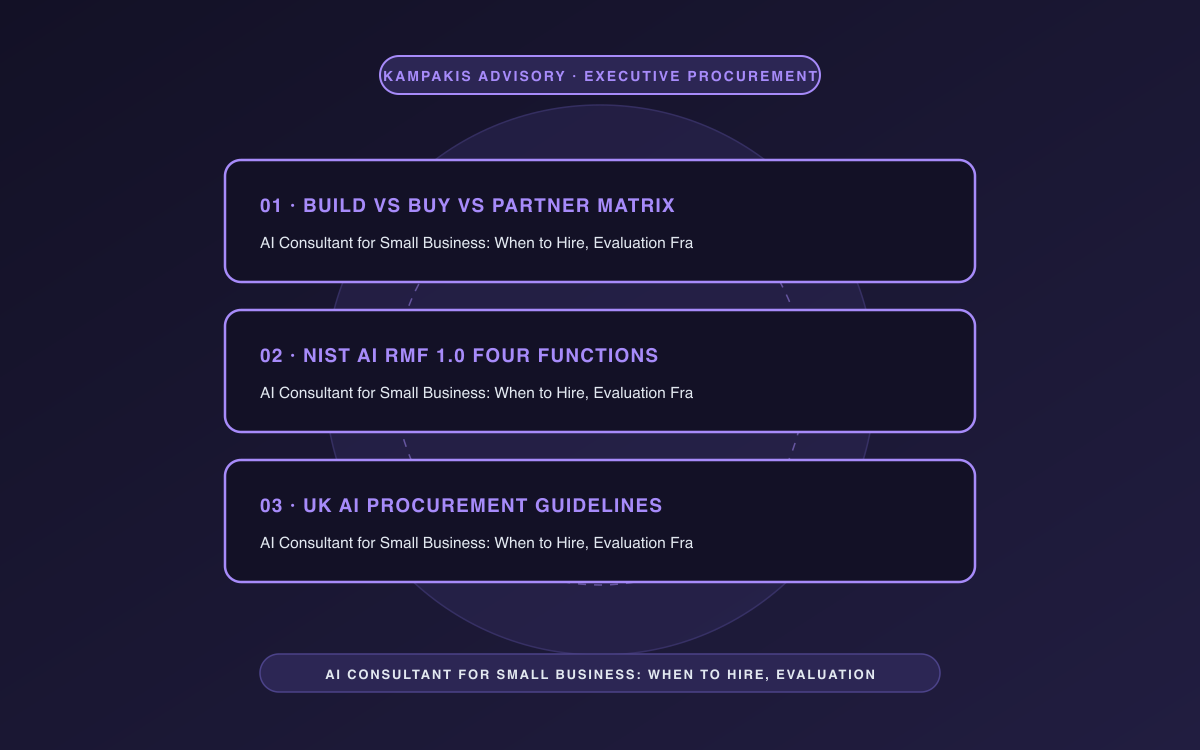
A central responsibility of an AI consultant is guiding small business leadership through the strategic decision to build custom algorithms in-house, buy existing commercial software, or partner with specialized system integrators. Sourced standards note that AI systems can be developed from scratch, acquired off the shelf, or integrated into platforms already deployed across the organization.
For small businesses with constrained operational overhead, building proprietary foundation models from scratch is almost always uneconomical. Instead, sourcing decisions generally center around custom integration versus off-the-shelf software adoption:
- Off-the-Shelf (Buy): Acquiring commercial software with embedded AI functionality (such as modern enterprise resource planning systems or customer service tools). This path minimizes initial engineering expense but requires careful contract reviews regarding data ownership, privacy, and vendor lock-in.
- Configured Solutions (Partner): Working with external technical partners to build proprietary layers over existing APIs or enterprise cloud platforms. This allows the small business to maintain ownership of proprietary domain logic while avoiding infrastructure maintenance overhead.
- Bespoke Development (Build): Developing custom predictive statistical models tailored specifically to proprietary business datasets. This is justified only when the business owns a defensible, proprietary dataset that yields a distinct competitive advantage in its specific market niche.
AI Governance and Operational Risk Management
Deploying AI introduces operational risks that diverge from traditional software, including model drift, unverified outputs, algorithmic bias, and privacy vulnerabilities. Small businesses cannot afford unmonitored deployments that create legal liability or reputational harm.
The standard benchmark for operationalizing trustworthy AI systems is the NIST Artificial Intelligence Risk Management Framework (AI RMF 1.0). Developed by the National Institute of Standards and Technology, the AI RMF 1.0 establishes four core operational functions designed to govern risk across the entire system lifecycle:
- Govern: Establishes cross-cutting culture, organizational accountability, policies, risk tolerance, and clear approval pathways for every deployed AI use case.
- Map: Contextualizes the system by cataloging what process it touches, what data it ingests, what decisions it influences, which stakeholders are affected, and the specific failure modes that could emerge.
- Measure: Implements rigorous evaluation metrics, such as error rates, override frequencies, exception tracking, and reproducibility benchmarks tested against real-world inputs rather than sanitized vendor demonstrations.
- Manage: Details incident response protocols, operational thresholds that trigger manual overrides, system pause capabilities, and ongoing post-deployment monitoring.
NIST AI RMF 1.0 outlines seven key trustworthiness characteristics that organizations must balance: validity and reliability, safety, security and resilience, accountability and transparency, explainability and interpretability, privacy enhancement, and fairness with harmful bias managed. External advisors should assist leadership in establishing these review mechanisms before any system is moved into production.
Comparing Strategic AI Implementation Frameworks
Organizations evaluating AI management, procurement, and risk governance rely on established standards from national and international oversight bodies. Understanding how these standards intersect helps small enterprises choose the right guidance for their immediate operational stage.
| Framework / Standard | Publishing Entity | Primary Focus | Application to Small Business |
|---|---|---|---|
| NIST AI RMF 1.0 (NIST AI 100-1) | National Institute of Standards and Technology (NIST) | Voluntary, socio-technical risk management across four functions: Govern, Map, Measure, Manage. | Provides an operational structure for assessing failure modes, data privacy, model reliability, and human oversight. |
| Guidelines for AI Procurement | UK Office for AI / DSIT | Commercial procurement standards, multidisciplinary evaluation, and supplier assessment. | Serves as a buyer guide for evaluating external AI software vendors, data requirements, and contract terms. |
| AI Playbook for the UK Government | UK Government Digital Service / DSIT | Ten strategic principles for safe, secure, lawful, and lifecycle-managed AI adoption. | Guides decision-making regarding meaningful human control, security vulnerabilities, and right-tool selection. |
Professional Qualifications and Routes into AI Consulting
Because the title of consultant is not universally protected, evaluating the background of an AI advisor requires examining formal credentials, practical technical competence, and verified professional affiliations. As outlined by the UK National Careers Service, professional management consultants enter the field through specialized degree programs in business studies, finance, mathematics, or science, postgraduate study (such as an MBA or advanced quantitative degrees), higher apprenticeships, or direct progression from practical technical roles in IT, business management, and quantitative analytics.
Recognized industry bodies such as the Management Consultancies Association (MCA), the Chartered Management Institute (CMI), and the Institute of Consulting maintain professional standards, including routes to becoming a Chartered Management Consultant. In quantitative and data science disciplines, membership in bodies such as the Royal Statistical Society reflects adherence to statistical rigor, ethical data practices, and continuous professional development.
When assessing an advisor’s background, small businesses should look for demonstrated competence across both technical execution and business strategy. Inquiries into an advisor’s track record, published research, and corporate advisory history can be explored via the Dr Stylianos Kampakis background profile and AI Strategy and Advisory Services portal.
Source-Backed Evaluation Checklist: What to Ask an AI Consultant
Before entering into a commercial agreement with an external AI advisor or technical consultancy, small business executives should conduct a structured interview using principles derived from official procurement and risk management guidelines. Evaluating candidates against proven frameworks ensures that prospective advisors can address governance, architecture, and deployment risks effectively.
- Data Readiness Assessment: How will you evaluate the quality, governance, and potential bias in our baseline operational data before recommending an algorithmic tool? (Ref: UK Guidelines for AI Procurement, Consideration 3).
- Architectural Necessity: Why is a machine learning or generative AI model required for this operational objective rather than deterministic automation or conventional software? (Ref: UK AI Playbook, Principle 6: Use the right tool for the job).
- Governance and Oversight: How does your proposed solution align with the NIST AI RMF core functions (Govern, Map, Measure, Manage) to ensure meaningful human control? (Ref: NIST AI RMF 1.0; UK AI Playbook, Principle 4).
- Commercial and Vendor Independence: Do you receive financial commissions, reseller margins, or referral fees from the software providers, cloud vendors, or platforms you recommend?
- Operational Measurement and Monitoring: What concrete metrics (e.g., error rate, exception frequency, override rates) will we track to ensure the deployed system does not drift over time? (Ref: NIST AI RMF 1.0, Measure Function).
- Multidisciplinary Delivery: How do you ensure domain expertise, data engineering, and operational workflow requirements are integrated into the final solution? (Ref: UK Guidelines for AI Procurement, Consideration 2).
Frequently Asked Questions
What is the difference between an AI consultant and a software developer?
A software developer focuses primarily on writing code, integrating software modules, and maintaining application infrastructure. An AI strategy consultant focuses on operational viability, data readiness, architectural selection, procurement evaluation, regulatory compliance, and aligning technical tools with business strategy.
Can an AI consultant make our small business “NIST AI RMF Compliant”?
No external vendor or consultant can grant a formal “NIST AI RMF certification” because the NIST framework is a voluntary guidance document rather than an auditable legal seal. What an advisor can do is implement the framework’s Govern, Map, Measure, and Manage functions to establish auditable risk governance and document operational controls.
How much data does a small business need before hiring an AI consultant?
A business does not need perfectly curated data warehouses before engaging an advisor. In fact, engaging an advisor to conduct a preliminary data audit can prevent the business from investing in incompatible data architectures. However, the business must possess accessible transaction logs, business records, or operational workflows that can be systematically audited.
References
- UK Department for Science, Innovation & Technology (DSIT), Office for AI. Guidelines for AI procurement. Crown Copyright.
- UK Government Digital Service, DSIT. Artificial Intelligence Playbook for the UK Government. Crown Copyright.
- National Institute of Standards and Technology (NIST). Artificial Intelligence Risk Management Framework (AI RMF 1.0), NIST AI 100-1. U.S. Department of Commerce.
- National Careers Service. Management consultant job profile. UK Department for Education.
Atlas Paragon Small Business Operations & Security Guides
Independent, evidence-backed checklists for small-business software selection, accounting workflows, and security.