
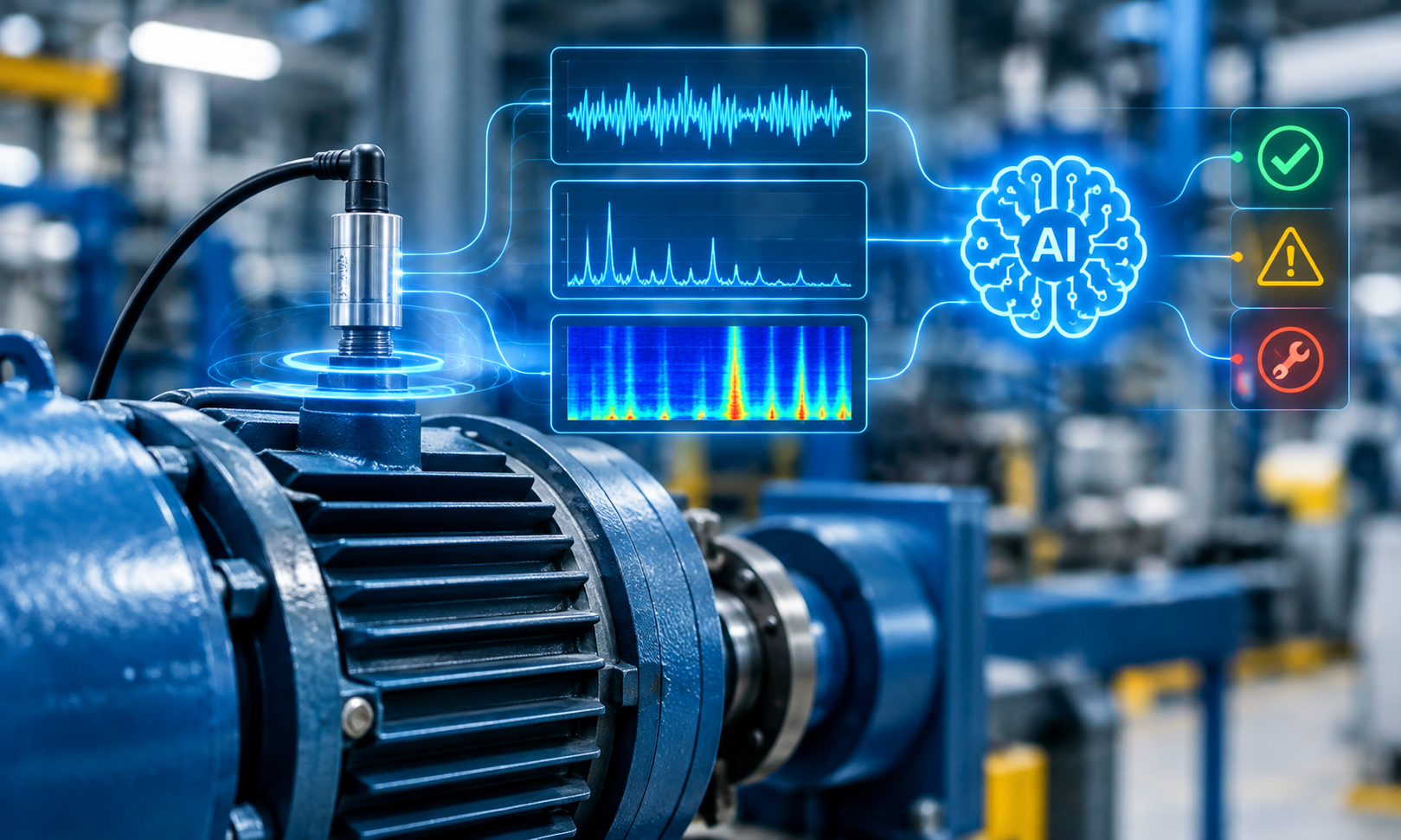
A rotating machine rarely fails without warning. Bearings develop defects, shafts move out of alignment, gears wear, fasteners loosen and rotating components become unbalanced. Long before a machine stops, many of these changes alter its vibration pattern.
That makes vibration one of the most useful measurements in condition monitoring. The difficult part is not collecting a vibration value. It is deciding what to measure, capturing the signal correctly and separating meaningful changes from normal variation in speed, load and operating conditions.
Machine-learning models can help with the last part, but their usefulness depends heavily on the quality of the measurement chain that comes before them.
Vibration data is more than a single number
A vibration sensor records mechanical motion over time. Depending on the sensor and monitoring system, that motion may be represented as acceleration, velocity or displacement.
These quantities describe related motion, but they do not emphasise the same behaviour. Acceleration is particularly useful for higher-frequency components and impacts. Velocity is widely used for overall machinery vibration within defined frequency bands. Displacement is important when shaft movement or low-frequency motion is the main concern.
For predictive maintenance, reducing all of this information to one overall vibration number can hide useful detail.
A bearing defect, for example, may produce short repetitive impacts. Gear damage may introduce components around gear-mesh frequencies and their sidebands. Misalignment can create a different spectral pattern, while imbalance often produces a strong response related to rotational speed.
The time waveform therefore contains information that can be transformed into several forms before it reaches a machine-learning model.
The sensor determines what the model can see
No algorithm can recover information that was never measured correctly. Piezoelectric accelerometers remain common on industrial machinery because they offer good sensitivity across a broad dynamic frequency range. IEPE versions include built-in electronics and are convenient for permanent or semi-permanent monitoring systems where suitable constant-current excitation is available.
MEMS accelerometers solve a somewhat different measurement problem. Many can measure down to DC and cover slow motion and static acceleration as well as vibration within their specified bandwidth. They are also well suited to compact monitoring nodes because signal conversion and digital interfaces can be integrated close to the sensing element.
Eddy-current proximity probes are used when relative shaft displacement is more important than casing acceleration, particularly on certain types of rotating machinery.
Choosing between these technologies requires more than comparing nominal sensitivity. Frequency range, noise floor, maximum acceleration, mounting method, temperature, electrical interface and the actual fault signatures of interest all matter. A useful technical reference on vibration and acceleration sensors covers these differences together with mounting, signal conditioning and acquisition requirements.
The practical point is simple: sensor selection is part of the analytics problem. A model trained on poorly chosen or inconsistently installed sensors starts with incomplete evidence.
Mounting can change the signal
Two identical accelerometers mounted at different points on the same machine can produce substantially different data. The best measurement point normally provides a rigid mechanical path from the component of interest to the sensor. On a motor or gearbox, this often means a bearing housing rather than a thin cover, guard or flexible bracket.
Mounting stiffness also affects high-frequency response. A properly prepared stud mount generally transfers vibration more consistently than a temporary magnetic base or a compliant adhesive interface. Orientation matters as well because an accelerometer measures motion along defined axes.
These details are easy to overlook when attention is focused on dashboards and algorithms. They matter because predictive systems depend on repeatability. If the mounting location, axis or mechanical coupling changes, the resulting distribution shift may look to the model like a change in machine condition.
A maintenance system should therefore record sensor position, orientation, mounting method and relevant acquisition settings as part of the asset configuration.
Sampling and signal conditioning come before machine learning
The electrical signal from a vibration sensor is not automatically ready for analysis. An IEPE accelerometer requires appropriate excitation and input conditioning. A charge-mode piezoelectric sensor requires a charge amplifier or compatible acquisition input. An analogue MEMS sensor needs an ADC with suitable input range and filtering. Digital MEMS devices may perform some filtering internally, but their output data rate and internal filter settings still affect the information available downstream.
Sampling rate is another important choice.
If frequency-domain analysis is required, the acquisition system must sample fast enough for the frequency range of interest. It also needs an anti-alias strategy. Simply increasing the numerical sample rate does not solve aliasing if higher-frequency energy reaches the converter without adequate filtering.
Signal clipping creates another problem. Strong impacts can exceed the measurement range of the sensor or acquisition channel. Once clipping occurs, the shape and spectral content of the waveform are distorted. A machine-learning model may still return a result, but it is analysing a damaged representation of the physical event.
The measurement chain should therefore be treated as one system: sensor, mounting, cabling, conditioning, converter, sampling configuration and processing.
Turning vibration waveforms into useful features
Raw time-series data can be used directly by some models, but many industrial monitoring systems still benefit from engineered features. Simple statistical features include RMS level, peak amplitude, crest factor, variance and kurtosis. They reduce a section of waveform into values that can be compared over time.
Frequency-domain analysis adds another layer. A Fourier transform can reveal components associated with shaft speed, harmonics, gear mesh or other periodic behaviour. Spectral-band energy can then be tracked instead of relying on one overall vibration level.
Envelope analysis is useful when repetitive impacts are buried in other machine vibration. Filtering and demodulation can make bearing-related impact patterns easier to identify.
The right feature set depends on the machine and the failure mechanism. A feature that works well for a rolling-element bearing may be uninformative for another component.
For that reason, feature engineering should begin with knowledge of the equipment rather than with a large generic list of mathematical descriptors.
Baselines are usually more useful than universal thresholds
A vibration level that is normal for one machine can be abnormal for another. Machine size, speed, foundation stiffness, load, drive arrangement and process conditions all influence the measured signal. Even two nominally identical machines can establish different baselines after installation.
Predictive maintenance systems work better when they understand normal behaviour for the specific asset and operating state.
That can involve several baselines rather than one. A pump operating near full flow may have a different vibration signature from the same pump at partial load. A variable-speed motor naturally changes its spectral content as rotational speed changes.
Operating context should therefore be included in the data whenever possible. Speed, load, temperature, process state and production mode can help distinguish a real developing fault from a harmless change in operation.
Where machine learning adds value
Traditional condition monitoring often uses fixed thresholds. These remain useful because they are transparent and easy to validate. They are especially effective where well-established alarm criteria already exist.
Machine learning becomes useful when the normal operating envelope is more complicated.
An anomaly-detection model can learn relationships between multiple features and identify observations that do not fit the established baseline. A supervised model can classify known fault states when enough labelled examples exist. Regression models can estimate degradation indicators or support remaining-useful-life calculations when the available data supports that type of prediction.
In practice, labelled industrial failure data is often limited. Machines are repaired before catastrophic failure, operating conditions change, and historical maintenance records may not map cleanly to sensor data.
This is why anomaly detection is often a practical starting point. Instead of requiring examples of every possible defect, the system learns normal behaviour and flags meaningful deviations for investigation.
The output should not automatically be interpreted as a diagnosis. An anomaly means that measured behaviour has changed. Determining why it changed still requires engineering context.
False alarms are a data problem as much as a model problem
A monitoring system that generates too many alarms quickly loses credibility with maintenance teams. False alarms can originate far upstream from the model. A loose sensor, damaged cable, electrical interference, temporary impact, startup event or unexpected operating mode can all generate unusual data.
Models can also produce unnecessary alarms when the training data does not represent the full range of legitimate machine operation.
Before changing algorithms, it is worth checking whether the measurement itself is stable. Comparing neighbouring sensors, reviewing the raw waveform, checking operating conditions and inspecting the sensor installation can often explain an apparent anomaly faster than retraining a model.
Good predictive maintenance therefore needs both data science and measurement discipline.
Trends usually matter more than isolated readings
Many mechanical problems develop gradually. A single elevated vibration reading may result from a temporary operating condition. A sustained change over days or weeks is more informative, particularly when several independent features move together.
For example, a slowly increasing vibration component combined with rising temperature and changes in motor current may provide stronger evidence than any one measurement on its own.
This is where long-term sensor data becomes especially valuable. Instead of asking whether a measurement exceeds one threshold, the monitoring system can evaluate direction, rate of change and relationships between variables.
Machine-learning models can help identify these multivariable patterns, but the underlying time history must remain consistent. Sensor replacements, changes in gain, different mounting positions or revised filtering settings should be documented so they are not mistaken for changes in the machine.
Edge processing changes how vibration systems are built
Continuous high-rate vibration monitoring can generate substantial amounts of data. Sending every raw waveform to a central server is not always necessary. An edge device can perform filtering, spectral analysis and feature extraction near the machine. It can transmit compact condition indicators during normal operation and retain or upload detailed waveforms when an abnormal event occurs.
This architecture reduces bandwidth requirements and can shorten response time. It is particularly useful for wireless monitoring systems or installations with many measurement points.
The trade-off is that processing decisions move closer to the sensor. Filter settings, window length, feature definitions and event-trigger logic become part of the measurement configuration and must be managed carefully.
If too much information is discarded at the edge, later analysis cannot reconstruct it.
Predictive maintenance starts with measurement quality
AI can detect subtle patterns across large volumes of condition-monitoring data, but it does not remove the need for careful instrumentation. The useful chain begins with a clearly defined measurement objective. The sensor must suit the expected frequency range and environment. Mounting must be repeatable. Signal conditioning and sampling must preserve the information of interest. Operating context must be recorded alongside the vibration data.
Only then does the analytical layer have a reliable basis for learning normal behaviour and identifying meaningful change.
For vibration-based predictive maintenance, better models matter. Better measurements usually matter first.