
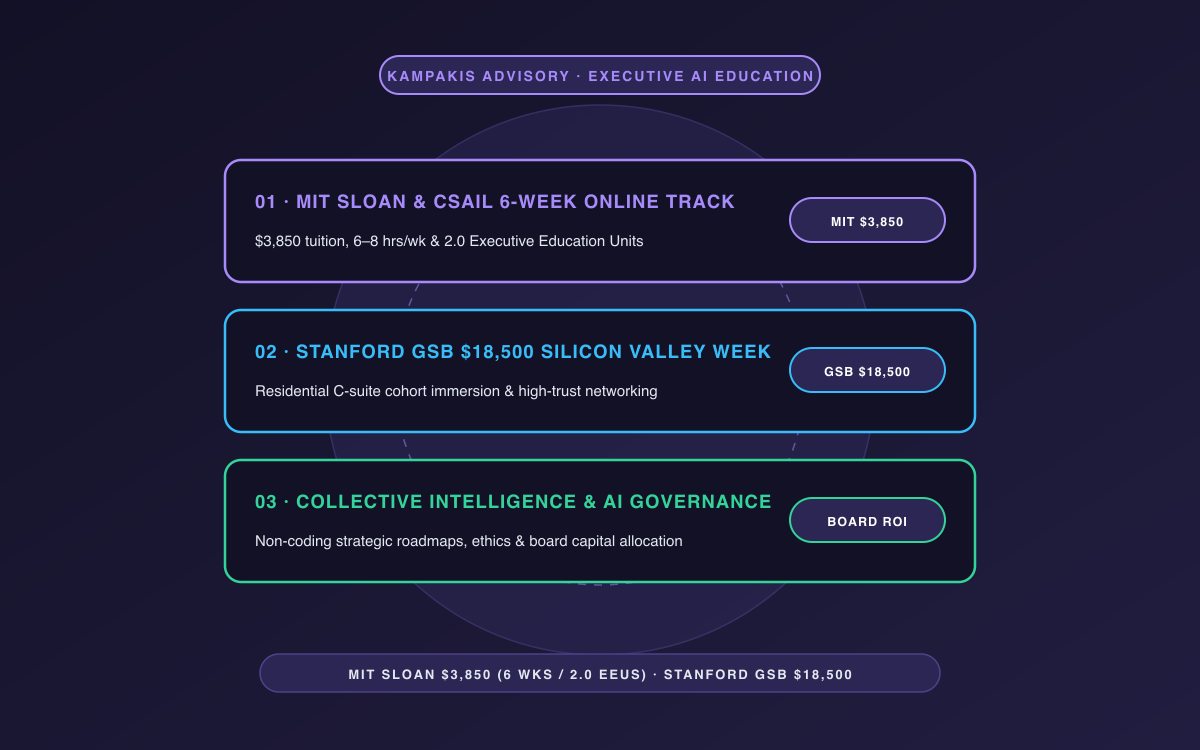
Selecting the best artificial intelligence online course requires senior decision-makers to distinguish between technical coding bootcamps and executive-level strategic education. For business leaders, C-suite officers, and technical managers, the primary objective is rarely writing algorithmic scripts; it is mastering organizational design, evaluating cross-functional integration, and directing capital toward high-leverage deployments. Institutional offerings from top research universities provide structured frameworks to bridge the gap between technical teams and enterprise strategy.
Through strategic insights informed by data strategy research and organizational leadership, this review evaluates the leading executive curriculum available in self-paced digital formats alongside premier residential alternatives, assessing their curriculum depth, executive time commitment, and strategic ROI.
MIT Sloan: Artificial Intelligence: Implications for Business Strategy
Developed jointly by the MIT Sloan School of Management and the MIT Computer Science and Artificial Intelligence Laboratory (CSAIL), Artificial Intelligence: Implications for Business Strategy is designed specifically for managers and senior executives seeking strategic literacy without programming prerequisites. The program approaches machine learning and autonomy through an organizational lens, examining how human-machine collaboration reshapes organizational capabilities.
The course curriculum addresses four foundational technology pillars: machine learning, natural language processing, generative AI, and robotics. Participants evaluate how these capabilities alter enterprise operations, workforce composition, and broader societal dynamics. A core component of the program is an applied individual project in which leaders formulate an actionable AI roadmap tailored to their own enterprise or industry context, translating conceptual frameworks directly into operational strategy.
Delivered completely online through weekly self-paced modules, the program spans six weeks with an expected commitment of six to eight hours per week (comprising four to five core hours and two to three recommended extension hours). Tuition is set at $3,850, and graduates earn an official Certificate of Completion from MIT Sloan alongside 2.0 Executive Education Units (EEUs), which count toward the broader MIT Sloan Executive Certificate track.
Comparative Formats: Asynchronous Online vs. Immersive Executive Seminars
While MIT Sloan offers a flexible online delivery model, executives often weigh self-paced digital learning against intensive, on-campus executive programs. Stanford Graduate School of Business (GSB) operates specialized executive programs that address similar strategic imperatives through immersive, week-long residential formats at a price point of $18,500, including private accommodations and all meals.
For instance, Stanford GSB’s The AI-Powered Organization (directed by Professors Jonathan Levav and Amir Goldberg) concentrates on organizational structure, work redesign, and leading hybrid human-AI teams across finance, operations, and marketing. Similarly, Stanford’s Harnessing AI for Breakthrough Innovation and Strategic Impact (directed by Paul Oyer and Mykel J. Kochenderfer in collaboration with the Stanford Institute for Human-Centered Artificial Intelligence) guides senior leaders through the innovation landscape from generative systems to full autonomy.
For executives balancing operational responsibilities across enterprise initiatives—such as modernization efforts within financial services, analytics hubs, or artificial intelligence in insurance industry workflows—the asynchronous online model provides continuous, iterative learning without requiring a week away from enterprise leadership duties.
Executive Program Comparison
The table below summarizes verified executive programs from top-tier research institutions, comparing delivery formats, duration, pricing, and key focus areas for strategic leadership. Each program reflects a distinct pedagogical approach suited to different operational constraints and executive leadership requirements.
| Program & Institution | Format & Duration | Tuition | Target Audience & Prerequisites | Core Strategic Focus |
|---|---|---|---|---|
| MIT Sloan / CSAIL: Artificial Intelligence: Implications for Business Strategy | Self-Paced Online; 6 weeks (6–8 hrs/week) | $3,850 | Mid-level to C-suite leaders; no technical background required | Managerial frameworks, generative AI, NLP, robotics, individual enterprise roadmap |
| Stanford GSB: The AI-Powered Organization | In-Person (Stanford, CA); 6 days | $18,500 | C-suite, SVPs, GMs, functional leaders; no technical background required | Organizational redesign, hybrid human-AI teams, work restructuring across core operations |
| Stanford GSB: Harnessing AI for Breakthrough Innovation and Strategic Impact | In-Person (Stanford, CA); 6 days | $18,500 | Senior executives, board members, investors; no technical background required | Technological innovation, generative models to autonomy, cross-functional tech team communication |
How to Select the Right AI Course for Your Leadership Role
Determining the right executive program depends on organizational mandate, scheduling constraints, and intended business outcomes. Leaders should evaluate the following structural dimensions before enrolling:
Workload and Schedule Flexibility: Online self-paced programs allow leaders to integrate study into active executive schedules over several weeks. In contrast, residential executive seminars require an intensive, full-time commitment on campus, which offers immersive peer engagement but disrupts ongoing operational oversight.
Practical Application vs. Organizational Renewal: Programs requiring an individual capstone project—such as MIT Sloan’s organizational roadmap—deliver direct business artifacts that can be integrated into immediate strategy planning. This makes online self-paced programs valuable for leaders tasked with immediate roadmapping across distributed teams or functional units.
Technical Depth vs. Governance: Neither executive track requires software development experience. Instead, both prioritize bridging technical teams with executive strategy, ensuring leaders can evaluate vendor proposals, allocate resources effectively, and communicate clearly across engineering and board-level stakeholders, as explored in ongoing executive advisory resources.
Frequently Asked Questions
Prospective executive participants frequently evaluate several core operational considerations before applying. Key questions surrounding technical prerequisites, time commitments, and institutional credentials are addressed below based on official university documentation.
Do executive AI online courses require technical coding experience?
No. Executive-focused programs from institutions such as MIT Sloan and Stanford GSB are tailored for managerial and strategic decision-making. They explicitly state that no programming or computer science background is required. The curriculum emphasizes organizational design, strategic opportunities, and technological capabilities rather than algorithmic syntax.
What is the weekly time commitment for MIT Sloan’s online course?
MIT Sloan’s Artificial Intelligence: Implications for Business Strategy estimates a study commitment of six to eight hours per week over six weeks. This includes four to five hours dedicated to core video lectures, quizzes, and project milestones, with two to three optional hours allocated for non-compulsory extension activities.
What credentials do participants receive upon completion?
Participants completing the MIT Sloan program receive an official digital Certificate of Completion from the MIT Sloan School of Management, along with 2.0 Executive Education Units (EEUs) that can be applied toward an MIT Sloan Executive Certificate. In parallel, participants who attend Stanford GSB executive programs earn an official certificate of completion upon concluding their on-campus sessions.
References
- MIT Sloan Executive Education. “Artificial Intelligence: Implications for Business Strategy.” Course Overview, Schedule, and Tuition Data. Accessed October 2026.
- Stanford Graduate School of Business. “The AI-Powered Organization.” Executive Education Curriculum and Schedule. Accessed October 2026.
- Stanford Graduate School of Business. “Harnessing AI for Breakthrough Innovation and Strategic Impact.” Executive Education Program Details. Accessed October 2026.
Fractional CAIO & Strategic Board Advisory
High-level fractional guidance on AI strategy, IP monetization, and corporate AI governance.