
Running a small business means making every marketing dollar count. Unlike larger companies with dedicated marketing teams and substantial budgets, small businesses need strategies that continue generating results long after the initial investment. That’s why search engine optimization (SEO) has become one of the most valuable digital marketing channels for businesses looking to attract consistent, high-quality traffic without relying entirely on paid advertising.
However, the phrase affordable SEO often creates confusion. Some business owners assume it means finding the cheapest provider available, while others believe quality SEO is always expensive. Neither assumption is entirely true. Affordable SEO is about achieving meaningful business growth through smart investments, efficient strategies, and sustainable optimization, not about spending the least amount of money.
The challenge is that the SEO industry is filled with agencies promising quick rankings, hundreds of backlinks, or guaranteed first-page positions. While these offers may seem attractive, they rarely address what truly matters: generating qualified traffic that converts into customers. Successful SEO isn’t measured by the number of tasks completed each month but by how effectively those tasks improve your online visibility and business performance.
In this guide, you’ll learn what affordable SEO should actually include, how to distinguish genuine value from low-cost shortcuts, and how to invest in strategies that continue delivering results as your business grows.
Why Small Businesses Need SEO More Than Big Brands

Large brands already enjoy advantages that small businesses don’t. They have established reputations, loyal customers, strong brand recognition, and websites that have often accumulated authority over many years. When people search for these brands directly, search engines recognize their popularity and credibility, making it easier for them to maintain visibility.
Small businesses operate under different conditions. Every website visitor matters because each new customer has a greater impact on revenue. Competing solely through paid advertising can quickly become expensive, especially in industries where every click costs several dollars. SEO offers a way to reduce that dependency by attracting potential customers who are already searching for the products or services you provide.
More importantly, SEO compounds over time. A well-optimized page can continue generating traffic, leads, and sales for months or even years without requiring additional advertising spend for every visitor. While paid campaigns stop producing results as soon as the budget ends, strong organic rankings continue working around the clock.
This reflects a principle that experienced SEO professionals understand well: traffic alone isn’t the goal; qualified traffic is. Ten visitors actively looking for your services are often worth far more than one thousand visitors who have no intention of becoming customers.
What Affordable SEO Services Should Include
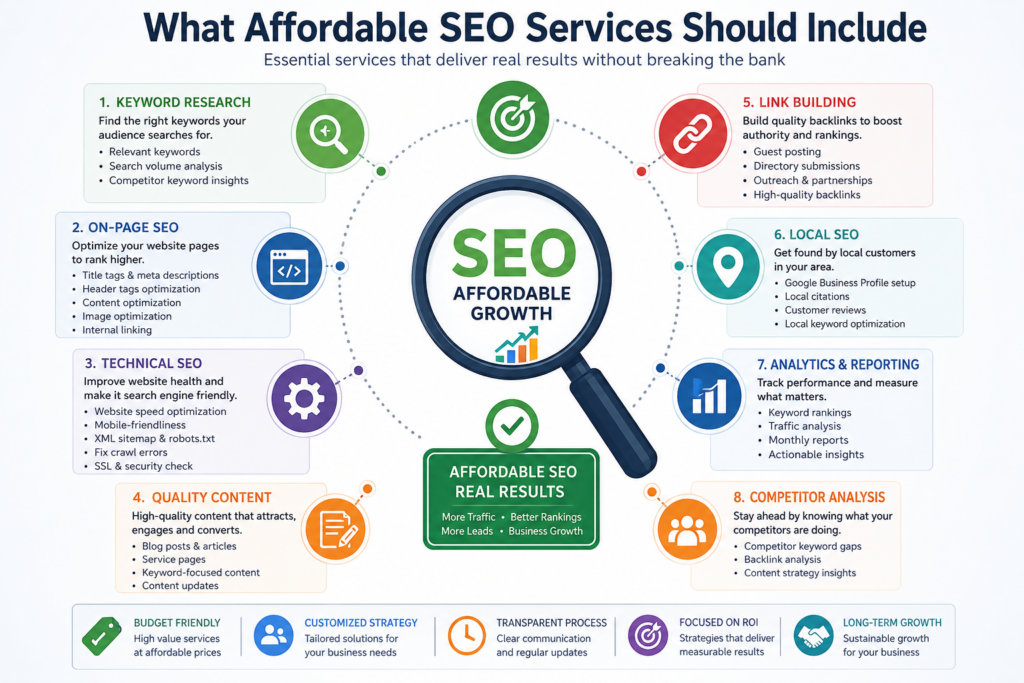
Affordable SEO isn’t about receiving fewer services; it’s about investing in the activities that create the greatest business impact. An effective SEO strategy prioritizes work based on opportunity instead of trying to perform every optimization at once.
Everything begins with keyword research, but not the traditional approach of chasing the highest search volume. Effective keyword research identifies what your ideal customers search for throughout their buying journey. This includes informational searches, comparison queries, local searches, and commercial intent keywords that indicate someone is ready to make a decision.
From there, on-page optimization ensures every important page communicates its purpose clearly to both search engines and users. This includes optimizing titles, headings, URLs, internal links, images, and content while naturally incorporating relevant search terms. Good on-page SEO improves clarity and user experience rather than simply inserting keywords repeatedly.
A strong strategy also includes technical SEO, but many businesses misunderstand its role. Technical improvements such as fixing crawl errors, improving site speed, optimizing mobile usability, implementing structured data, and maintaining a logical site architecture help search engines access and understand your website efficiently. However, technical SEO is not a magic solution. Once a website reaches a healthy technical foundation, additional gains often come from better content and stronger authority rather than endless technical adjustments.
Affordable SEO should also include local optimization whenever location influences customer decisions. Optimizing your Google Business Profile, maintaining consistent business information across directories, encouraging customer reviews, and creating location-specific pages all strengthen local visibility. For service-based businesses, local SEO often delivers one of the highest returns because it targets customers already searching nearby.
Finally, every campaign should include clear reporting. However, reporting shouldn’t focus only on rankings or completed tasks. Businesses should understand how SEO contributes to qualified traffic, leads, phone calls, inquiries, sales, and overall return on investment. Rankings are useful indicators, but business growth remains the ultimate objective.
Affordable SEO vs Cheap SEO: The Difference That Matters

Although these terms are often used interchangeably, affordable SEO and cheap SEO represent two completely different approaches.
Affordable SEO focuses on building sustainable growth through proven optimization practices. It recognizes that businesses have budget limitations and prioritizes the activities most likely to produce measurable results. The objective isn’t to do everything immediately; it’s to do the right things at the right time.
Cheap SEO, on the other hand, often reduces costs by cutting corners. This may involve automated content creation without editorial review, irrelevant backlink campaigns, duplicate content, mass directory submissions, or generic strategies applied to every client regardless of industry. These shortcuts can produce temporary improvements but rarely create lasting business value.
One of the biggest misconceptions in SEO is that poor-quality work always results in an immediate Google penalty. In reality, that isn’t how most unsuccessful campaigns fail.
A more common problem is something experienced professionals sometimes describe as SEO debt. Just as technical debt accumulates in software development, SEO debt builds when websites rely on shortcuts that eventually require expensive corrections. Low-quality content may need to be rewritten, spammy backlinks may require cleanup, poorly organized site structures often need rebuilding, and pages created solely for search engines frequently have to be consolidated or removed.
Businesses end up paying twice: once for ineffective SEO and again to repair the long-term damage.
The most reliable SEO providers don’t sell shortcuts;s they build systems that continue generating value long after the initial optimization work is complete.
How Much Should Affordable SEO Cost?
There’s no universal price for SEO because every business starts from a different position. A newly launched local business has very different needs than an established e-commerce store competing nationwide. Industry competition, website condition, business goals, and the amount of work required all influence pricing, which is why fixed “one-size-fits-all” packages rarely deliver the best value.
Most SEO providers use one of three pricing models:
- Monthly retainers, where the agency continuously optimizes your website over time.
- Project-based pricing for specific objectives like a website migration, technical audit, or content overhaul.
- Hourly consulting for businesses that need strategic guidance instead of ongoing execution.
For most small businesses, a monthly retainer makes the most sense because SEO is an ongoing process rather than a one-time task. Search algorithms evolve, competitors continue optimizing their websites, and new content opportunities appear regularly. Maintaining momentum is often more valuable than completing isolated projects.
Instead of asking, “What’s the cheapest SEO package?”, ask “What work will have the biggest impact on my business?” Two providers may charge the same monthly fee while delivering completely different value. One might spend most of the budget producing reports and low-quality backlinks, while another focuses on improving high-converting pages, building topical authority, and increasing qualified traffic.
The best SEO providers don’t recommend the most expensive package. Instead, they identify the highest-priority opportunities first, helping businesses invest where they’ll see the greatest long-term return.
How to Choose an Affordable SEO Provider
Finding an affordable SEO provider isn’t about comparing prices; it’s about comparing thinking.
Many agencies advertise identical deliverables: keyword research, on-page optimization, content creation, backlinks, and monthly reports. Since these services appear similar on paper, business owners often choose based on price alone. Unfortunately, that’s where many disappointing SEO experiences begin.
What separates an experienced SEO provider isn’t the list of services they offer; it’s how they prioritize them.
A knowledgeable provider starts by understanding your business, target customers, competitors, and revenue goals before discussing rankings. They want to know which services generate the highest profit, which locations matter most, and what type of customers you’re trying to attract. SEO should support business objectives, not operate independently from them.
Transparency is equally important. Reliable providers explain what they’re doing, why they’re doing it, and how success will be measured. They set realistic expectations instead of promising overnight results because sustainable SEO requires consistency, not shortcuts.
It’s also worth reviewing previous work, but don’t focus only on ranking screenshots. Rankings can be influenced by many factors and don’t always reflect business success. Instead, look for evidence of increased organic traffic, improved lead generation, stronger local visibility, or measurable business growth. Those outcomes demonstrate that SEO is supporting real commercial objectives.
Perhaps the most valuable question you can ask any SEO provider is:
“If you had to spend my budget on only three activities during the next three months, what would they be and why?”
Their answer will reveal far more about their expertise than a lengthy list of deliverables.
Affordable Local SEO for Small Businesses
For businesses targeting specific cities or service areas, local SEO is one of the most affordable ways to attract qualified customers. People searching for services nearby usually have higher purchase intent, making local SEO a cost-effective strategy for generating consistent leads without competing in expensive national search results.
Google Business Profile
Google Business Profile is the foundation of local SEO. It helps your business appear in Google Search and Google Maps with accurate business information, business hours, contact details, photos, products, services, and customer reviews. Regular profile updates, posts, and review management improve visibility and customer trust. For most businesses, this should be the first optimization priority.
Average Cost: Free (or \(50-\)200/month if managed by an agency).
BrightLocal
BrightLocal is one of the most popular local SEO platforms for small businesses and agencies. It offers local rank tracking, citation management, Google Business Profile auditing, reputation management, review monitoring, and competitor analysis from a single dashboard.
Average Cost: Approximately \(39-\)79/month depending on the plan.
Whitespark
Whitespark specializes in citation building and local ranking improvements. It helps businesses submit accurate information to trusted directories, discover citation opportunities, monitor local rankings, and improve local search authority.
Average Cost: Citation services typically start around \(20-\)100+ per campaign, while software plans begin at approximately $20/month.
Localo
Localo is designed specifically for Google Business Profile optimization. It provides optimization recommendations, keyword tracking, competitor monitoring, AI-powered suggestions, and performance reporting, making it ideal for businesses focused primarily on Google Maps visibility.
Average Cost: Around \(29-\)99/month.
Affordable Agencies Worth Considering
Several well-known agencies provide strong local SEO services while offering good value for the quality delivered. WebFX is widely recognized for its comprehensive local SEO solutions and transparent reporting. HigherVisibility is a trusted choice for local businesses looking for scalable SEO campaigns, while Thrive Internet Marketing Agency is known for offering affordable local SEO packages that combine Google Business Profile management, on-page optimization, citation building, and monthly performance reporting.
For most small businesses, investing in affordable local SEO before expanding into national SEO is the smarter strategy. It builds local authority, attracts qualified customers, generates measurable revenue, and creates a strong foundation for long-term organic growth.
Common SEO Mistakes That Waste Small Business Budgets
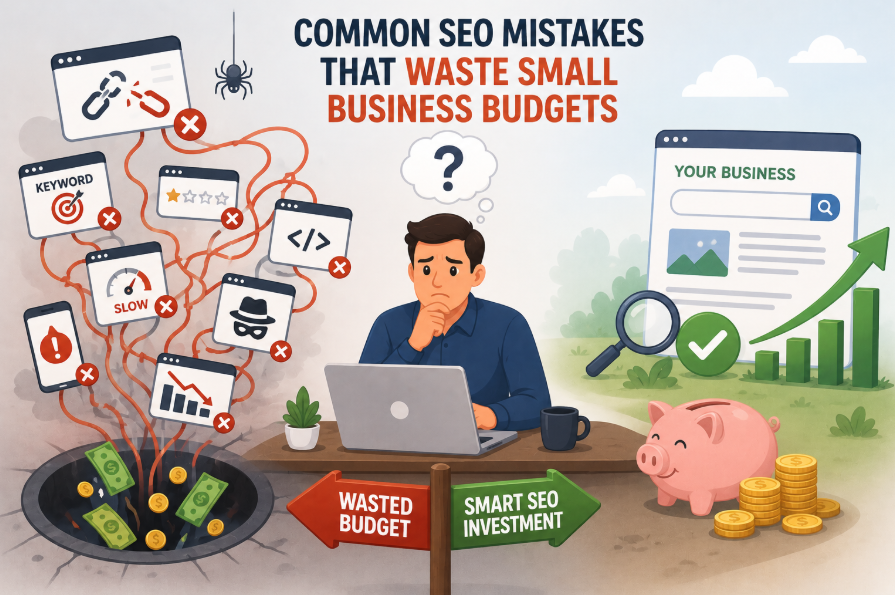
Many small businesses don’t struggle because they invest too little in SEO; they struggle because they invest in the wrong things. Even a modest budget can produce excellent results when it’s allocated strategically. On the other hand, a larger budget can disappear quickly if it’s spent on activities that add little long-term value.
Treating SEO Like a Checklist
One of the biggest mistakes is chasing high-volume keywords too early. It’s tempting to target broad search terms because they appear to offer the greatest traffic potential. However, these keywords are usually dominated by established websites with years of authority, extensive content libraries, and strong backlink profiles. Trying to outrank them immediately often leads to slow progress and disappointing results.
A better strategy is to focus on high-intent, lower-competition keywords that closely match your services. These searches may receive fewer monthly visits, but they’re far more likely to convert because users already know what they’re looking for.
Another common mistake is treating SEO as a checklist instead of a business strategy. Publishing blog posts every week, building backlinks every month, or optimizing hundreds of pages doesn’t automatically improve performance if those activities aren’t aligned with customer needs. Every SEO task should support a measurable business objective, whether that’s increasing qualified traffic, generating leads, or improving conversions.
Ignoring Search Intent
Many businesses also underestimate the importance of search intent. Ranking for a keyword doesn’t guarantee success if the content fails to satisfy what users actually expect. Someone searching for educational information isn’t ready for an aggressive sales page, while someone looking for a service provider doesn’t want to read a lengthy beginner’s guide before finding contact information. Understanding why people search is just as important as knowing what they search for.
Publishing Content Without a Strategy
Another costly mistake is producing large amounts of content without a clear strategy. More pages don’t necessarily create more authority. Search engines increasingly reward websites that demonstrate expertise through well-organized, comprehensive content rather than publishing articles simply to target additional keywords. Ten valuable pages that thoroughly cover a topic often outperform fifty thin articles with overlapping information.
Over-Relying on AI Automation
Businesses should also be cautious of relying entirely on automation. AI has become an excellent productivity tool for research, outlining, and drafting, but publishing unedited, generic content rarely creates a competitive advantage. If every website can generate similar articles within minutes, originality, expertise, practical experience, and genuine insights become even more important differentiators.
Measuring Rankings Instead of Results
Perhaps the most overlooked mistake is measuring SEO success by rankings alone. Rankings fluctuate naturally, and different keywords contribute different levels of business value. A small improvement in rankings for a highly commercial search term may generate more revenue than reaching the first position for an informational keyword with significantly higher search volume.
Ultimately, the businesses that succeed with SEO aren’t those doing the most work; they’re the ones consistently doing the right work.
Signs Your SEO Investment Is Working
SEO rarely delivers overnight success, but it does leave clear indicators that your strategy is moving in the right direction. The challenge is knowing which signals deserve your attention.
The first positive sign is an increase in qualified organic traffic rather than simply more visitors. If people are spending more time on your website, exploring additional pages, requesting quotes, or contacting your business, your SEO efforts are attracting the right audience.
User Engagement Is Improving
You should also notice stronger engagement metrics. Higher click-through rates from search results, lower bounce rates, longer session durations, and increased conversions all suggest that your content matches user expectations. While these metrics don’t directly determine rankings, they often reflect a better overall user experience.
Local Business Activity Is Growing
For local businesses, improvements may appear through increased calls, direction requests, website visits from your Google Business Profile, and more customer reviews. These actions often translate into real business opportunities long before dramatic ranking improvements become visible.
Branded Searches Are Increasing
One advanced indicator that many businesses overlook is the growth of branded searches. As your SEO strategy strengthens your online presence, more people begin searching specifically for your business name rather than generic services. This demonstrates growing brand awareness and trust, two factors that support long-term marketing success beyond SEO itself.
Leads and Revenue Are Increasing
Most importantly, your business should see measurable improvements in leads, inquiries, sales, or revenue. Rankings and traffic are valuable because they contribute to these outcomes, not because they are the end goal. If your SEO campaign is generating meaningful business growth, it’s working.
Frequently Asked Questions
Is affordable SEO worth it for small businesses?
Yes, provided the strategy focuses on long-term growth rather than quick wins. Affordable SEO helps small businesses attract qualified organic traffic, improve visibility, and reduce dependence on paid advertising without requiring enterprise-level marketing budgets.
How long does affordable SEO take to show results?
Most businesses begin noticing measurable improvements within three to six months, although the exact timeline depends on competition, website quality, industry, and the amount of optimization required. SEO is a long-term investment, and consistent improvements generally produce more sustainable results than rapid ranking gains.
Can affordable SEO compete with larger companies?
Absolutely. Small businesses rarely need to compete for every broad keyword. By targeting niche services, local markets, and high-intent searches, they can often outperform larger competitors where relevance matters more than brand size.
What should an affordable SEO package include?
A quality SEO package should typically include keyword research, on-page optimization, technical improvements, content strategy, local SEO where applicable, performance reporting, and ongoing recommendations based on business goals. The exact mix should be tailored to your website rather than copied from a standard package.
Is local SEO enough for every small business?
Not always. Local SEO is essential for businesses serving specific geographic areas, but companies selling nationally or internationally usually need broader content strategies, technical optimization, and authority-building efforts alongside local optimization.
Should I hire a freelancer or an SEO agency?
The right choice depends on your goals. Freelancers can be an excellent option for focused projects or smaller budgets, while agencies often provide access to broader expertise across technical SEO, content, strategy, and reporting. Rather than choosing based on price alone, evaluate experience, communication, and strategic thinking.
Final Thoughts
Affordable SEO isn’t about finding the lowest-priced provider;r it’s about making informed decisions that produce sustainable business growth.
The most successful small businesses don’t win because they publish the most content or buy the largest number of backlinks. They succeed because they invest in strategies that align with their customers’ needs, build long-term authority, and improve their visibility where it matters most.
If there’s one takeaway from this guide, it’s that SEO should always be evaluated as a business investment, not a marketing expense. The right strategy attracts qualified visitors, builds trust, strengthens your online presence, and continues delivering value long after the initial optimization work is complete.
When approached with realistic expectations and a focus on quality over shortcuts, affordable SEO can become one of the most cost-effective growth channels available to a small business, helping you compete smarter, earn lasting visibility, and build a stronger foundation for future success.
Published at https://skampakis.com/
Sponsored Editorial Publishing & Tech Media Placement
Get your technical product or case study published on The Data Scientist with domain authority backlinks.