
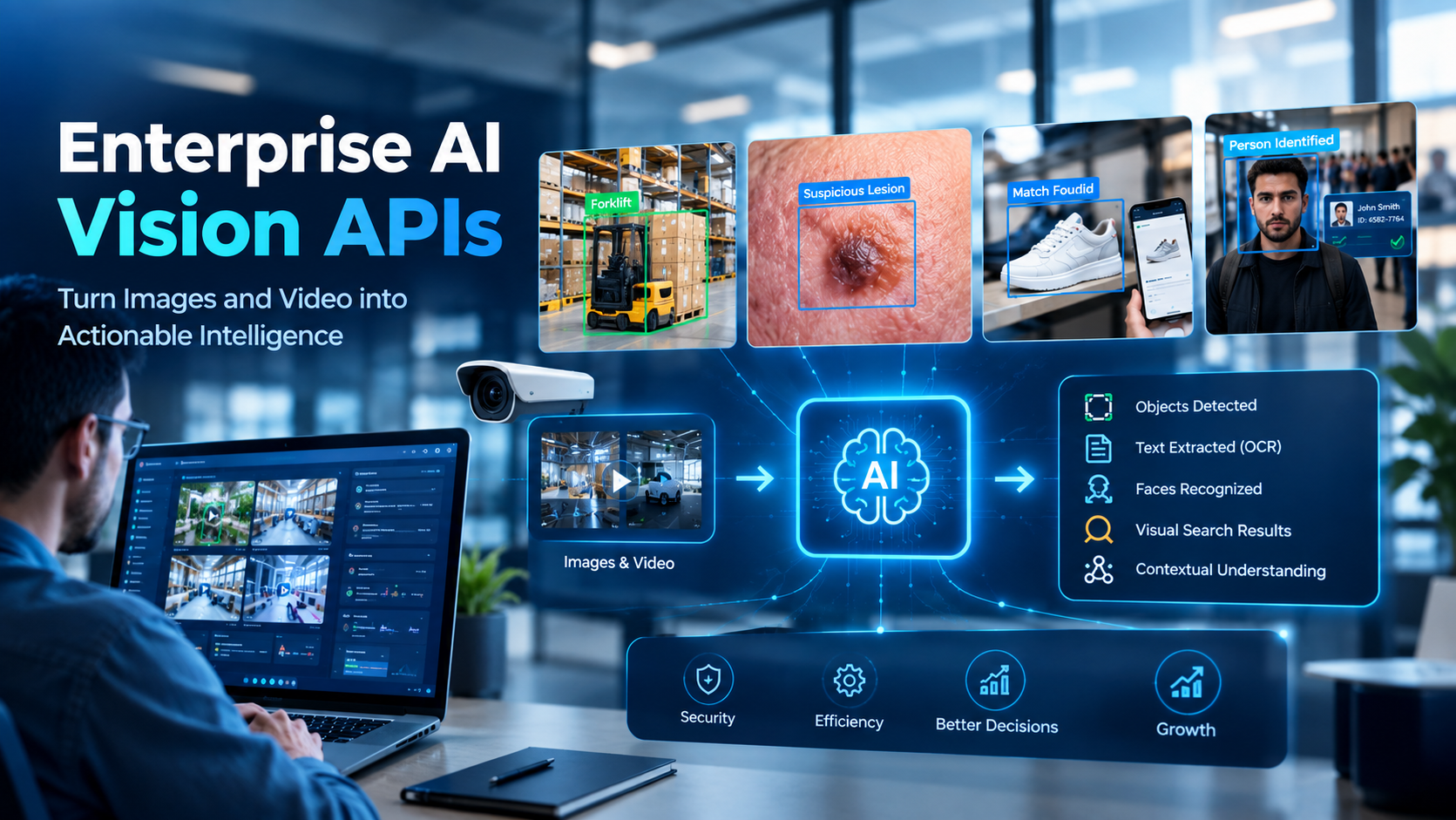
A warehouse camera flags a mispacked pallet before it ever leaves the dock. A dermatology app spots a suspicious lesion pattern in seconds. A retailer matches a customer’s phone photo to the exact sneaker in stock. None of this runs on custom-built neural networks anymore. It runs on Enterprise AI Vision APIs, the plug-and-play infrastructure that lets any engineering team add sight to their software without training a model from scratch. These systems can also support image search techniques helping applications analyze, classify, and match visual content more efficiently.
That shift is not a niche trend. The global computer vision market is projected to reach $58.29 billion by 2030, growing at nearly 20% a year, according to Grand View Research. For CTOs and product leads, the question is no longer whether to adopt vision AI, but which Enterprise AI Vision APIs to build on, and how to deploy them without blowing the budget or the compliance review.
This guide breaks down what these APIs actually do, how the major platforms compare, and how to build a vision AI strategy that survives contact with real production traffic. If you want a deeper technical breakdown of the underlying retrieval techniques, this piece on AI-powered image search techniques is a useful companion read.
What Are Enterprise AI Vision APIs?
Enterprise AI Vision APIs are hosted services, accessed via REST API, SDK, or webhook, that let applications extract meaning from images and video without an in-house machine learning team. Under the hood, most run on convolutional neural networks (CNNs) or newer vision-language models, the deep learning architectures that were pretrained on massive labeled datasets, then exposed as simple endpoints: send an image, get back structured data.
Instead of standing up your own GPU cluster, writing training pipelines, and hiring PhDs to fine-tune object detection models, a developer can send a POST request and receive labels, bounding boxes, or a similarity score in milliseconds. That’s the entire value proposition of Enterprise AI Vision APIs: they turn a research problem into an integration problem.
Core Capabilities Behind the API Call
Most Enterprise AI Vision APIs bundle several distinct computer vision capabilities under one interface:
- Object detection and instance segmentation: locating and outlining individual items (a forklift, a defective bottle cap, a shopping cart) within a frame
- Facial recognition and analysis: identity verification, demographic estimation, and liveness checks
- Optical character recognition (OCR): pulling text from receipts, ID documents, or shelf labels
- Visual search at scale: matching an uploaded photo against a catalog of millions of reference images, the same category of technique covered in the AI-powered image search methods guide linked above
- Multimodal and contextual understanding: newer VLM-based endpoints that can answer natural-language questions about an image (“is this shelf understocked?”) rather than just returning labels
Each capability maps to a specific business use case, and enterprise vision AI strategy usually means combining several of them into one pipeline rather than picking just one.
Comparing the Major Enterprise AI Vision APIs
| Platform | Strongest Use Case | Deployment Model | Notable Trade-off |
| Google Cloud Vision | General-purpose labeling, OCR, web detection | Cloud, pay-per-use | Strong accuracy, but per-call pricing scales fast |
| Amazon Rekognition | Facial analysis, content moderation, video | Cloud (AWS-native) | Deep AWS ecosystem lock-in |
| Microsoft Azure AI Vision | Enterprise document intelligence, OCR | Cloud + hybrid | Best fit for Microsoft-centric IT stacks |
| IBM Watson Visual Recognition | Custom classification for regulated industries | Cloud/on-prem | Smaller pretrained model catalog |
| Clarifai / Imagga / DeepAI | Rapid prototyping, niche tagging | Cloud API | Less enterprise SLA depth |
| Roboflow + Ultralytics YOLO26 | Custom-trained, edge-deployable detection | Self-hosted or hybrid | Requires more MLOps ownership |
This is the practical shape of any AI vision API comparison: the big cloud vision API vs on-premises decision usually comes down to data sensitivity, latency tolerance, and how much control your team wants over model weights.
Cloud Vision API vs. On-Premises: The Real Trade-off
Cloud-hosted Enterprise AI Vision APIs win on speed to market: no infrastructure to provision, automatic scaling, and pay-per-use pricing that turns capital expense into operating expense. But they introduce network latency, recurring per-call costs, and, for healthcare or finance workloads under HIPAA or GDPR, real questions about where image data physically travels.
That’s why 2026’s dominant pattern is hybrid: run lightweight inference at the edge for time-critical or privacy-sensitive tasks, and reserve cloud vision API calls for heavier, less latency-sensitive work. This is exactly the gap that open-source frameworks like OpenCV, TensorFlow, and PyTorch, paired with production-ready detectors like Ultralytics YOLO26, are built to fill. YOLO26 in particular has been engineered for edge deployment, reportedly delivering up to 43% faster CPU inference than prior generations while dropping the non-maximum suppression step that historically complicated real-time deployment. For manufacturing lines, robotics, and automotive applications where a round trip to the cloud isn’t acceptable, that edge-first design matters more than raw benchmark accuracy.
Where Enterprise AI Vision APIs Are Actually Deployed
- Retail: visual search at scale for “shop this photo” features, shelf-inventory auditing, and loss prevention. To understand the technology behind these experiences, see How Does AI Visual Search Work.
- Manufacturing: defect detection and quality control on the line, often via edge deployment
- Healthcare – imaging triage support (always as a second opinion, never as a sole diagnostic authority)
- Logistics – package damage detection, license plate and barcode OCR at dock doors
- Security – anomaly detection in surveillance feeds
- Agriculture and robotics – crop health monitoring and machine navigation, two of the fastest-growing verticals for edge AI vision
Firms like AI Monk, Scaleflex, Vector Labs, and Abbacus Technologies have each published implementation guides on this exact stack, underscoring how standardized the integration pattern has become: pick a computer vision API for business needs, wrap it in a thin service layer, and monitor accuracy drift over time.
Building a Vision AI Strategy That Scales
A durable enterprise vision AI strategy needs more than API keys. Before committing budget, map out:
- Model lifecycle management – how pretrained models get evaluated, fine-tuned on your domain data, and retired when a domain gap appears between training data and production images; closing that gap often means sourcing or commissioning custom vision training datasets instead of relying on generic pretrained sets
- AI governance and responsible AI review – bias testing, especially for facial recognition, and documented human-in-the-loop checkpoints
- ROI measurement – tie API costs directly to a business metric (shrinkage reduced, defects caught, support tickets deflected) rather than raw accuracy scores
- Integration architecture – REST API and SDK choices, webhook event design, and fallback logic when a provider has an outage
Enterprise AI Vision APIs are powerful precisely because they abstract away the deep learning complexity, but that abstraction only pays off if the surrounding MLOps and governance discipline is in place.
Frequently Asked Questions
What are Enterprise AI Vision APIs?
They are hosted computer vision services, from providers like Google Cloud Vision, Amazon Rekognition, and Azure AI Vision, that let applications detect objects, read text, and analyze images through a simple API call instead of an in-house model.
How do Enterprise AI Vision APIs work?
An application sends an image (or video frame) to the API endpoint; a pretrained neural network processes it server-side and returns structured JSON with labels, bounding boxes, or confidence scores.
What are the benefits of Enterprise AI Vision APIs?
They remove the need for in-house ML expertise, offer pay-per-use pricing, scale automatically, and get new capabilities to production in days instead of months.
How do I get started with Enterprise AI Vision APIs?
Start with a narrow use case, test two or three providers against your own sample images, measure accuracy on your actual data (not published benchmarks), then integrate via SDK with clear fallback handling.
What are the limitations of Enterprise AI Vision APIs?
Per-call costs scale with volume, latency can be an issue for real-time use cases, and pretrained models often need fine-tuning to close the domain gap for specialized imagery.
Cloud vision API vs. on-premises: which is better?
Cloud APIs are faster to deploy and cheaper to start; on-premises or edge deployment (via OpenCV, TensorFlow, or Ultralytics YOLO26) wins when latency, data residency, or per-call costs at scale become the deciding factor.
Enterprise AI Vision APIs vs. building a custom model: which is better?
APIs win for common tasks (OCR, general object detection) where pretrained accuracy is already high. Custom models, fine-tuned on your own data, win when your use case is domain-specific enough that off-the-shelf accuracy falls short.